


If you’ve been following the portfolio for any length of time, you already know our playbook: find an unassailable data moat, sit on your hands, and let operating leverage do the heavy lifting. And when it comes to the undisputed heavyweight champion of “you owe me money, and I know exactly where you live” data, nobody plays the game quite like Red Violet ($RDVT).
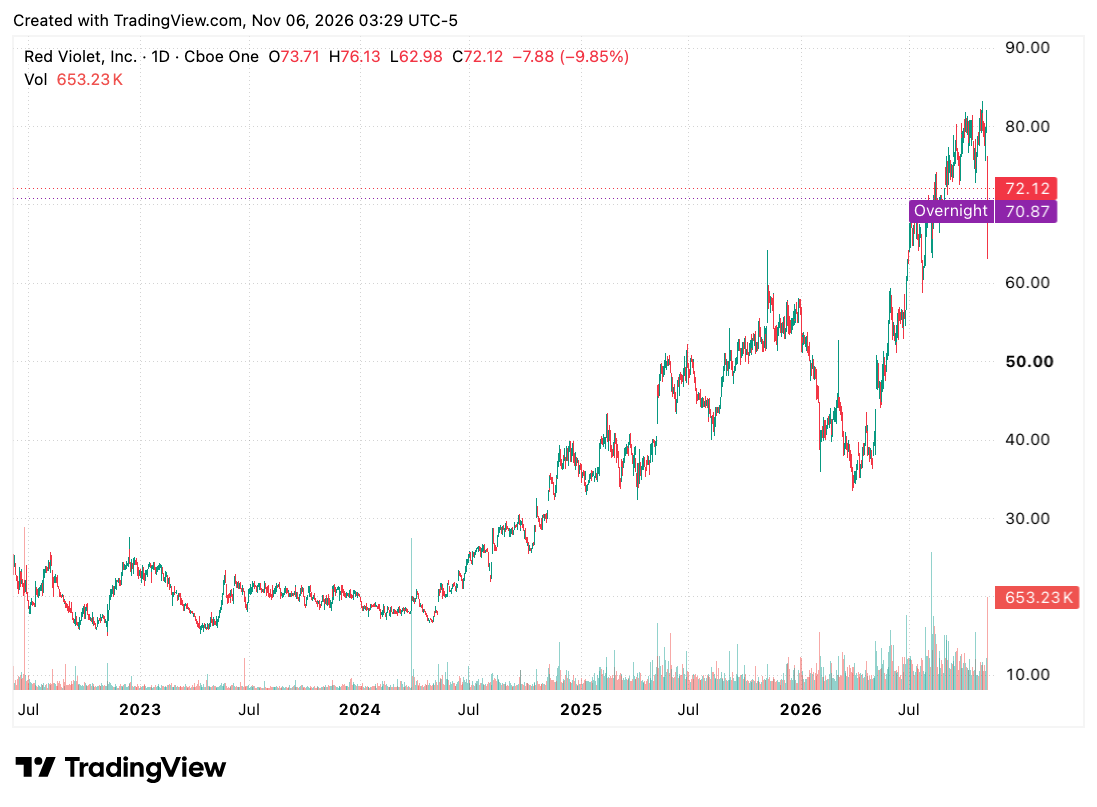
Long-time readers might remember the victory lap from earlier this year. We don’t currently own a single share, but 2026 was kind to us here… RDVT ended up being our best single-name trade of the year, handing us a clean +98.53% return off an average cost basis right around $40.
Most micro- and small-cap setups are classic “one-and-done” catalyst plays: you get the pop, take the cash off the table, and never look back. But occasionally, names like RDVT or TGS force you to slow down and pay closer attention. Despite the tiny market caps, these aren’t speculative shell games.
They boast legitimate network effects, real cash-flow generation, and the structural DNA to be multi-decade compounders.
But… The market’s mood swings down here are violent. Volatility routinely launches valuations well past sanity on the upside, only to drag them straight into the gutter on the way down. More importantly, in an era where AI is aggressively rewriting the playbook on proprietary datasets, even the deepest moats deserve constant stress-testing.
So, we tore through the latest quarterly print and the footnotes to see what’s really under the hood.
Today, we’re unpacking:
The good, the bad, and the ugly from the latest 10-Q and earnings call.
The 2 glaring red flags we genuinely dislike right now.
A no-nonsense DCF model to figure out what the business is actually worth today, and whether Mr. Market is giving us another entry point or asking us to pay for perfection.
Grab a coffee. Let’s break it down.

None of the following should be construed as investment advice. Please consult a financial advisor before making any investment decision. You will find a full disclaimer at the end of this post.


🔍 RedViolet ($RDVT) Q3 Observations
Red Violet Inc. (NASDAQ: RDVT) builds identity intelligence software. Its cloud-native platform, CORE, utilizes a proprietary entity-resolution engine (IRON) to map out complex real-time connections among individuals, businesses, and assets.
The company commercializes this tech across two main brands:
IDI (idiCORE): An enterprise-grade risk, compliance, investigative, and fraud prevention solution sold to financial services, law enforcement, corporate security, collections, and background screening firms.
FOREWARN: A mobile safety app built originally for the real estate industry to verify prospective clients before face-to-face meetings.

Q3 Quantitative Observations
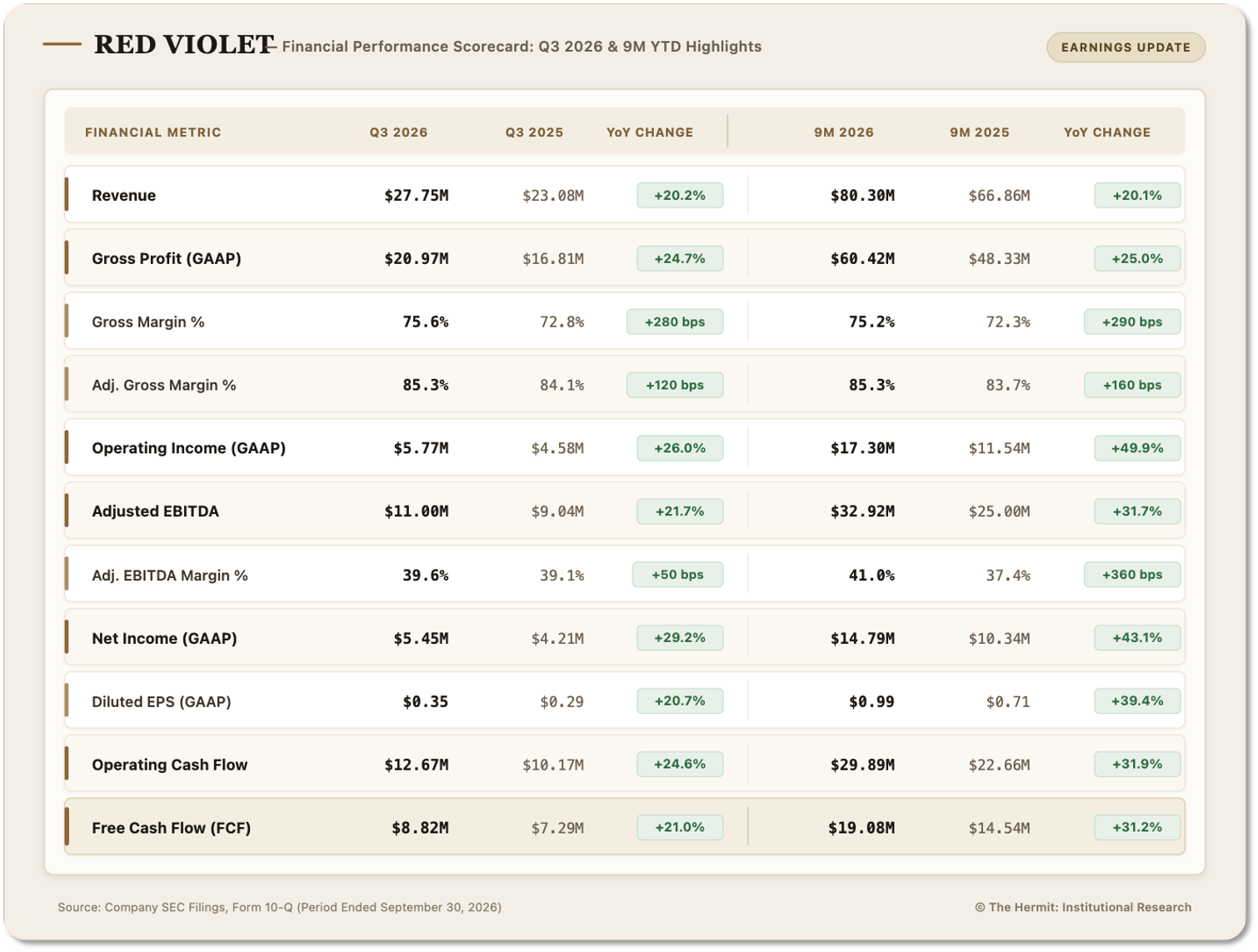
In Q3 2026, revenue increased +20% to $27.75m (surpassing $100m in LTM revs for the first time).
Other than the obvious statement that their performance is really good, two things happened during the month that are not shown here:
In August 2026, the company completed a public offering of ~1.92m shares at $60.00/share, bringing in $108.7m (net).
As of September 30, 2026, Red Violet holds $165.66m in cash (basically US Treasuries) with zero debt.
The question, though, is why does this already cash-flow-positive company need cash?

Q3 Qualitative Observations. On Growth.
The answer to that question comes in the form of two internal reinvestment themes and one inorganic possibility.
(1) Expansion into Home Healthcare [Organic]
Having captured over 50% of all US Realtor Associations (>665 associations under contract) with a 100% renewal rate, Red Violet is effectively duplicating the FOREWARN play in the home healthcare market.
The addressable market here is ~4m home health aides and >12k Medicare-certified agencies. Atm, Red Violet is rolling out mobile apps and scheduling/workforce API integrations to provide pre-visit household safety verification.
This seems like a great use of cash.
(2) Enterprise & Public Sector Move [Organic]
The company is moving upstream from small transactional accounts to multi-year enterprise contracts ($100k+ ARR).
In the public sector, RDVT has begun displacing legacy providers (e.g., LexisNexis, Thomson Reuters CLEAR) at major municipal law enforcement and state agency levels, with federal procurement testing underway.
It’s just a much better product.
This is an acceptable development, although we must note that these processes come with strict compliance rules (more work) and long procurement processes (more work and a possible distraction). As long as this is an add-on and not just a substitute, we like the development.
(3) Iffy M&A Deployment [Inorganic]
Around June, we were already hearing rumors that their capital raise was being done almost exclusively for this purpose. At various points in time, including the quarterly call commentary, management has outlined an acquisition focused on:
Proprietary data assets to feed into their identity graph.
Enabling software/AI capabilities where “buying beats building”.
Entry into adjacent vertical markets or selective international footprints.
Although on paper this may sound smart, acquisitions are usually a red flag. Unless you are a specialist, people are, in general, clueless about how this works.
You commonly rely on external help, assume too many synergies, pay too much, and worst of all, you are left holding a bag of multicultural, unintegrable people playing politics instead of focusing on making money through a better product.
So… no bueno.

Q3 Qualitative Observations. On Core Business.
Beyond the M&A developments, there are also some internal business decisions that we dislike, including some accounting shenanigans and just blatant lying to our faces, which sure, is perfectly legal, but man… we’re not stupid, so why do it?
Treasury Management
Following the $108.7m equity raise, RDVT used its excess cash and bought a ton of Treasury securities ($36.29m short-term and $61.32m long-term).
Sadly, we don’t know what short- and long-term actually mean. Is it direct holdings, is it an ETF, is it 0- 3 months, is it up to 10 years?
Due to interest rate hikes, the portfolio recorded a small unrealized loss of $476k ($352k net of tax) through Accumulated Other Comprehensive Income (AOCI).
They stated that “all securities carry zero credit risk and will be held to maturity”, but if you’re using that cash to buy a company, you don’t know that, so… why?
This is unnecessary, albeit minor. I wouldn’t even call it a yellow flag.
Capitalized Software Dynamics
As every software company does, we did it back in the day w/ ~5% of revenues; RDVT heavily capitalizes software development costs.
During 9M 2026, RDVT capitalized $12.04m in intangible assets (including $1.47m of capitalized SBC), while recognizing $8.23m in intangible amortization.
There is $9.02m of internal-use software currently under development that has not yet started amortizing.
This accounting BS enhances GAAP operating margins relative to cash flow while deferring expense recognition over 5 to 10 years. You paid for it, and it’s probably useless in a few years. Again, all software companies do this, but it’s not 5% of rev, more like 15%.
Backlog or Lost Money
Contractual pricing models continue to expand, accounting for 78% of Q3 2026 revenue (up from 75% in Q3 2025).
Unbilled receivables totaled $1.70m ($1.11m current, $0.59m long-term).
RDVT disclosed $23.90m of remaining unsatisfied performance obligations under multi-year contracts, with $12.15m scheduled to be recognized in 2027. Hopefully, this will turn into actual revenue.
Historically, they’ve performed well here, but it’s always an important check.
Hidden Share-Based Comp
This is the part we dislike and a direct copy of the SpaceX payment package, just that goals are not going to freaking Mars. While GAAP SBC for 9M 2026 was $6.37m (plus $1.47m capitalized), there’s a disclosed but not factored-in massive executive incentive package:
In January 2026, executives were granted 832,690 RSUs ($52.77 grant-date fair value = ~$43.9m) tied to aggressive revenue and adjusted EBITDA margin thresholds through March 2030.
Another acquisition-focused grant of 30,000 RSUs was made in April 2026… a shit incentive, as it guarantees (or pushes for) an acquisition.
Because management has deemed these milestones “not probable of achievement” under ASC 718 to date, zero expense has been recognized for them. Total unvested, unrecorded SBC expense sits at $46.14m.
Once these performance milestones become probable, P&L operating expenses will absorb 6% dilution charges.
Other Items. Commitments & Daniel’s Law Litigation
Beyond these, there are also two minor items that are still something to note for the company. RDVT has $32.44m in fixed future commitments: a 5-year cloud agreement ($3.0m/yr minimum) and core flat-fee data supplier licenses.
Also, RDVT is one of ~150 data brokers sued in New Jersey state court under Daniel’s Law (Atlas Data Privacy Corp) for alleged failure to suppress covered public officials’ home addresses/phone numbers within 10 days.
Liquidated statutory damages could be substantial across defendants; however, RDVT has confirmed the claim falls within the scope of its commercial liability insurance, which is actively covering defense costs and indemnification.
Minor, but still there.

Q3 Valuation Update
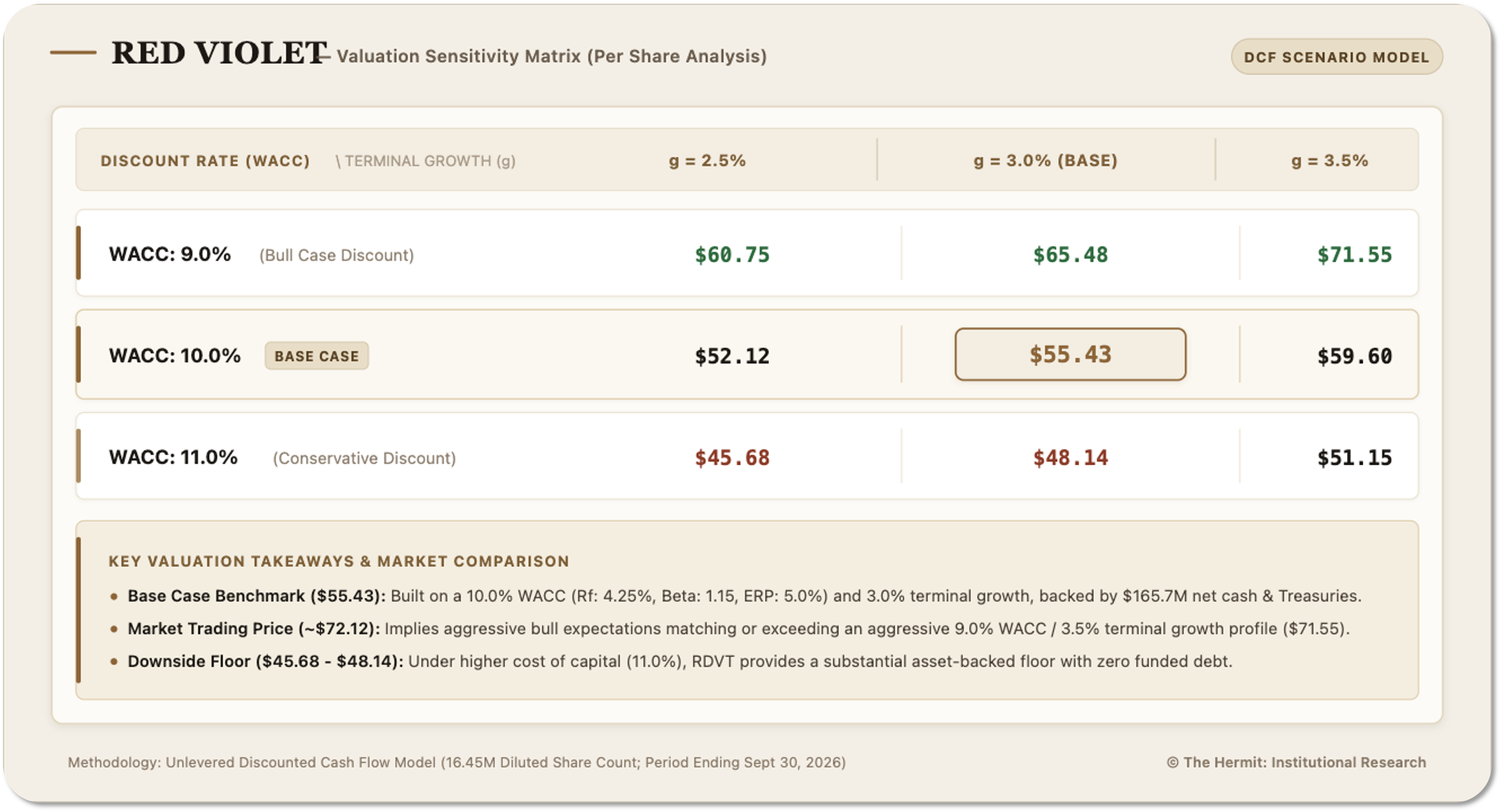
Not much changed in terms of valuation. The numbers the company reported were very close to our assumptions. The only real update is the present value (PV) of cash flows.
With that in mind, the $55 price tag seems fair.

If you found value in this analysis, please hit the ❤️ button and share your thoughts in the comments. It helps us bring institutional-grade research to a wider audience.
And if you liked this post, we’re confident you’ll love this:

The "not probable" label is what I'd watch on those RSUs. Management calls the targets unlikely for the accounting, then talks growth on the call. If they flip to probable, the catch-up charge lands in the same quarter the numbers look best.
Are those shares in your $55, or did you leave them out?