


My dear fellow Hermits 👋
This is a step-by-step guide to structuring your forever portfolio, helping you learn quickly and avoid rookie mistakes.
Before we start, if you’re new here, we highly recommend checking out our…
… it’ll give you a better sense of who we are and why you might want to listen.
“What’s your biggest financial challenge?”
This post is the answer to the top challenges you’ve shared with us.
Over the past 12 months, we’ve collected hundreds of responses. Here are a few of them…
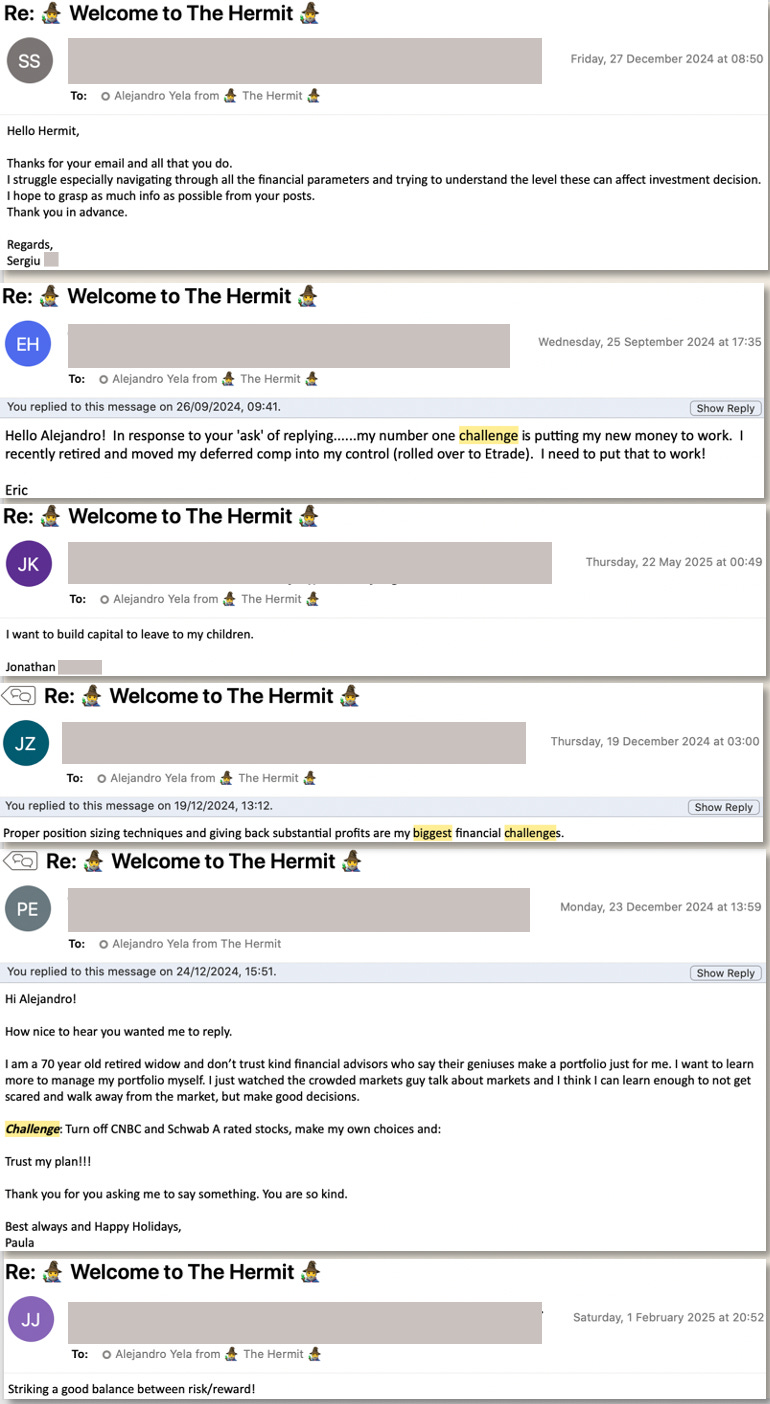
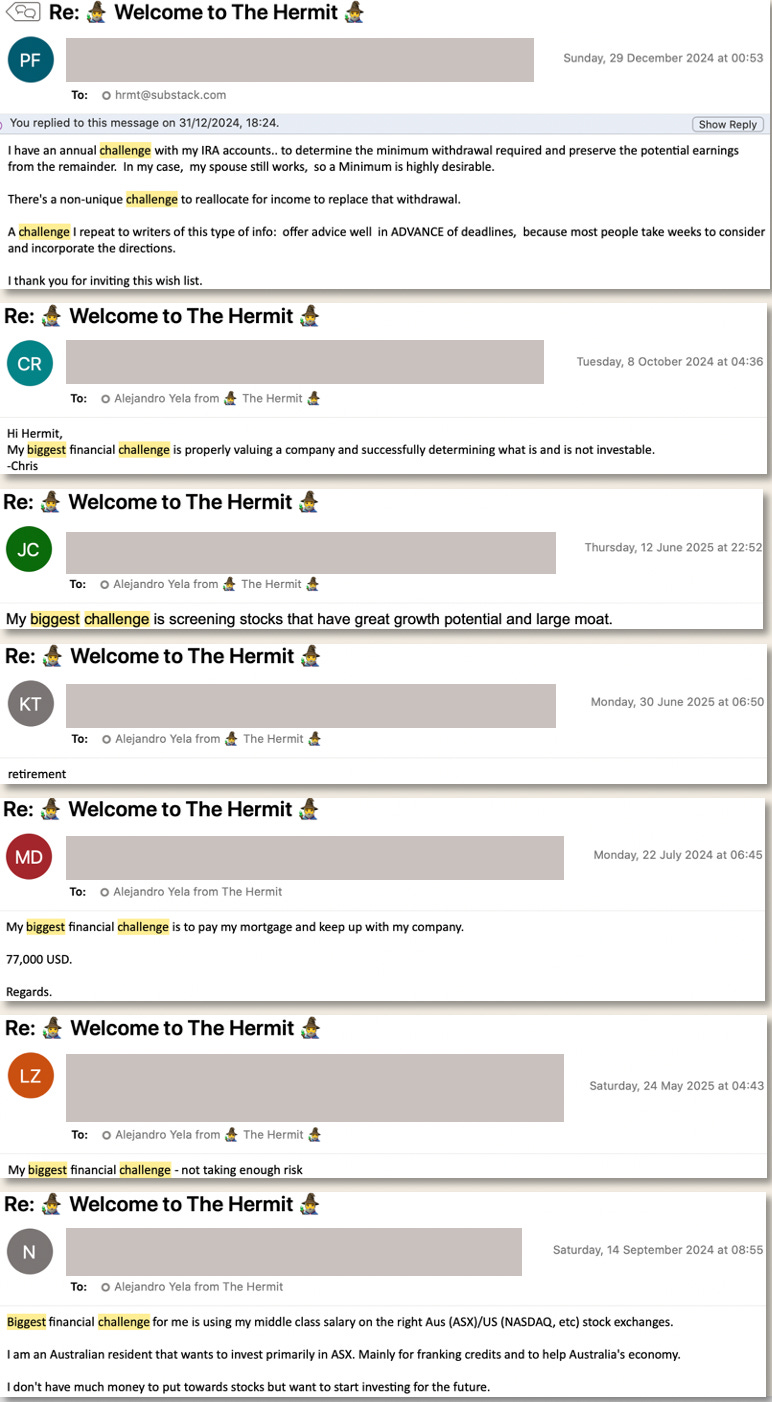
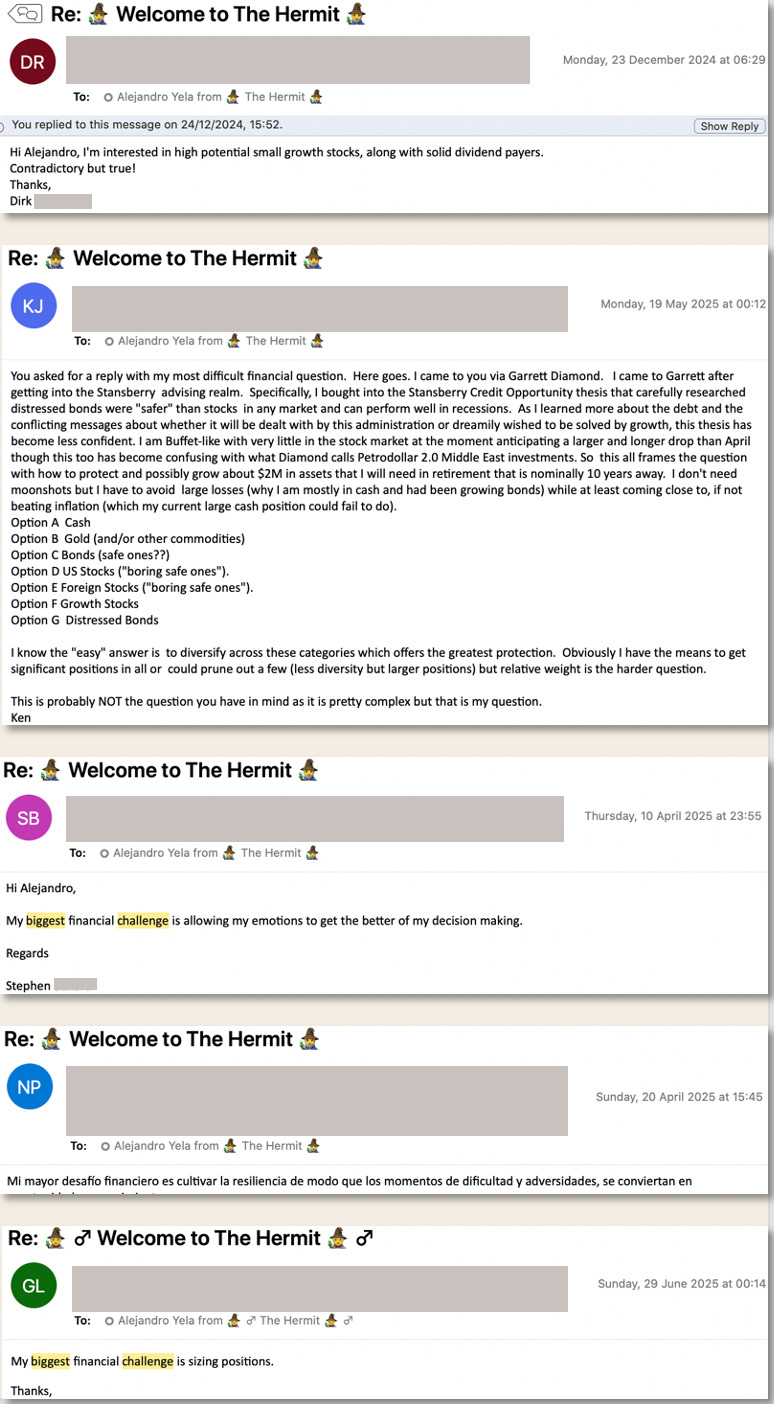
If we had to distill the biggest challenges you face, they tend to fall into five core buckets:
Emotionally handling downturns. Staying calm when markets drop
Planning for retirement or future generations. Figuring out how much, by when, and for whom
Identifying worthwhile opportunities. Separating noise from signal
Sizing positions. Knowing how much to allocate, and to what
Paying off debt. Balancing growth with financial clean-up
This post breaks down exactly how to blend ETFs, individual stocks, and “mental reps” into a hands-on portfolio.
The last one you will ever need and the one we've been using for the better part of the decade.
It’s built around three key layers:
1.- Short-term safety
2.- Mid-term curiosity
3.- Long-term conviction
We’ll walk you through a simple three-step progression, one that builds up to the mechanics of our All-Weather Portfolio.
Along the way, you’ll get sample allocations (w/ factsheets and ISINs), real-world examples, and a battle-tested action plan for when markets go to sh*t.
This isn’t one of those “compounding over 40 years” or “if you’d invested in the ’80s” fairy tales.
This post is about building a real personalized plan. One you can understand, commit to, and set up within 24 hours.
It’s our take on a very structured and disciplined yet simple learning system.
Important notes:
👉 Don’t move to the next step until you can confidently check all the boxes for the one before it
👉 Be sure to read and understand fully the list of common mistakes (at the bottom)
👉 Understand that this is our complete framework for your entire net worth, not just your stock portfolio
As professionals, we at The Hermit follow this framework with modified weights, but that’s because investing is our business. So we’ll allocate more towards individual names while keeping the portfolio coherent.
As a retail investor, you’re not spending all day analyzing companies, managing risk, and tracking catalysts… and that’s perfectly fine.
If all this feels familiar, you’re exactly who this post is for.
This content is intended for informational purposes only and should not be taken as investment advice. Please do your own research or consult with a professional advisor before making any financial decision. You will find a full disclaimer at the end of the post.

1. Do You Need The Cash Tomorrow?
If you’re not willing to own a stock for ten years, don’t even think about owning it for ten minutes.
— Warren Buffett
This plan is only worth doing if you’re willing to commit for at least a decade. Anything shorter and you’re just dipping your toes, not building lasting wealth or understanding.
💵 No Savings, No Strategy
Let’s be blunt: this entire exercise is pointless if you’re not saving money.
If you can’t commit to saving at least $100 a month, don’t waste your time setting up portfolios or picking assets.
Instead, focus all your energy on boosting your income:
Get better at your craft
Ask for a raise
Promote your services
Build a side hustle
Sell your time more effectively
In short: grind until you have investable capital. You can’t grow what doesn’t exist.
🛑 Expect Setbacks… and Prepare for Them
Life is what happens to you while you're busy making other plans.
— John Lennon singing 1980’s Beautiful Boy (Darling Boy)
Your car breaks down. A medical bill shows up. Your boiler explodes.
These things are not excuses… they’re part of life. So plan for them.
Make sure you have an emergency buffer or a separate savings account to cover unexpected costs.
Don’t tap into your portfolio to deal with life. That defeats the whole purpose.
🏖️ When You’re Already Living Off Your Capital…
Suppose you're already deep into retirement and relying on your savings as your primary source of income.
In that case, the All-Weather Portfolio may not be appropriate for you, at least not with the majority of your capital.
In your case, the priority should shift from long-term growth to reliable cash flow.
That means allocating most of your savings toward income-generating assets:
High-quality bonds with staggered maturities
Dividend-paying stocks
Cash equivalents that support near-term liquidity
The goal is to create a payment timeline that delivers predictable income every 1 to 3 months, aligning with your lifestyle needs.
Your best bet might be to stay conservative, preserve capital, and live comfortably off the yield.
If this applies to you, this post is not for you.
Here’s our take on super safe cash equivalents and when you should use each one:

👇 If you answered all of the above with a big fat “I’m Ready!”, it’s time to move on to the next section and start compounding.

2. Do You Owe Money?
The most important rule of trading is to play great defense, not great offense. You can always stay in the game as long as you don’t blow up.
— Paul Tudor Jones
Here’s a hard truth: you can either compound for yourself, or for someone else.
Think about it… mortgages, credit cards, student loans, car loans…
Each of these is a structure designed to tap into your future self and funnel money to someone else.
![The Dynamics of U.S. Credit Card Debt since 2000 [oc] : r/dataisbeautiful](https://substackcdn.com/image/fetch/$s_!t-8q!,f_auto,q_auto:good,fl_progressive:steep/https%3A%2F%2Fsubstack-post-media.s3.amazonaws.com%2Fpublic%2Fimages%2F97393d0b-404f-4617-a998-18f10acb15bd_3600x4800.png "The Dynamics of U.S. Credit Card Debt since 2000 [oc] : r/dataisbeautiful")
Some of these debts, such as credit cards or certain personal loans, can carry interest rates of 29% or higher.
That’s market-crushingly bad.
If you're carrying high-interest debt, then the best “investment” you can possibly make isn’t in stocks, crypto, or gold.
It’s in paying that off.
Why?
Because a guaranteed 29% return (essentially what you get by eliminating 29% APR debt) is better than anything else you’ll find in the public markets.
Before you start building a portfolio, ensure you're not inadvertently fueling someone else's compounding engine.
👇 If you answered the of the above with a big fat “I’m Ready!”, it’s time to move on to the next section and start implementing.
3. The All-Weather Portfolio
The concept of diversification makes sense to a point, but it’s easy to overdo. If you look at Berkshire, Charlie and I operated mostly with five positions. If you’ve got a harem of 40 women, you never get to know any of them very well.
— Warren Buffett (with Munger’s clear influence)
The framework is simple:
We’ll select a small set of products we understand and allocate to them consistently, month after month.
The goal is to dollar-cost average over time. By buying progressively, we reduce the risk of overpaying and avoid trying to time the market.
If markets drop? Don’t worry, we’ll share a clear action plan for downturns, along with sample portfolios you can use from day one.
💼 Portfolio Structure
We are going to divide the portfolio into four equally weighted sections:
25% ➡️ Large Caps
25% ➡️ Indexed International
25% ➡️ Opportunistic
25% ➡️ Cash Equivalents
Your monthly allocation should remain constant.
For example, if you’re saving $1,000, split it into four equal parts of $250 and allocate each to the four categories.
If you’re ever unsure what to do, default back to this base allocation.
Consistency beats cleverness every time.
👇 This rule applies at all times except during a major market downturn.
📉 What to Do When Markets Crash. Action Plan
The plan requires ONE action.
If your large-cap index drops 20% or more, you’ll trigger a one-time reallocation: take the capital from your cash section and redistribute it into the core three buckets.
Whether the market is down 20%, 25%, or 30% doesn’t matter. The key is to act once, with intention, approximately when the drawdown hits that threshold.
If you follow this rule with discipline, we can almost guarantee you won’t regret it.
Practically speaking, here’s what that means…
Sell the ➡️ Cash Equivalents position and purchase the other three sections with those funds:
33% ➡️ Large Caps
33% ➡️ Indexed International
33% ➡️ Opportunistic
If the downturn lasts several months, any new monthly contributions should be split evenly across the three core buckets (the 33% allocations).
Once markets recover and reach new highs, simply revert to your original strategy, allocating across all four sections, including the cash sleeve.
Let’s walk through a real-world example using the S&P 500 from 2021 to today.
If you’ve understood the framework so far, here’s your chance to apply it…
👉 Take a look at the chart below and ask yourself:
When would you trigger the one-time reallocation(s)?
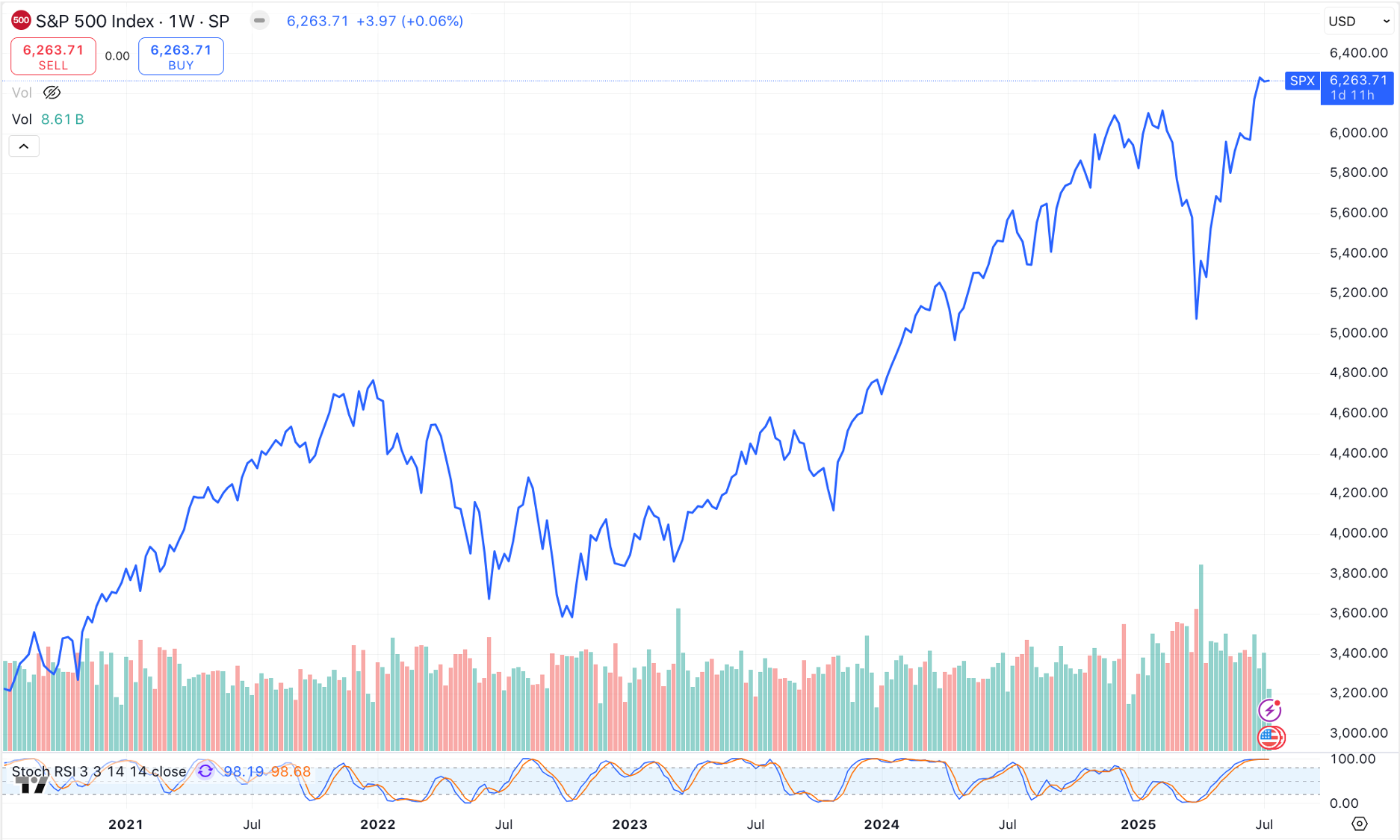
We’re going to use a Japanese candlestick chart because they offer a more detailed view of the market’s peaks and troughs, helping us better visualize when key moves and drawdowns occurred.
Each candle represents a week of price movements.
Both the line chart (above) and the candlestick chart (below) have identical data.
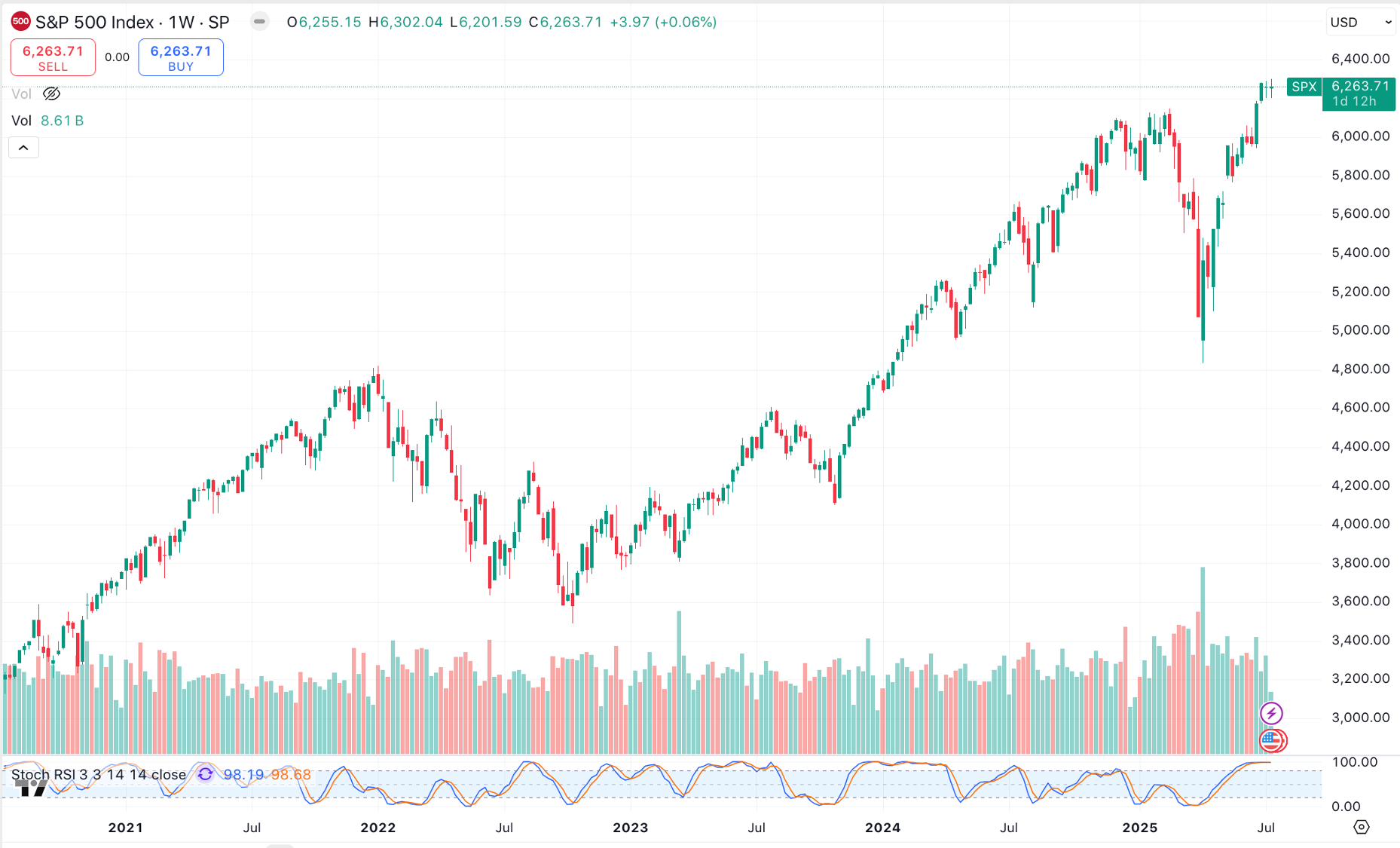
Our goal here is to pinpoint exactly when you should shift your allocation.
The arrows indicate the moments where you take the accumulated capital from the cash bucket and redistribute it evenly across the other three categories.
The chart is color-coded to guide you better:
🟦 Blue zones represent normal conditions — stick to the standard 25% split across all four buckets.
🟨 Yellow zones represent downturn periods — shift to a 33% split among the three core categories.
These signals indicate how to allocate your monthly deposits based on market conditions.
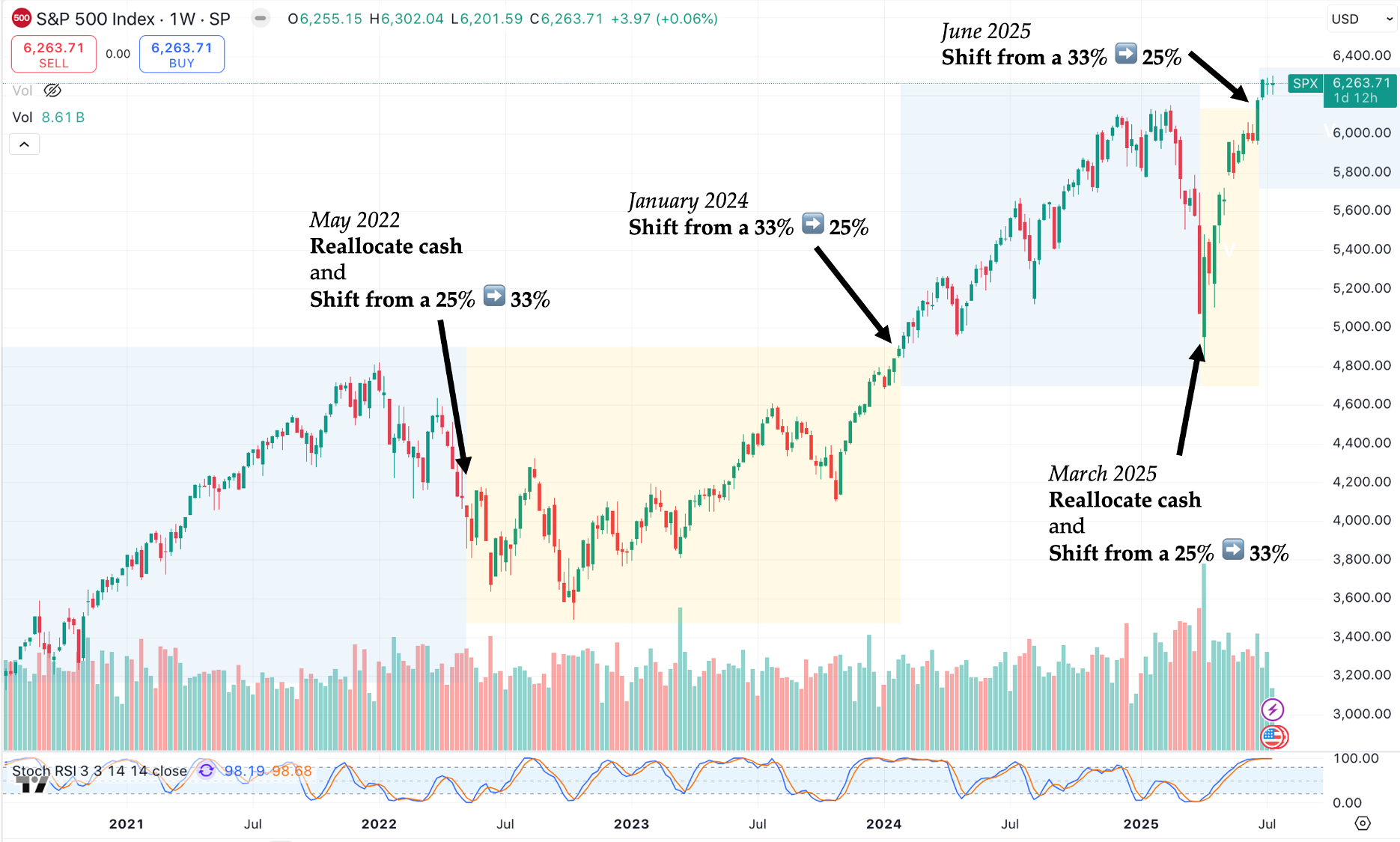
There’s no need to monitor this weekly.
Just check in once a month when you make your regular allocation.
If the –20% threshold has been reached, that’s your signal.
👉 Shift from a 25% ➡️ 33% allocation across the three core buckets and execute the one-time action of splitting the accumulated cash into the other assets.
➡️ Opportunistic (bucket)
🧠 This is the only section of the portfolio where we get to be a little creative… and a little bold.
The goal here is to sprinkle in optionality: assets with asymmetric upside, higher volatility, and the potential to outperform when the world surprises you.
Think of this as your “exploration capital”. It’s still disciplined, but open to taking calculated risks.
This part of your portfolio could include:
Emerging market ETFs — Exposure to fast-growing regions (e.g. 🇨🇳 China, 🇮🇳 India, 🇧🇷 Brazil, 🇹🇷 Turkey, 🇮🇩 Indonesia, 🇵🇱 Poland, etc.)
Frontier market ETFs — Exposure to even more speculative regions (e.g. 🇦🇷 Argentina, 🇰🇿 Kazakhstan, 🇻🇳 Vietnam, 🇳🇬 Nigeria, 🇬🇪 Georgia, etc.)
Thematic ETFs — Concentrated exposure to long-term trends (e.g. AI, biotech, space, water, nuclear, quantum, etc.)
Hedge or Mutual Funds — Select manager(s) that you trust with alternative strategies that can compound
Individual stock picks — Especially small-caps or overlooked compounders that are not part of the major indices
Private or pre-public investments — Crowdfunding, angel deals, venture deals or SPVs (if accessible and understood)
Commodities — Energy, gold, uranium, gas… real tangible assets with macro leverage that can act as a cushion or hedge (not particularly good long term)
Cryptocurrencies — High-risk, high-variance bets on blockchain infrastructure or digital money (not a big fan)
Derivatives — Mainly as downside insurance or intelligent leverage (e.g., LEAPS, protective puts, swaps)
What we want you to do here is mix and match. We want to make some discretionary and consistent bets.
The most important thing is knowing what you're buying.
For example, if you're considering crypto assets, you should have a solid grasp of how the underlying protocols actually work.
If not, start here. This will give you a solid base of understanding, but probably not enough to put your money at risk:

Let’s take a look at a few sample portfolios.
For each holding, you’ll see the allocation percentage, the asset name, the ticker symbol (in parentheses), and the ISIN code [in brackets].
Use these amounts as a rough guide. Some months you’ll end up allocating a bit more or less here and there. We’re talking ±2% and that’s perfectly fine.
🧙♂️ Sample Portfolio #1
✅ Large Caps
25% ➡️ iShares Core S&P 500 ETF ($IVV) [US4642872000]
We’re aiming for broad market exposure, and US equities are a solid choice.
The annual fee on this ETF is 0.03%.
✅ Indexed International
25% ➡️ iShares MSCI World ETF ($URTH) [IE00B4L5Y983]
Our goal is to achieve broad, global exposure.
The annual fee on this ETF is 0.24%.
✅ Opportunistic
10% ➡️ Hermit Ventures
5% ➡️ Global X MSCI Argentina ETF ($ARGT) [US37950E2596]
5% ➡️ iShares MSCI Indonesia ETF ($EIDO) [US46429B3096]
5% ➡️ iShares Physical Gold ETC ($SGLN) [IE00B4ND3602]
This combination gives us diversified exposure across key areas:
Small listed and private companies via our HoldCo
An emerging market
A frontier market
And physical gold (not a synthetic derivative; it’s a real, allocated metal)
The annual fees on these ETFs are as follows:
Argentina: 0.59%
Indonesia: 0.59%
Gold: 0.12%
You can read and listen to more info on Hermit Ventures here:

✅ Cash Equivalents
25% ➡️ Vanguard 0-3 Month Treasury Bill ETF ($VBIL) [US9220408457]
Essentially a money market fund equivalent, but with the added benefit of gaining value if interest rates decline.
The annual fee on this ETF is 0.07%.
🎯 Hands-On Strategy Guidance
If you were allocating $1,000 per month, here’s how the split would look:
$250 ➡️ Core S&P 500 ETF
$250 ➡️ MSCI World ETF
$100 ➡️ Hermit Ventures
$50 ➡️ MSCI Argentina ETF
$50 ➡️ MSCI Indonesia ETF
$50 ➡️ Physical Gold ETC
$250 ➡️ 0-3 Month Treasury Bill ETF
This ensures an even distribution and compounding for the long term.
📉 Downturn Strategy Guidance
If we enter a yellow zone (i.e. a market downturn), the first step is to redistribute the accumulated cash.
For example, let’s say you’ve saved $5,250 in cash equivalents over 20 months. Here’s how you would reallocate it:
$1,748 ➡️ Core S&P 500 ETF
$1,748 ➡️ MSCI World ETF
$698 ➡️ Hermit Ventures
$352 ➡️ MSCI Argentina ETF
$352 ➡️ MSCI Indonesia ETF
$352 ➡️ Physical Gold ETC
$0 ➡️ 0-3 Month Treasury Bill ETF
From that point until the market returns to its previous highs, you’ll continue allocating $1,000 per month using the following adjusted split:
$333 ➡️ Core S&P 500 ETF
$333 ➡️ MSCI World ETF
$133 ➡️ Hermit Ventures
$67 ➡️ MSCI Argentina ETF
$67 ➡️ MSCI Indonesia ETF
$67 ➡️ Physical Gold ETC
$0 ➡️ 0-3 Month Treasury Bill ETF
🧙♂️ Sample Portfolio #2
✅ Large Caps
25% ➡️ Vanguard Total Stock Market ETF ($VTI) [US9229087690]
We’re aiming for broad market exposure, and US equities are a solid choice.
The annual fee on this ETF is 0.03%.
✅ Indexed International
25% ➡️ SPDR MSCI World UCITS ETF ($SPPW) [IE00BFY0GT14]
Our goal is to achieve broad, global exposure.
The annual fee on this ETF is 0.12%.
✅ Opportunistic
10% ➡️ Hermit Ventures
5% ➡️ iShares MSCI Israel ETF ($EIS) [US4642866325]
5% ➡️ Amundi MSCI Japan UCITS ETF ($LCUJ) [LU1781541252]
2% ➡️ Crocs Inc. ($CROX) [US2270461096]
2% ➡️ NameSilo Technologies Corp. ($URL) [CA62987T1030]
1% ➡️ Kingsway Financial Services ($KFS) [US4969042021]
This combination gives us diversified exposure across key areas:
Small listed and private companies via our HoldCo
Two emerging markets
Three individual names that we believe to be compounders
The annual fees on these ETFs are as follows:
Israel: 0.59%
Japan: 0.21%
✅ Cash Equivalents
25% ➡️ Vanguard Federal Money Market Fund ($VMRXX) [US9229065084]
A money market fund, essentially a deposit held at the U.S. central bank
The annual fee on this ETF is 0.10%.
🎯 Hands-On Strategy Guidance
If you were allocating $1,000 per month, here’s how the split would look:
$250 ➡️ Core S&P 500 ETF
$250 ➡️ MSCI World ETF
$100 ➡️ Hermit Ventures
$50 ➡️ MSCI Israel ETF
$50 ➡️ MSCI Japan UCITS ETF
$20 ➡️ Crocs
$20 ➡️ NameSilo Technologies
$10 ➡️ Kingsway Financial Services
$250 ➡️ Money Market Fund
This ensures an even distribution and compounding for the long term.
📉 Downturn Strategy Guidance
If we enter a yellow zone (i.e. a market downturn), the first step is to redistribute the accumulated cash.
For example, let’s say you’ve saved $7,236 in cash equivalents over 27 months. Here’s how you would reallocate it:
$2,412 ➡️ Core S&P 500 ETF
$2,412 ➡️ MSCI World ETF
$965 ➡️ Hermit Ventures
$482 ➡️ MSCI Israel ETF
$482 ➡️ MSCI Japan UCITS ETF
$193 ➡️ Crocs
$193 ➡️ NameSilo Technologies
$97 ➡️ Kingsway Financial Services
$0 ➡️ Money Market Fund
From that point until the market returns to its previous highs, you’ll continue allocating $1,000 per month using the following adjusted split:
$333 ➡️ Core S&P 500 ETF
$333 ➡️ MSCI World ETF
$133 ➡️ Hermit Ventures
$67 ➡️ MSCI Israel ETF
$67 ➡️ MSCI Japan UCITS ETF
$27 ➡️ Crocs
$27 ➡️ NameSilo Technologies
$13 ➡️ Kingsway Financial Services
$0 ➡️ Money Market Fund
🤦♂️ Common Mistakes
The first rule of compounding: Never interrupt it unnecessarily.
— Charlie Munger
❌ 1. Don’t allocate all at once
Maybe it’s from a lawsuit win or a generous aunt’s inheritance… If you’ve come into some starting capital, don’t just throw it all into the market at once.
Instead, break it into at least 20 monthly tranches, spreading your entry over 20 months. This smooths out volatility and reduces the risk of terrible timing.
Want to play it even safer?
Park it in cash equivalents and wait for a market drawdown before deploying any of it. That’s when you’ll get the best bang for your buck.
❌ 2. Don’t allocate to indexed small caps
Small-cap indices are anti-compounding machines. They’re full of value traps, zombie stocks, and excessive churn.
This is a stock-picker’s domain, not a “buy the whole basket” game. If you can’t pick selectively, stay out.
❌ 3. Don’t pick more than five individual stocks
If you’re choosing your own names, keep it tight. A small list forces you to think clearly, do the work, and size with purpose.
More than 5, and you’re just collecting names, not managing a portfolio.
Pro tip
This principle applies across the board. Your portfolio should be limited to a maximum of 10-ish positions in total.
❌ 4. Don’t change your core selection
With the exception of the opportunistic sleeve, your main holdings should remain untouched. No tinkering, no overthinking. Stability means compounding.
❌ 5. Don’t update the opportunistic section more than twice a year
The optionality bucket is where you’re allowed to get creative, but creativity without constraint becomes chaos.
Limit changes to 2x per year, and try to keep turnover under 10% of your total portfolio.
❌ 6. Don’t take financial advice from your bank
When a banker pitches you a “recommended” (branded) fund, remember: they make money from fees, not performance.
If you choose to go the fund route, prioritize ultra-low-cost ETFs, ideally from industry leaders like Vanguard, BlackRock (iShares), or State Street (SPDR).
There are a few other reputable options that still offer solid value, such as Amundi, Xtrackers (DWS), UBS, and WisdomTree, but it's best to avoid venturing too far off the beaten path.
In this case, bigger is better. You want scale, transparency, and liquidity. The major players deliver exactly that.
Also... If you choose an active strategy, make sure:
You know the manager,
You trust the strategy,
The risk/reward is asymmetric, and
It’s not highly correlated to the rest of your portfolio.
💸 Pulling the Money Out
We’ve walked through the right conditions to invest, detailed the full structure of the All-Weather Portfolio, and flagged the most common pitfalls to avoid.
Now, to wrap it all up, let’s tackle the ultimate question:
When should I stop?
The honest answer? Never.
As long as you’re alive, you should be invested. And when you’re no longer around, your capital should be working for those who come after you.
Your portfolio is a legacy engine. Ensure it continues to run and that those who inherit it are incentivized to continue investing.
With this in mind, it’s worth remembering that we don’t invest in a vacuum. We often have specific goals driving our decisions.
Maybe you're saving to buy a home, build a safety net, fund your child’s education, or eventually enjoy a comfortable retirement. These goals give structure and meaning to your investing strategy.
Each portfolio would ideally be tailored one-on-one to meet specific goals with corresponding timelines.
But let’s not derail this post into a separate book on goal-based investing.
Instead of redesigning the entire strategy, we’ll lean into the All-Weather Portfolio’s greatest strength: flexibility.
The key rule of thumb is simple:
👉 Pull out any money you’ll need within the next 2 to 5 years.
If you have a specific expense coming up, here’s how much of that money you should start moving into the ➡️ Cash Equivalents bucket:
💰 100% of the money you’ll need within 2 years
💰 ~80% of the money you’ll need in 2 to 3 years
💰 ~60% of the money you’ll need in 3 to 4 years
💰 ~50% of the money you’ll need in 4 to 5 years
This approach helps you protect short-term capital without derailing your long-term compounding engine.

¿Y una cartera que tiene como objetivo hacerse cada vez más grande sin perder la partida por el camino? ¿Tienes algún artículo sobre el objetivo de "capitalizarse"? Gracias.
25% oportunista
25% grandes empresas (ASML, AMAZON, BROOKFIELD...)
25% dividendos
25% Efectivo
Como lo ves? Me interesa tu punto de vista.
Simple and efficient. Should be default tactic for anyone and everyone! Good read.