


Leverage does not pass judgment; it merely accelerates arithmetic.
You guys know we’re suckers for great stories… and this one’s not only entertaining, but extraordinarily educational. Like an ogre, it has a lot of layers.

By now, we all know the gist of it. Leopold Aschenbrenner managed to vaporize $30 bn in a matter of weeks, clearing out roughly 67% of Situational Awareness LP while his wedding guests were gathering in Carmel for pre-ceremony colloquiums.

The immediate post-mortem from financial media was, to say the least, predictable: a 25-year-old former OpenAI researcher ran 4-to-1 leverage on concentrated tech equities, met a wave of prime broker margin calls, and was carried out on a stretcher.
On the morning of Thursday, July 30, Citadel stepped in, winning a fire-sale block auction against Millennium and Jane Street to absorb the fund’s $16bn public book at a steep discount. Aschenbrenner was left with roughly $10bn, anchored largely by an illiquid private stake in Anthropic.

Blaming leverage explains the surface component of it all, the speed of the liquidation… but it misses the underlying core of it all.
Aschenbrenner did not blow up because he used borrowed money. He blew up because his core economic premise, the thesis underpinning Silicon Valley’s multi-trillion-dollar infrastructure land grab, was fundamentally inverted.
Let’s break it down.
But before we do… at the end of this month, we are publishing our most exhaustive deep dive since launching The Hermit.
This is an overlooked micro/small-cap that the market has written off, but whose inflection into a high-quality compounder is backed by more than 50 first-hand interviews with management, competitors, plant operators, and institutional peers.
To welcome a few new readers ahead of the release, we’re opening an exclusive window for $100 off your annual subscription (forever), strictly limited to the first five subscribers.
Claiming one of these (now) two spots locks in your lifetime rate and keeps that full $100 credit intact if you later decide to step into our Inner Circle, which unlocks 360º portfolio tracking, private chat access, and uncut full-transcript access to the primary interviews we conduct (and their insights).

The Pseudo-Hedge and the Fatal Pivot
The fund was designed around a dual trade:
LONG the physical compute layer
+
SHORT enterprise software application “wrappers”
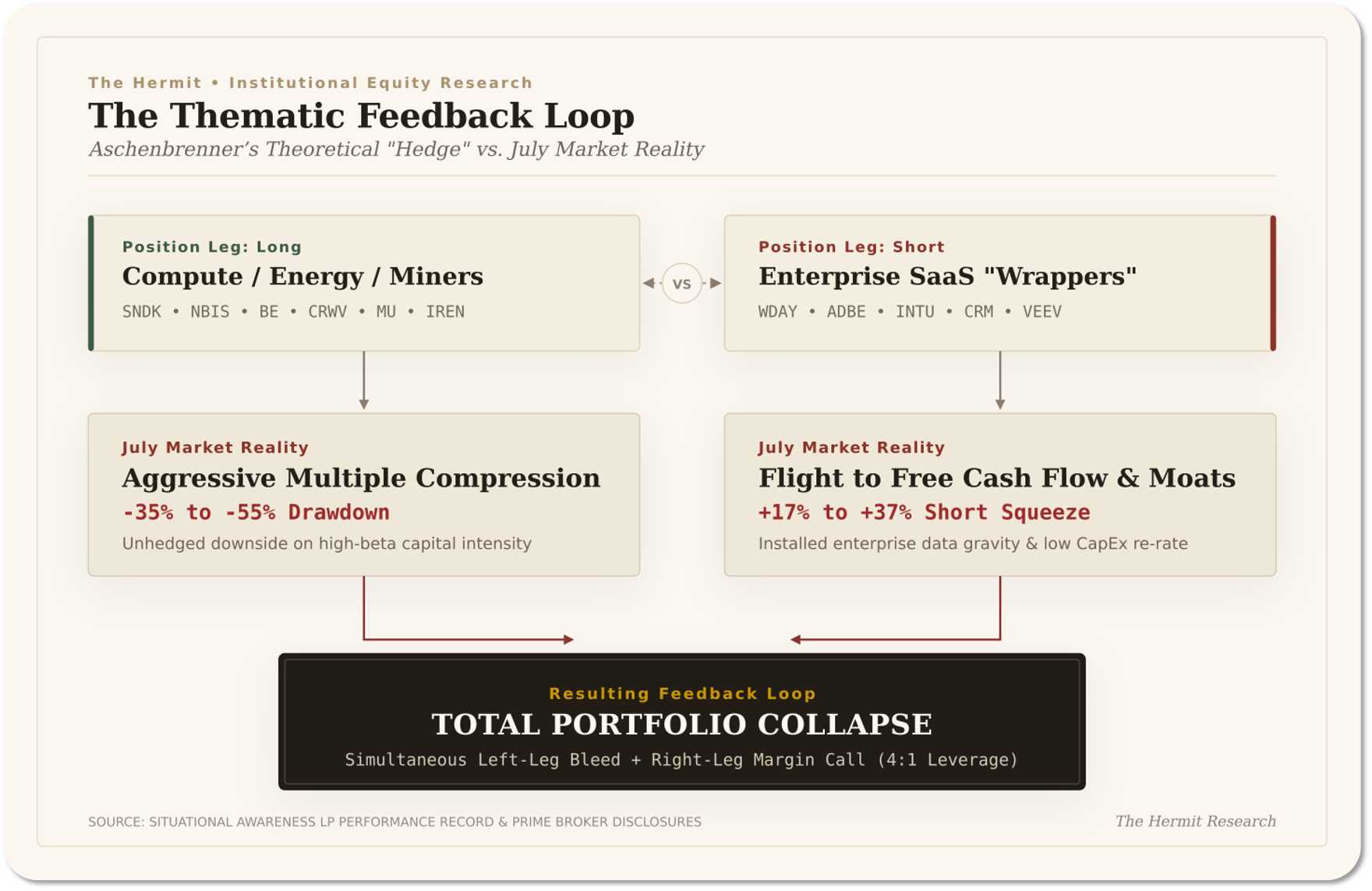
In theory, long/short equity eliminates broader market beta. For the uninitiated, that’s exposure to the ups and downs of the market.
In practice, Situational Awareness eliminated beta only to double down on an aggressive factor or thematic bet:
Long Hardware & Speculative Power: SanDisk (-55.3%), Nebius (-46.3%), Bloom Energy (-45.9%), CoreWeave (-38.9%), Micron (-36.0%), and IREN (-35.9%).
Short Enterprise SaaS: Workday (+37.2%), Adobe (+28.5%), Intuit (+27.6%), Salesforce (+20.3%), and Veeva Systems (+17.2%).
While the S&P 500 stayed essentially flat and Nvidia slipped just 5%, capital executed a violent rotation. That doesn’t mean individual companies are bad, but rather that there was a narrative change which, in retrospect, was a temporary blip of mostly noise.
This, however, resulted in institutional money for a second abandoned capital-hungry buildout infrastructure and piled into higher-margin + cash-generative software incumbents.
In essence, both sides of Aschenbrenner’s book detonated simultaneously.

SaaSpocalypse In a Nutshell
Aschenbrenner articulated the consensus view of the AI engineering complex, which is basically that large foundational models will automate knowledge work.
This, in turn, will make everything super cheap and, in the process, disintermediate “thin” software applications.
If an autonomous agent can code, reconcile books, and execute workflows, software companies selling digital labor become obsolete. They effectively become commoditized, and we all know human labor would be their higher cost.
Labor vs. agents can’t be compared in terms of cost per hour.
In our opinion, this view misdiagnoses what enterprise software actually sells. Corporations do not pay Salesforce or Microsoft for code; they pay for systems of record, legal compliance, and liability protection. And more importantly, they pay for consistency.
We’ll give you a few examples:
Veeva Systems dominates the pharmaceutical pipeline with 19 of the top 20 global biopharmas on its platform. Its architecture is validated under FDA 21 CFR Part 11 and GxP standards.
An AI agent generating raw code cannot replace a federally qualified audit trail where an unauthorized schema change halts a clinical trial.
A Veeva seat runs $1,800 to $6,600 annually against an enterprise field rep costing $150,000 to $220,000. Microsoft 365 E5 sits around $60 a month. Enterprise software represents 1% to 3% of a knowledge worker’s fully loaded cost.
Even if an internal open-source agent matches the software’s utility, no enterprise CIO risks multi-million-dollar compliance breaches to shave 100 basis points off headcount overhead.
Panorama Consulting pegs average enterprise ERP transition budget overruns at 189%, with Gartner projecting that over 70% of implementations fail to realize initial objectives.
Enterprises are locked into their core transactional databases (and contracts).
Rather than being hollowed out by models, mature software platforms are acting as compute toll booths. In fact, they’re the first to use agents to improve processes within their existing workflow. Incumbents package foundational models directly into validated workflows and charge high-margin markups:
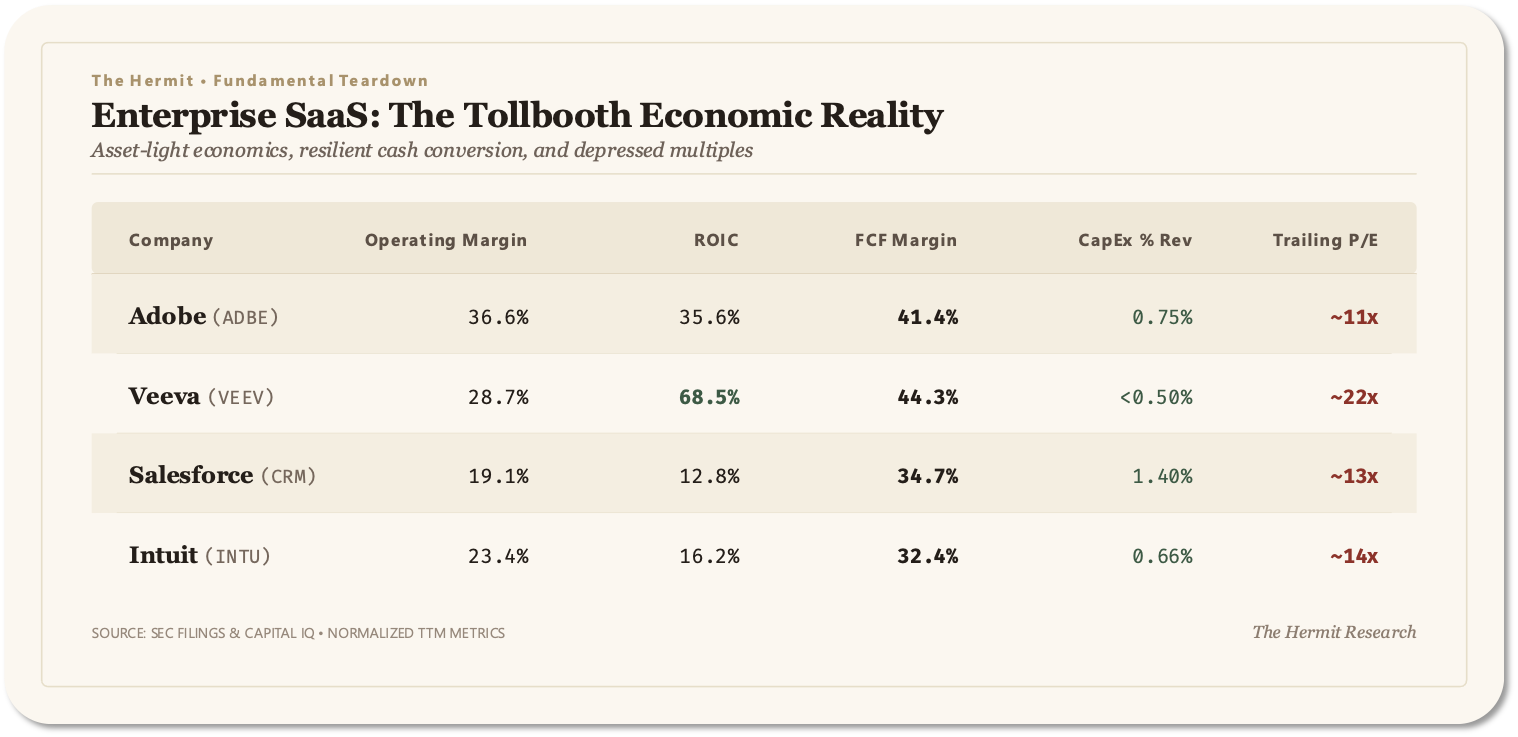
Market participants pricing these at 11 to 14 times earnings mistook deep-value cash-flow machines for dying entities.
And in the case of Situational Awareness, the sheer size of their shorts was pushing per-share prices down. The more capital it attracted, the more this was the case, as they needed to find liquid names that could act as a “hedge”. In fact, their size forced them to start using… alternative tactics.
If you look up the official public data for big software stocks like Adobe, Salesforce, Workday, Intuit, or Veeva, the numbers look completely harmless.
The stock exchanges publish a report twice a month showing how many shares are being bet against, and for these enterprise giants, that figure usually hovers between 1.5% and 4.5% of their available stock.
Something obviously changed in March for all of these.
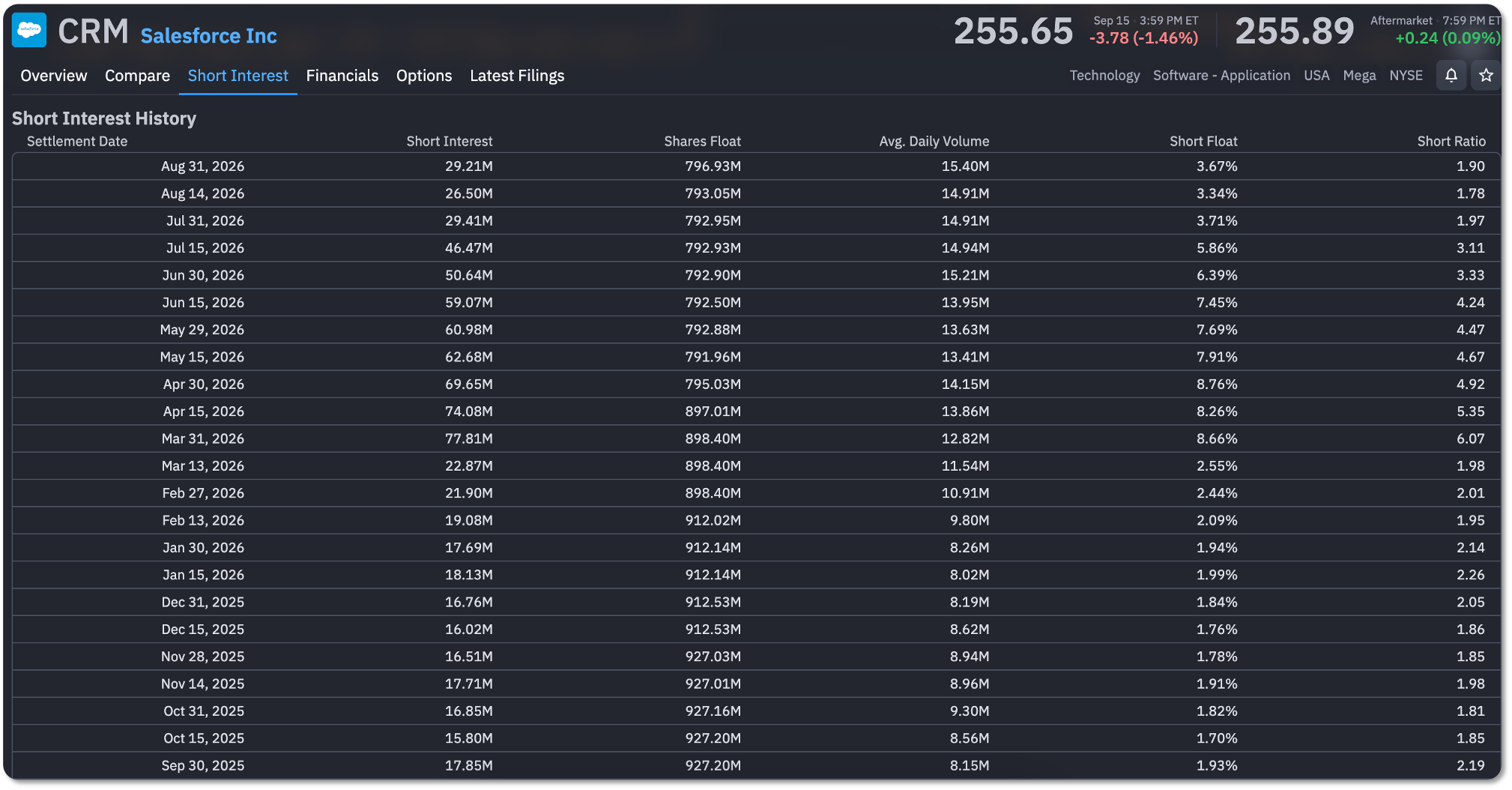
At one point, the size of these bets against a stock could no longer happen with just institutional money.
So they went directly to the prime brokerage banks like Goldman Sachs or J.P. Morgan and set up private derivative contracts. These are custom off-exchange side bets on baskets of stocks they label as “AI losers.”
Because these private swap contracts don’t show up in the standard public short-interest numbers, the real level of skepticism across the industry was actually invisible.
By July, institutional betting against legacy software had quietly reached multi-year records.
This is, by definition, a massive hidden traffic jam.

When Microsoft delivered a solid earnings report and buyers suddenly stepped in, every fund caught on the wrong side rushed to exit through a very narrow door at the same time.
Trying to unwind billions of dollars in off-market bets against an illiquid market triggered a short squeeze, rocketing these supposedly doomed software stocks up anywhere from 17% to 37% in just a few trading sessions.

The Capital Cycle and Depreciation Arithmetic
The inverse error of the thesis was assuming that massive societal transformation yields equivalent equity returns for infrastructure builders.
In historical capital expenditure cycles, the opposite is almost uniformly true.
Hyperscaler capex projections for 2026 approach $785bn, trending toward $1tn by 2027. Amazon alone is running near $220bn in annual capex guidance. Microsoft’s capital expenditure reached nearly 35% of total revenue, causing free cash flow to drop from $74.1bn to $67.0bn even as sales grew double digits.
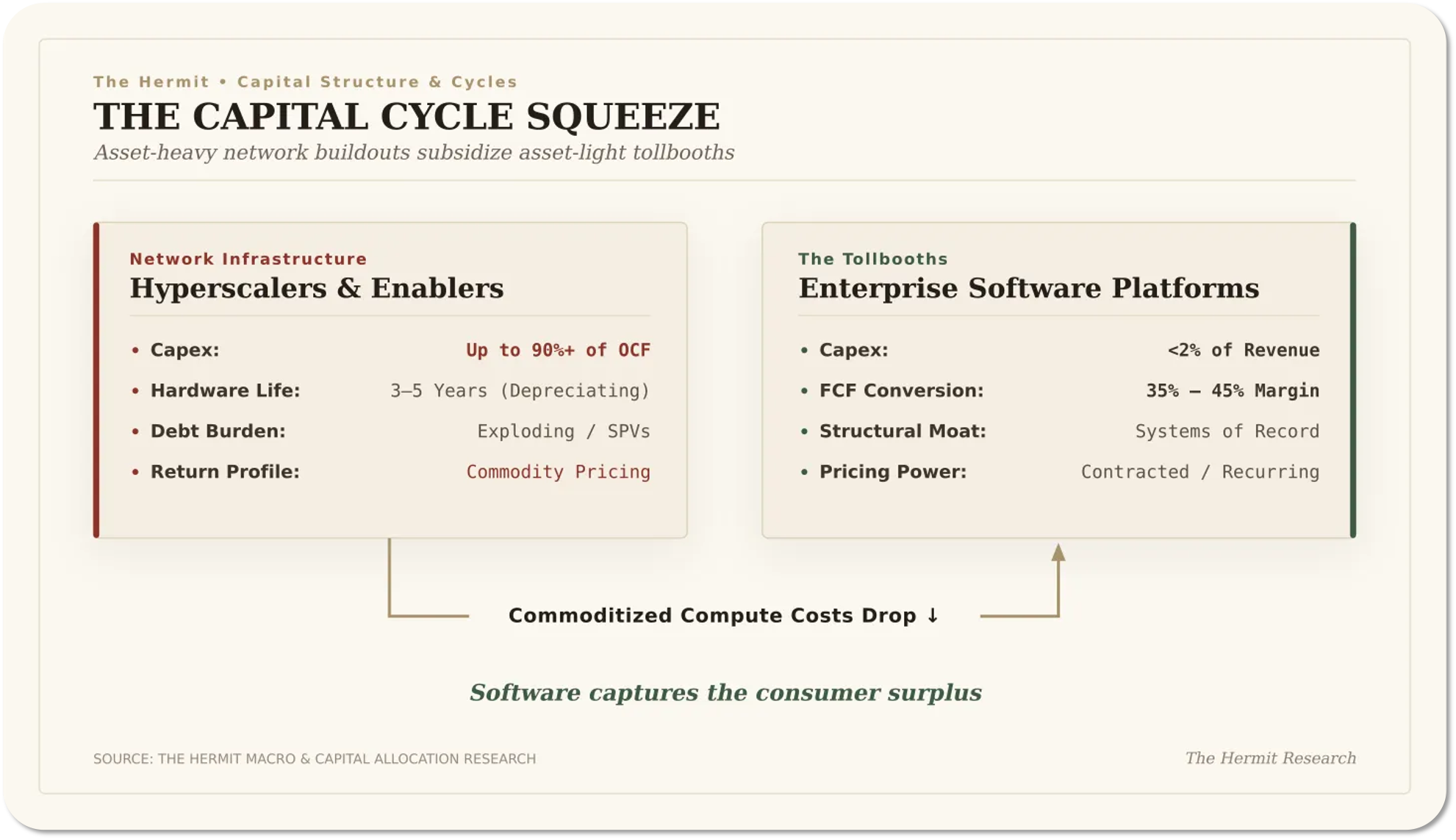
To shield operating income from this capital intensity, hyper-scalers extended server asset depreciation schedules from three years to six, inflating accounting profits by billions.
Amazon quietly bucked this trend by reverting hardware life back to five years, taking a $1.4bn depreciation charge because cutting-edge silicon becomes obsolete long before it physically degrades.
David Cahn (Sequoia) and Bain calculate an implied $800+ bn annual revenue deficit between infrastructure amortization requirements and real AI revenue.
While OpenAI and Anthropic generated a combined ~$23 bn in 2025, Nvidia extracts 72% to 75% gross margins upstream. The margin resides almost exclusively in selling the picks and shovels, not running the processing workloads.
Secondary infrastructure players like CoreWeave carry net debt above 8x EBITDA with double-digit debt coupons, while balance sheets across the sector are buffered through off-balance-sheet Special Purpose Vehicles (such as Meta’s $27bn Hyperion funding structure).
The combination of all these elements created a narrative that may or may not be entirely true. But overall, it’s a story… and like every good story, it’s based on facts, with a few myths and legends baked in.

Infrastructure Destroying Capital. A Trip Back to 1873
Capital markets have run this exact experiment before. Between 1865 and 1873, the United States built out its transcontinental rail system:
Rail track grew from 35,085 to 74,096 miles.
By 1870, railroad issues represented 87% of all New York Stock Exchange volume.
European capital poured in, chasing 6.5% to 7.5% debt yields.
The economic thesis of the transcontinental buildout was correct: rail completely transformed logistics, lowered shipping friction, and industrialized North America. Yet the equity was an absolute slaughterhouse.
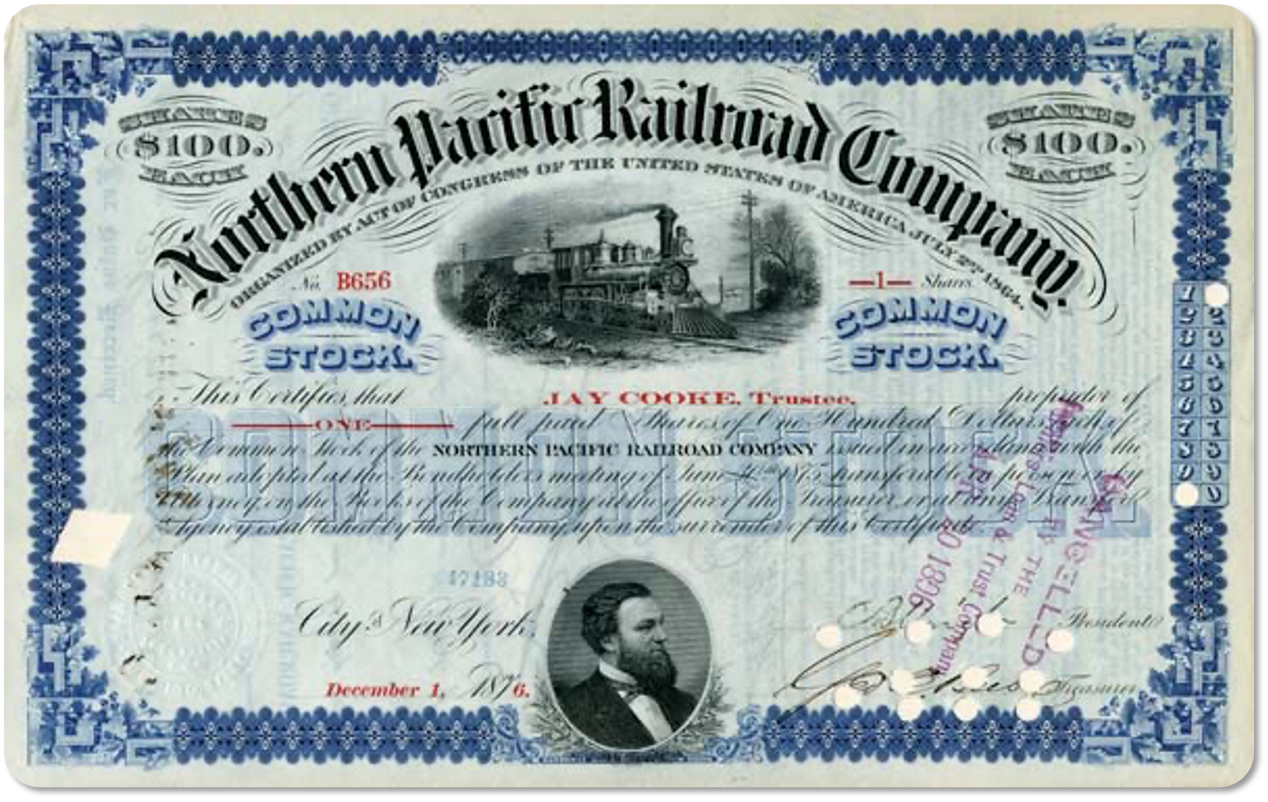
In September 1873, Jay Cooke & Co. (bank) collapsed under unplaced Northern Pacific rail paper. The NYSE shuttered for ten days.
By 1876, 134 rail companies defaulted on $500m of debt (that’s about $16bn in today’s money which at the time was even more because railways were 6% of US GDP); by 1877, fully 20% of all US rail mileage was in receivership. Severe price competition drove New York-to-Chicago freight rates from $1.88 per ton-mile down to $0.20.
Great for consumers, awful for companies trying to stay afloat.
The durable fortunes were not forged by the track layers. They were generated by the asset-light operators running cargo. Two great examples are:
Adams Express Company: Owned zero track. It secured payload space on competing trains to move high-value freight. Adams paid an unbroken $8 per share dividend straight through the Long Depression of the 1870s and 1890s, later converting into a closed-end fund that trades today on the NYSE (ADX).
Pullman’s Palace Car: Formed with $1m in initial equity to build luxury sleeper cars. Pullman leased the rolling stock directly to rail operators, taking virtually no physical line construction risk. By 1879, it cleared $1m in pure annual profit on a network funded by billions in defaulted capital.
The identical script played out in the 2000 telecom crash.
Global Crossing, WorldCom, and 360networks (Canadian) laid tens of millions of miles of dark fiber. Over 95% of transatlantic fiber lay unlit as operators went bankrupt at 1 to 2 cents on the dollar.
The ultimate beneficiaries were Amazon, Google, and Netflix, which built software monopolies on top of stranded, sub-marginal infrastructure capital.

A Bit of Math: Volatility Drag and the Ruin Problem
Aschenbrenner did not simply make an incorrect fundamental rotation call. To put it very plainly, he violated the mathematics of geometric compounding, technically inverting it to the point where it was working against him.
In leverage-constrained portfolio theory, the expected long-term compound growth rate (g) of a portfolio is approximated by:

Where:
mu (μ) is the expected arithmetic return.
sigma^2 (σ2) is the variance (volatility squared).
When applying leverage (L), expected return scales linearly, while the variance drag scales quadratically:

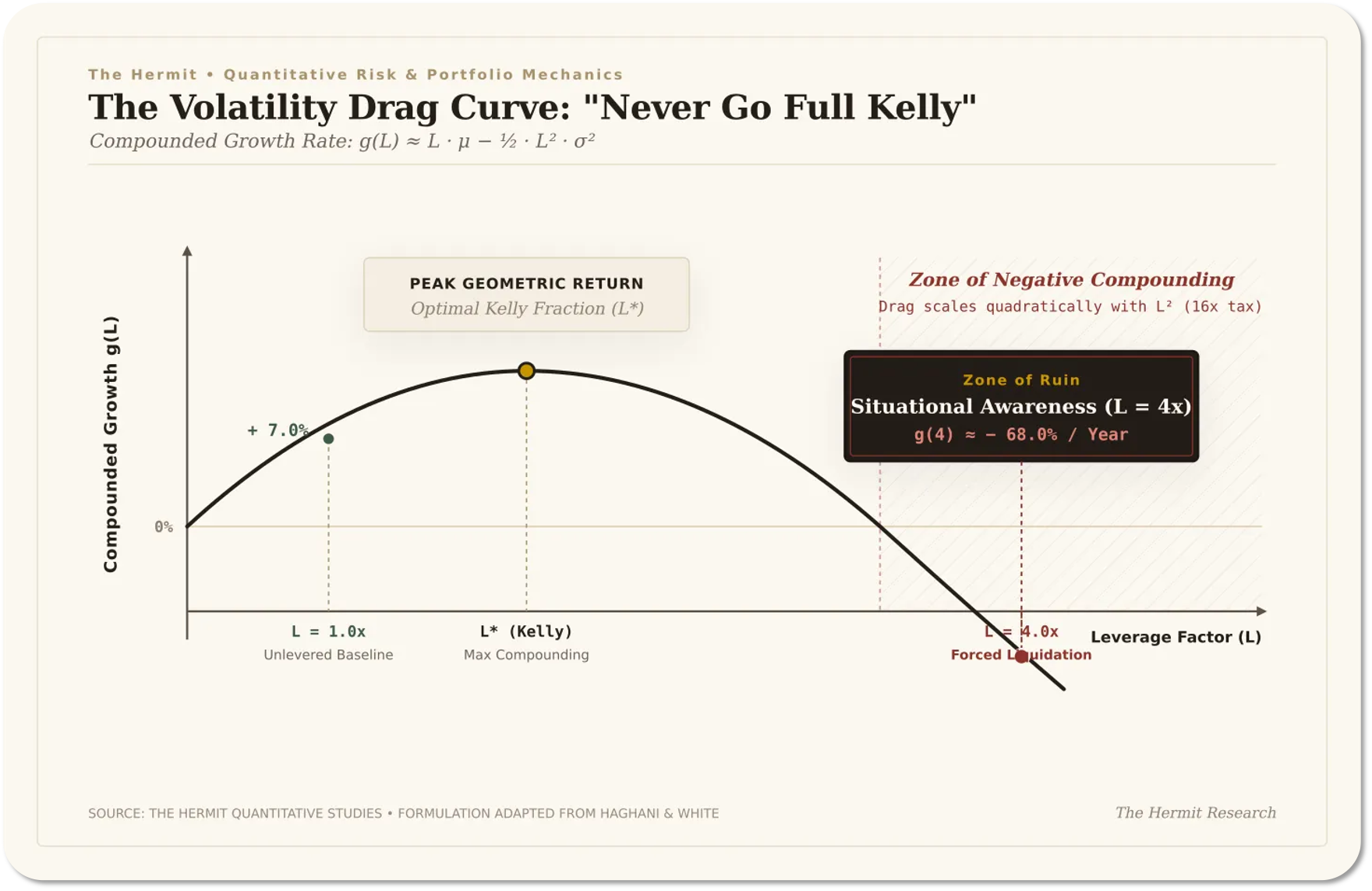
Note: For those who don’t know the Kelly Criterion, here’s a short guide. It effectively tells you how to optimize your bet given the certainty/conviction of an outcome.
Assuming an unlevered AI thematic basket with an expected return (μ) of 15% and an annualized volatility (σ) of 40%:
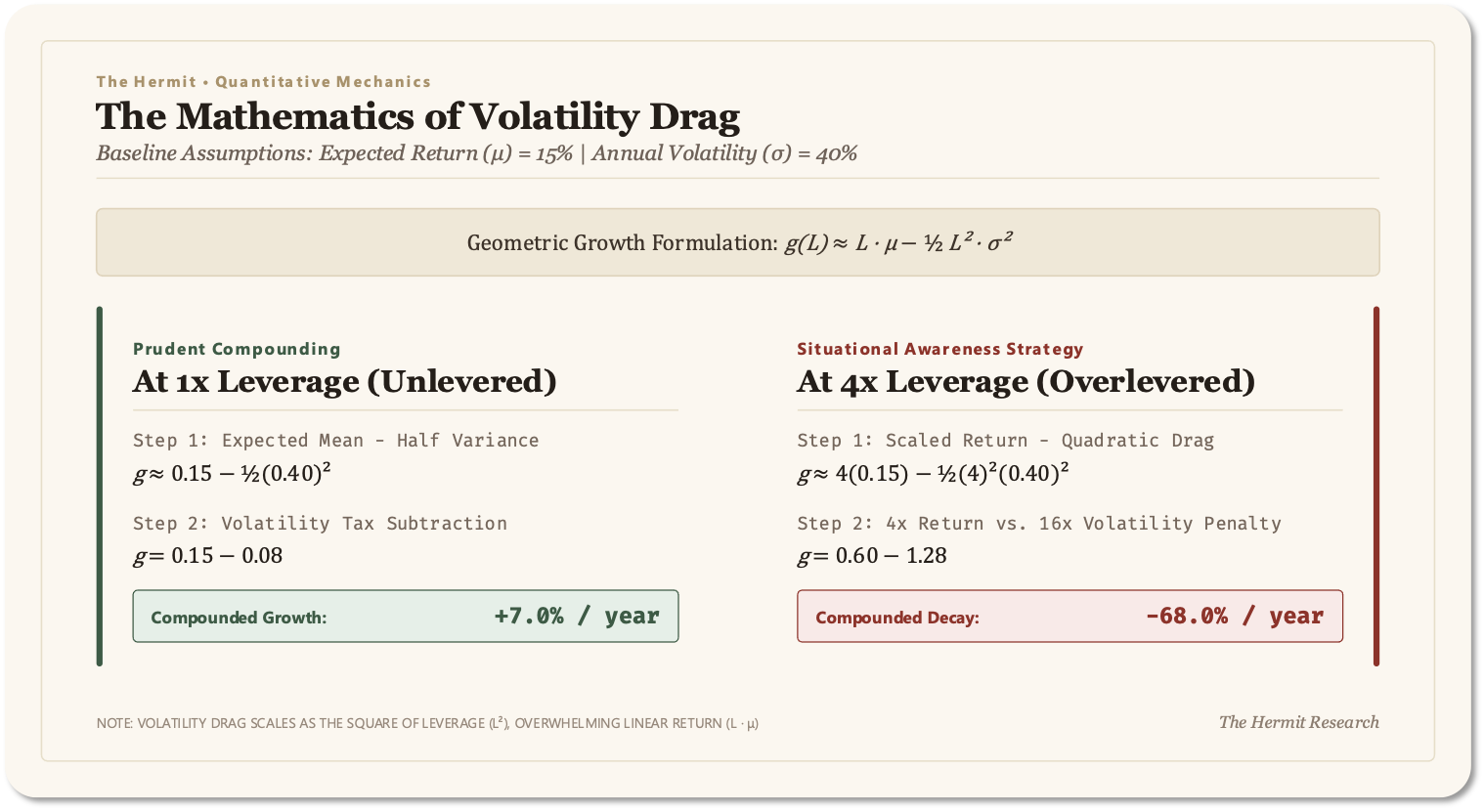
By running at 4x leverage on an asset class with 40% historical volatility, Aschenbrenner mathematically guaranteed a negative geometric (or exponential) drift.
Even if the terminal bull case for AI infrastructure carries a positive arithmetic mean over a decade, the distribution is extremely right-skewed. This means the positive mean is propped up by low-probability, hyper-lucrative tail scenarios, while the median path decays toward zero.
This may sound like a minor detail, but it makes all the difference… in fact (and as a side note), if we ever write a PhD dissertation, it will be on these mathematical moments and their effect on compound returns.
In sum, a low chance of super-high returns paired with a slightly negative median. Amplifying this profile with leverage leads to a near-guaranteed loss as you constrain your time horizon, cutting off the window needed for these rare giga-positive tail events to occur, while the average play plus the added cost of borrowing guarantees the downside.
Remember: when you use debt, someone else decides when the party stops.
A leveraged vehicle hits an absorbing boundary condition like a margin call, decades before the right tail has time to materialize. Even if things happen faster today, we can almost guarantee that the margin call will come in first.

Core Takeaways
The collapse of Situational Awareness LP marks the turning point of this first phase of the AI capital cycle.
We have observed market shifts towards the cash-flowing end of the spectrum, with companies like Google, Nvidia, and Microsoft taking on the burden of debt to finance these operations.

We strongly believe past, present, and future capital allocation rests on three principles:
Tech Transformation ≠ Capital Return
The absolute utility of a technological breakthrough has no correlation with the return on capital invested to construct its physical footprint.
When supply expands unchecked, basic infrastructure rapidly commoditizes.
Moats Lie in Systems of Record, Not Systems of Compute
Ripping out deeply entrenched, heavily regulated, and auditable enterprise workflows is economically irrational for corporate operators.
The applications will purchase commodity intelligence at marginal cost and re-sell it as high-margin workflow automation to their captive user bases.
Correct Capital Structure = Survival
No investment thesis survives excessive leverage if its factor exposures are correlated.
The winners of industrial shifts are consistently the liquid buyers of last resort… the Citadels, Pulmans, and Adams Expresses.
These acquire distressed, essential physical assets for cents on the dollar after the visionary capital has been liquidated.
We now and always will aspire to be one of these buyers of last resort.

If you found value in this analysis, please hit the ❤️ button and share your thoughts in the comments. It helps us bring institutional-grade research to a wider audience.
And if you liked this post, we’re confident you’ll love this:
