


Today’s write-up on French consulting firm Wavestone is completely open to everyone, made possible by our friends at Baseline.
If you appreciate having write-ups like this outside the paywall and want to see more of them, do check them out.
Partnerships like this keep the research independent, thorough, and accessible to the entire community.
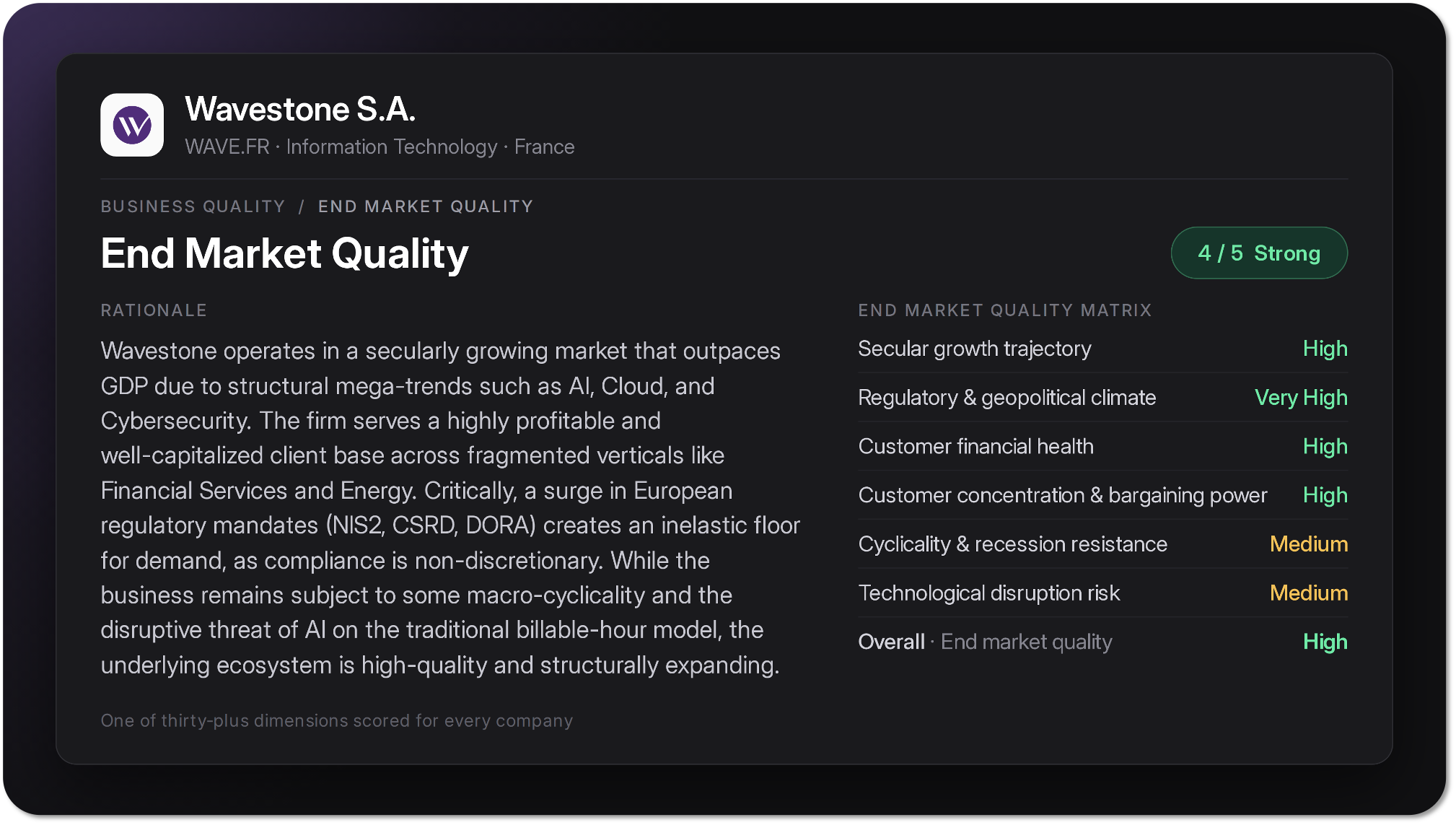
Baseline: Qualitative analysis at scale
Every fund asks the same question.
Does this business have pricing power, what are barriers to switching, is there AI risk?
We ask these questions, score the output, and provide in depth rationales, saving days of due diligence work.
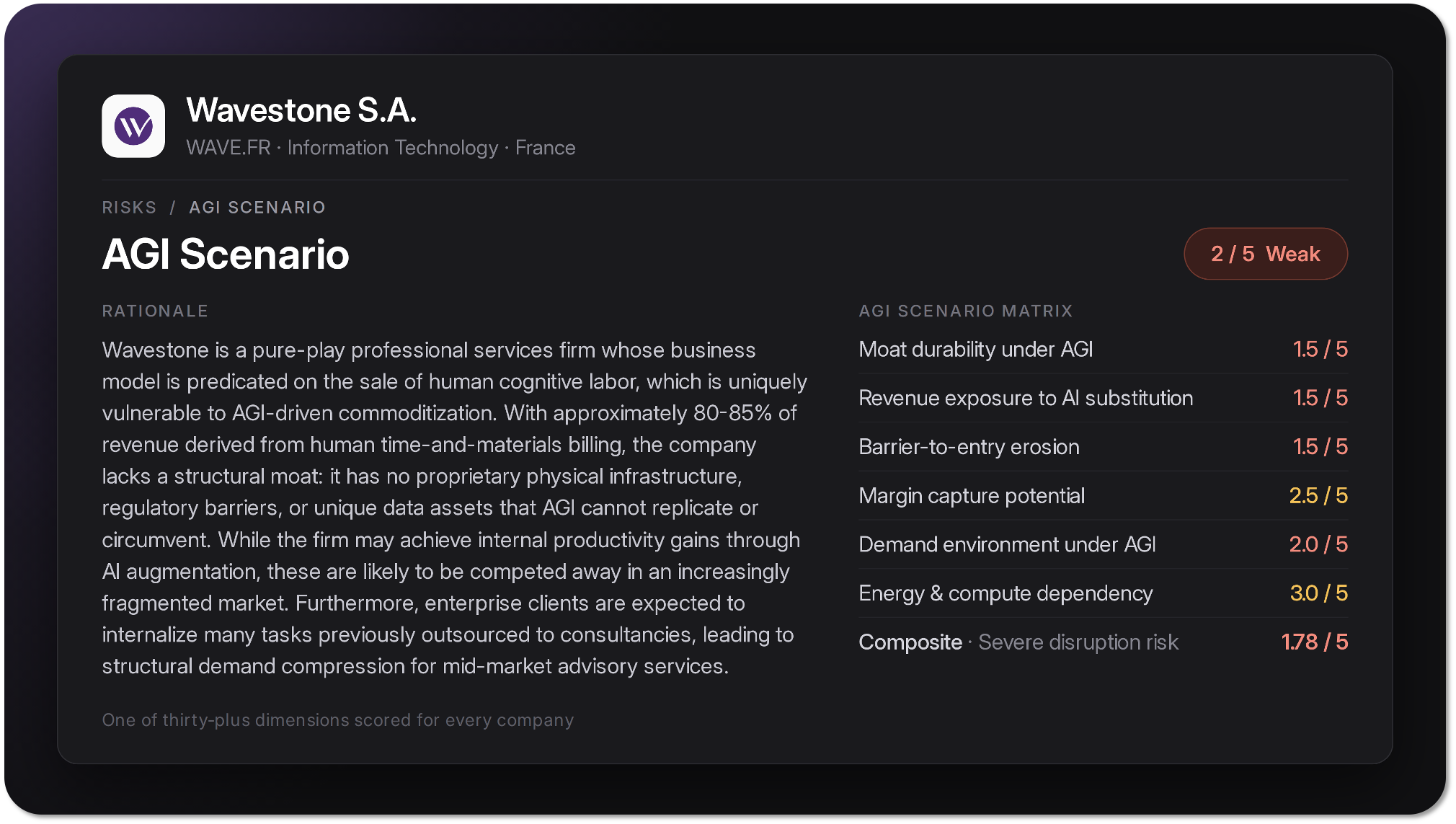
And you can download the full Baseline report for Wavestone here:

As we now do every week for transparency, here is our list of past Pick of the Week posts and their returns since publishing:
All picks (equally weighted): +15.52%
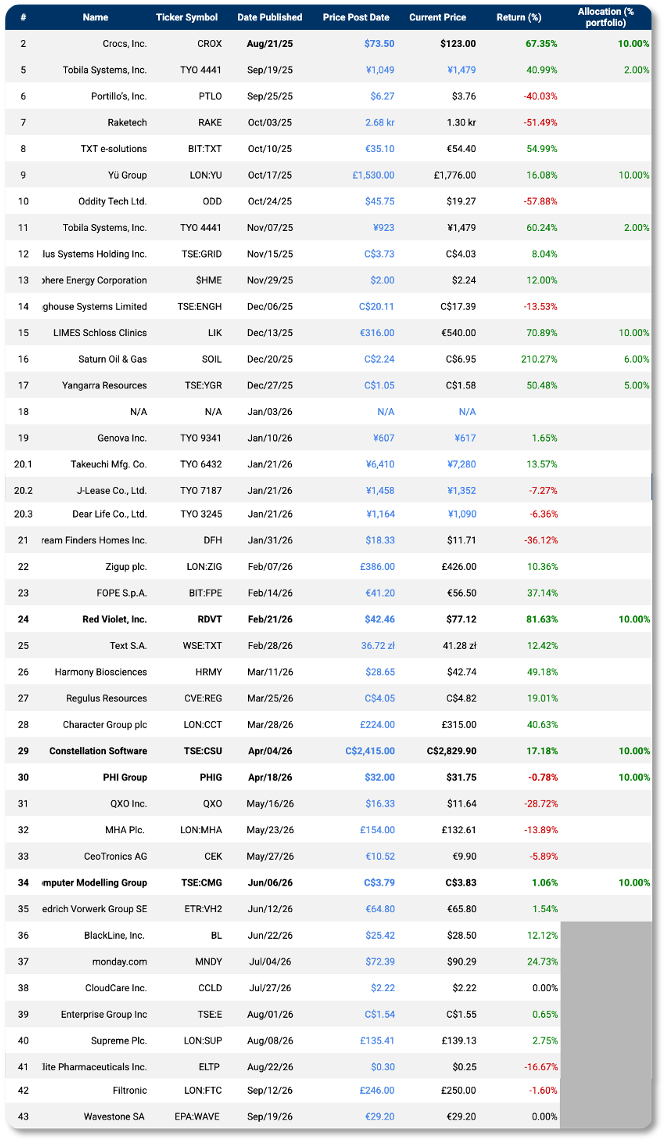

Pick of the Week. A curated series of high-conviction research on companies currently under our microscope. We screen for specific dislocations where the market has mispriced the balance sheet or earnings power (or both).
None of the following should be construed as investment advice. Please consult a financial advisor before making any investment decision. You will find a full disclaimer at the end of this post.

🌊 Wavestone SA ($WAVE)
⭐ Overall Grade: 8.5 / 10
Wavestone is a solid European consulting firm. I know what you’re thinking… another one of those (e.g. Accenture), but do listen in because these guys are absolutely crushing it while the sector is being punished. So it’s one of those macro super pessimistic with a micro doing fantastic stories.
These guys operate in the intersection of management tech and IT. Rather than executing on separate strategies, Wavestone positions itself as a trusted partner for tier-1 enterprises (more on these in a second) for complex and high-stakes transformations.
The company employs over 6,000 professionals across 17 countries, with primary operational strongholds concentrated in five key geographies: France, Germany, Switzerland, the United Kingdom, and the United States.
FYI, based on Wavestone’s client disclosures, these are the Top-20 accounts across these key sectors:
Energy & Utilities (18% of Group Revenue):
EDF (5% of total revenue)
Engie (3% of total revenue)
TotalEnergies (3% of total revenue)
Financial Services. Insurance & Banking (33% combined):
Crédit Agricole (4% of total revenue)
AXA (3% of total revenue)
BNP Paribas (2% of total revenue)
BPCE (2% of total revenue)
Munich Re (2% of total revenue)
Confidential Tier-1 Insurance Client (2% of total revenue)
Luxury & Consumer Goods (10% of Group Revenue):
L’Oréal (2% of total revenue)
Chanel (2% of total revenue)
Hermès (1% of total revenue)
(Wavestone also works extensively across Asia with LVMH)
Transportation, Travel & Logistics (13% of Group Revenue):
Deutsche Bahn (5% of total revenue)
SNCF (2% of total revenue)
SBB (Swiss Federal Railways) (2% of total revenue)
La Poste (1% of total revenue)
Now that you have a big-picture understanding of where they stand and who's buying, let's look at what they actually do and how they monetize it.
How Wavestone Makes Money & Unit Economics
Wavestone’s revenue model revolves around intellectual services and billed consulting hours/days.
Note: As you already know, having worked in this space, how it works comes naturally to us, but these guys do have a distinct tech edge.
The firm operates via two primary contracting frameworks:
Time-based Services: Approximately 45% of total revenue is derived from traditional time-and-materials contracts.
Fixed-price Contracts: Roughly 55% of revenue comes from fixed-price projects, where Wavestone assumes delivery risk but captures margin upside through efficient project execution and proprietary methodologies.
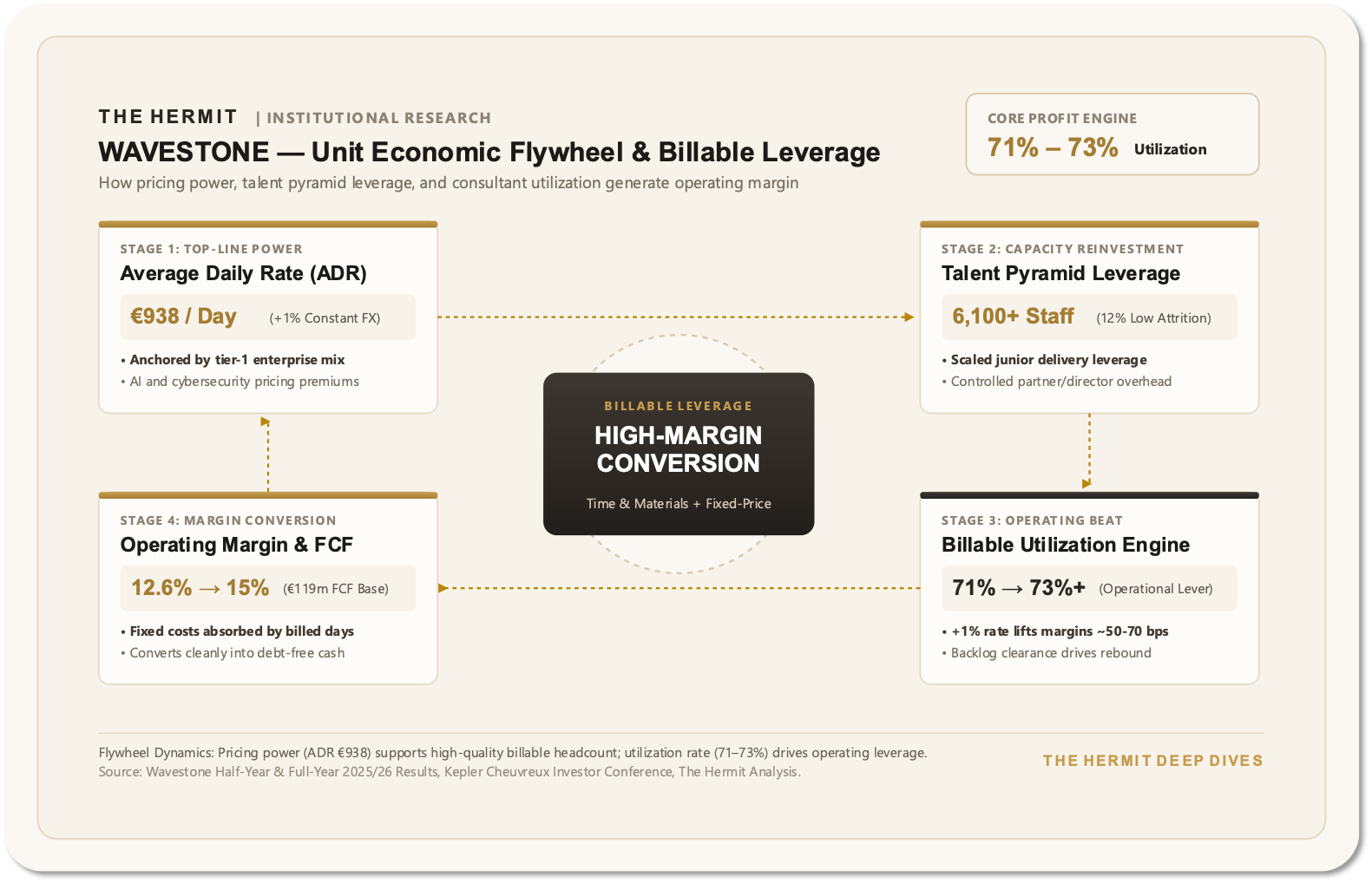
Key Unit Economic Drivers:
Wavestone commands a robust pricing power across its markets, with an annual ADR hovering around €938 (and varying slightly by geography). This is usually a product of expertise (specialization) and seniority. E.g. your typical partner/manager hours will be billed at 4-5x that of a junior consultant.
Note: While working for the Canadian Pacific spin off as an analyst (back in 2021/22) we charged roughly C$300-350/day for my extremely undeveloped financial modeling skills. My boss could charge up to C$1,500/day but he worked as a supervisor so less hours.
Your average project had roughly a C$500-600/day rate. These guys are doing 2x of that, so they’re freaking experts… or should we say LE EXPERTS 🥖.
The Utilization Rate is the critical operational heartbeat of the business… manhours (not very politically correct). It’s calculated as the ratio of billable days to total available billable hours (excluding vacations). Historically normalized around 72%–73%, utilization rates have faced temporary macro pressure (slipping to roughly 71%) as clients adjust deployment schedules.
75% and above is really good; 80% is peak.
The cost structure is heavily weighted toward personnel expenses (accounting for over €600m annually [2/3 of revenue]). Managing the balance between junior staffing, senior management oversight, and subcontracting purchases (~€134m) dictates operating margins (EBIT).
Economic Moats & Competitive Advantages
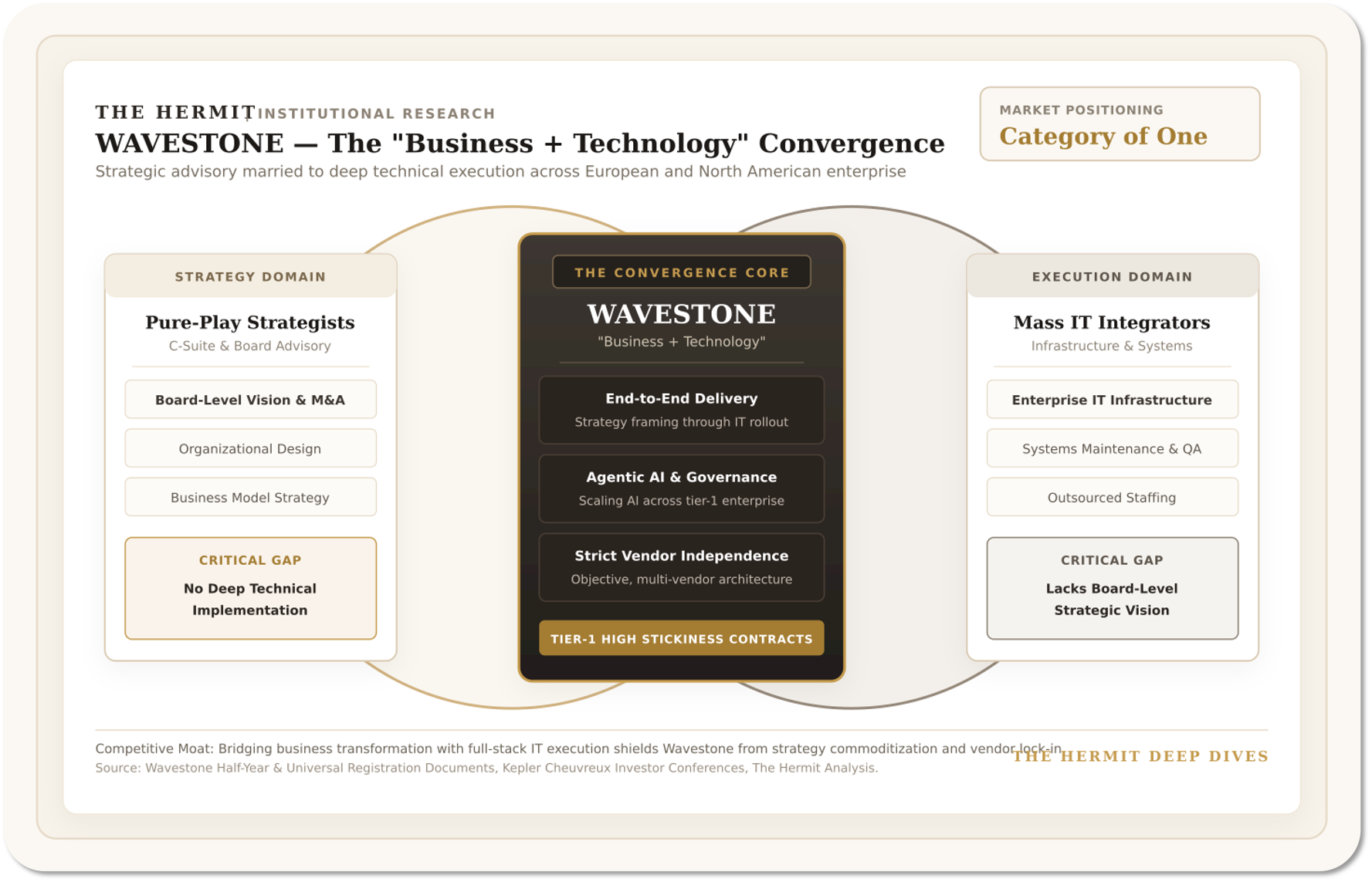
This really is a game of specialists. Most traditional consultants are either pure-play strategic advisors (lacking deep technical implementation capacity) or IT system integrators (lacking board-level strategic vision).
Wavestone is a combo of both, allowing it to design transformation roadmaps and execute them down to the code and infrastructure level. We guarantee you that this is much better than writing up a report, which usually no one reads.
Additionally, Wavestone derives a significant portion of its revenue from repeat relationships with mega-cap European institutions (e.g., EDF, Engie, Deutsche Bahn, TotalEnergies, and major European banks and insurers).
Switching costs are high because Wavestone embeds itself directly into core operational workflows. There are quite a lot of layers of bureaucracy in these institutions, plus career risk for the higher-ups, so supplier changes happen rarely, and when they do, they’re reaaaaaally slow.
On a final note, unlike consulting arms tied to major software vendors or audit firms, Wavestone remains independent. This objectivity is vital when advising executive boards on multi-million-dollar software and cloud architectures. It sounds like a small detail, but it really is a game changer. Instead of giving these companies multiple commodity-like services, they’re focused on one very specific thing.
Now, which of these companies can afford not to use AI?
🎯 Catalysts: Why Now?
Pretty Freaking Explosive Multi-Year AI Wave
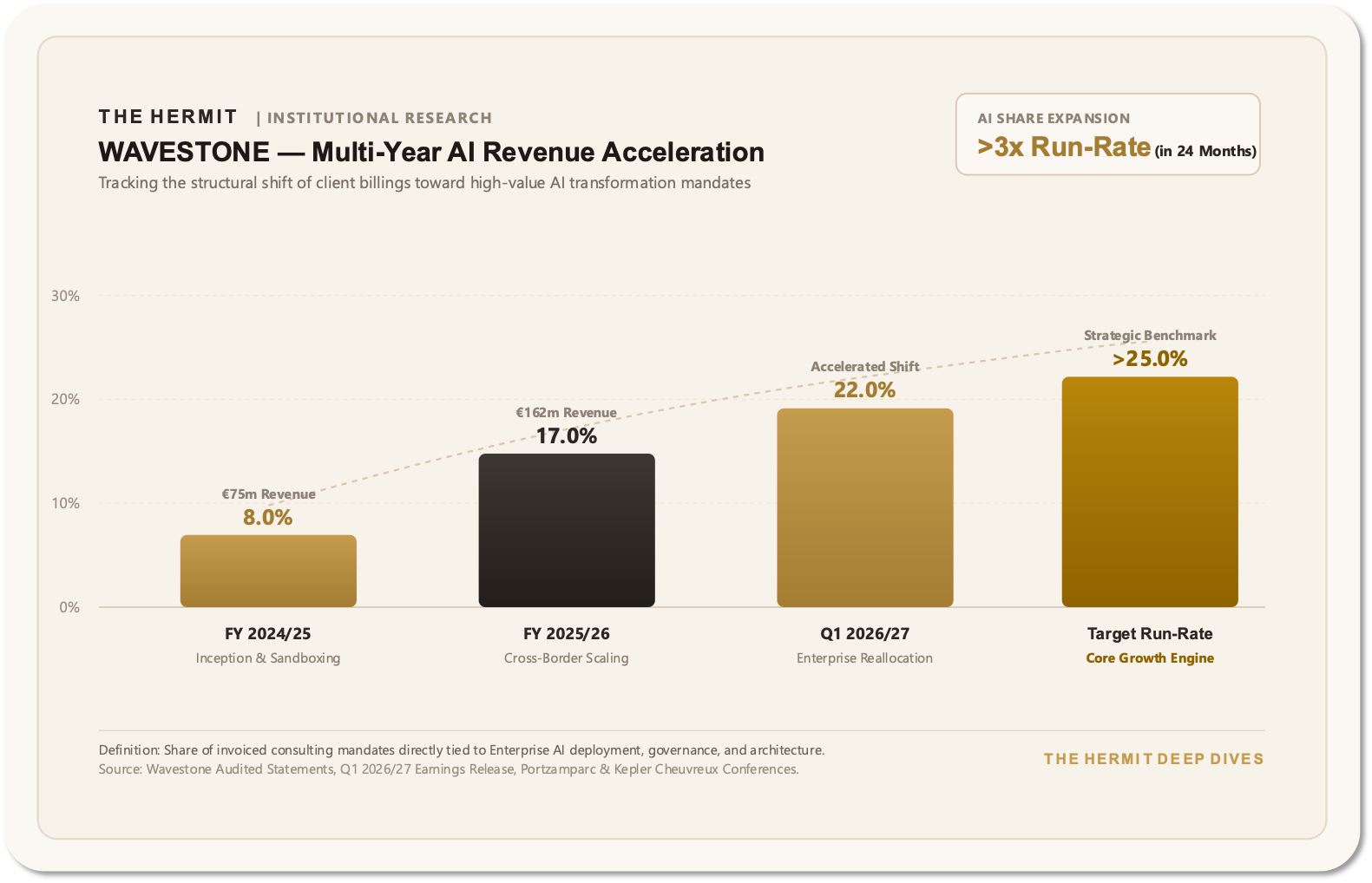
AI is the name of the game. It’s all transitioning from an experimental sandbox to a core corporate priority for all of their clients.
Wavestone’s AI-related revenue has expanded significantly, surging from 8% of total revenue in FY 2024/25 to 17% in FY 2025/26, and tracking even higher in recent quarters (reaching ~22%).
Management expects AI to become the firm’s primary growth catalyst, moving toward >25% of revenues.
Unlike software houses vulnerable to product disruption, Wavestone monetizes the implementation, organizational change management, and agentic governance required to scale AI safely inside Fortune 500 enterprises.
It really feels like when you buy an iPhone and then purchase an indestructible privacy screen, a hard case, and a subscription tutorial on how to get the most out of it… with all of the installation and guidance, of course, provided by Wavestone.
Thus Far… Value-Accretive M&A
Wavestone has strategically deployed its balance sheet to acquire high-value niche capabilities. We’ve seen this playbook before with firms like MHA absorbing Baker Tilly offices across regions to scale operations and consolidate costs.
The recent acquisitions of AI Builders (~50 consultants specializing in AI strategy in France) and Sand Cherry (a Denver-based US business consulting firm expanding their North American platform footprint to ~€103m in proforma revenue and ~370 employees) add directly into high-margin segments without overextending the balance sheet (net cash position of €121m).
Green Energy Transition (important in the EU)
While traditional segments like banking and transport have experienced headwinds, Wavestone’s strategic expansion into Energy and Utilities has turned it into the firm’s leading revenue sector (18%).
Driven by Europe’s mandate for energy autonomy and grid decarbonization, this vertical provides a structural, non-discretionary revenue stream.
It’s not where the super intense growth will occur, but green transition revenue serves as a very stable base from which to grow and expand via the AI theme.
Utilization Rebound = Operating Leverage
Consultant utilization rates dipped to ~72% during recent geopolitical and macroeconomic friction points (including trade policy shifts).
As enterprise decision paralysis thaws and backlogs clear, even a modest 2–3% recovery in utilization back toward historical normalized targets (73%–75%) will drive outsized operating margin expansion due to high operational leverage.
If they ever go past 75%… well, that’s a bull-case guarantee right there.
The 2030 Strategic Roadmap: “Lead the Shift”
We separated this section because it's not really a short-term (12-18 month) catalyst, but it does speak loudly of the ambition of the company. Probably the thing that makes us like this company the most is how they’re targeting growth, and that’s laid out in their 2030 plan (up to €100m in organic OPEX dedicated to AI and up to €800m in firepower for external growth (inorganic) funded via cash flows and debt facilities).
We could discuss this thoroughly, but it might just be better to show you where they’re focusing their efforts:
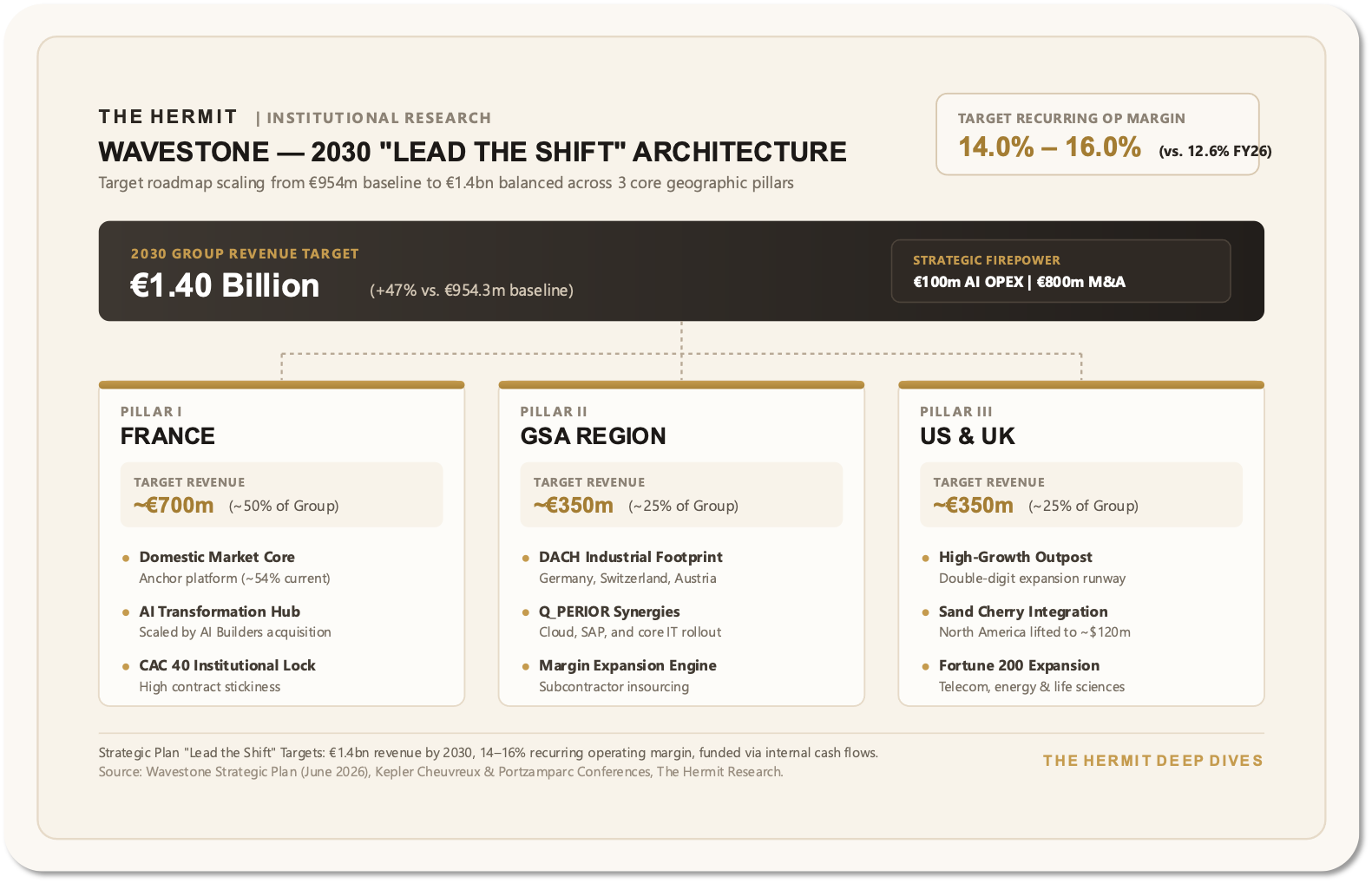
If you want to dive deeper into this, they explain it all out here: https://www.wavestone.com/en/lead-the-shift/
💰 What’s It Worth?
Both our cases use an 8.5% discount rate and a long-term terminal growth rate of 2.0%.
You can probably be more aggressive, but their healthy FCF, net cash position, and overall growth are really pointing in the right direction. Plus, there is no need for an illiquidity discount or any type of size add-ons to the WACC.
FYI, the company is sitting on €121.4m of net cash with a market cap of ~€730m (€29.20/share). They have effectively no debt, disregarding the €20.2m of property and equipment lease liabilities.
Base Case [€82.60] (183% Upside)
To figure this out, our projection model relies on a few key assumptions. We start conservatively, reflecting management’s guidance of modest organic growth between -1% and low single digits for the immediate term.
From there, we model a steady acceleration toward the 5% organic CAGR outlined in their 2030 roadmap. We assume operating margins gradually climb from 12% to 15% over the next five years, backed by strict operational execution and disciplined capital spending.
Over the next five years, the business is projected to generate roughly €454m in cumulative NPVed cash flows, with a terminal value contributing another €1.48bn in present value.
Bridging that enterprise value back to equity, adding back net cash and dividing by the 24.91m diluted shares outstanding, gives us an intrinsic value of €82.59 per share.
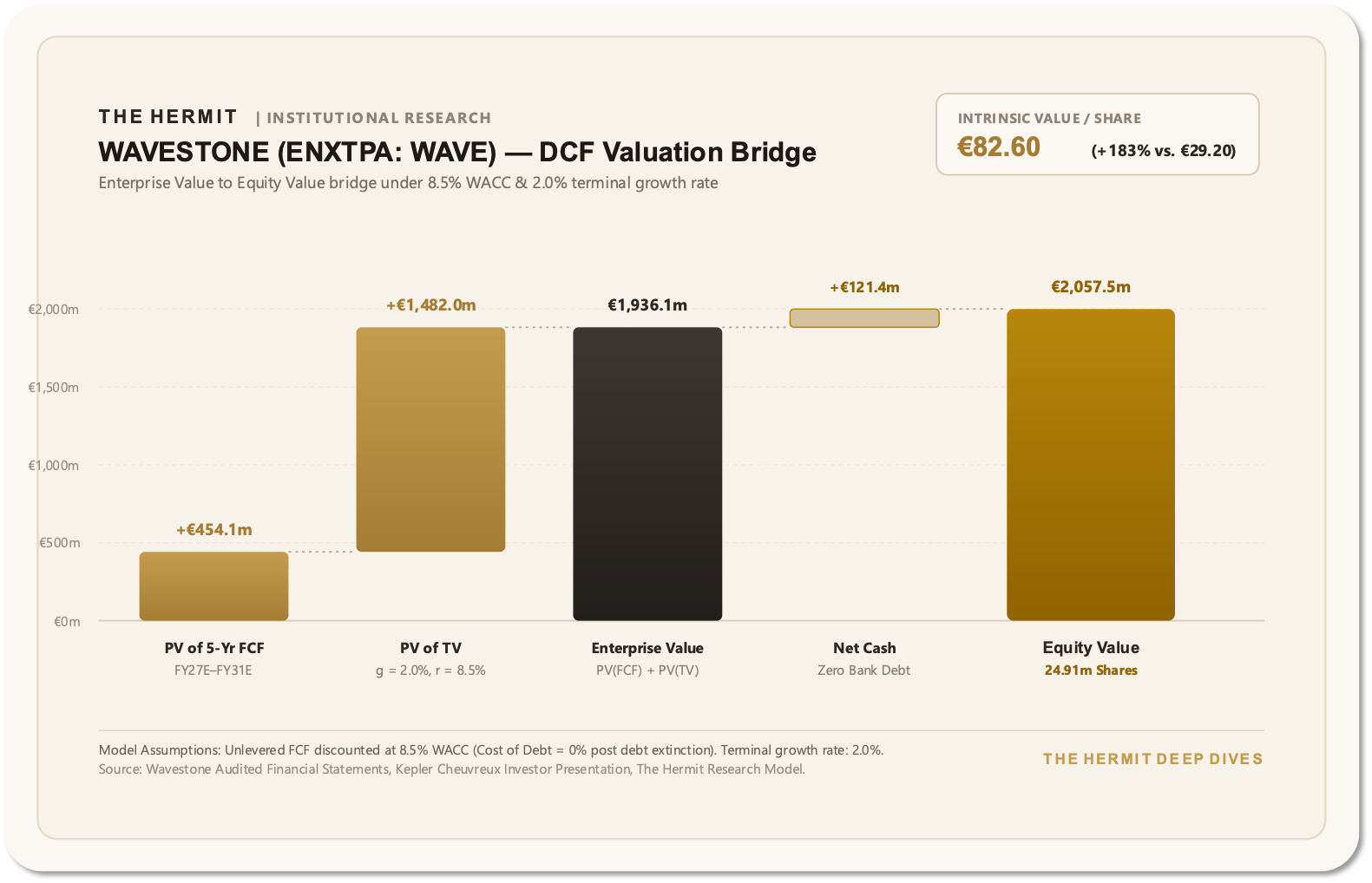
Wavestone has been dragged down by broader tech sector jitters and temporary utilization hurdles. However, its underlying cash engine remains pretty much untouched and debt-free.
This feels like a solid margin of safety.
Bear Case [€61.68]
Stress-testing our assumptions, we can include some macro headwinds lingering longer than expected, European client decision-making remaining sluggish, and the integration of recent acquisitions facing friction.
Instead of a smooth recovery, we model organic growth stagnating near 0% for the next two years before limping up to a modest 3% CAGR by 2030.
We also assume operational inefficiencies persist, keeping recurring operating margins compressed at an average of 10.5% to 11.5% rather than expanding.
Running those tighter margins and slower growth rates through the same WACC (8.5%) and growth rate (2%), the cumulative present value of explicit cash flows drops to €365m, and the present value of the terminal value shrinks to around €1.05bn. Adding back their net cash (€121.4m) gives us a stressed intrinsic value of roughly €61.68 per share.
Even under this pessimistic bear case, where management largely fails to execute their 2030 roadmap and margins stay depressed, the intrinsic value still sits comfortably above the current market price.
That’s, by definition, margin of safety.
Overall Take
We would not be surprised if there was a short-term rerating towards €60.00 to €75.00 once the narrative changes and as their AI transformation strat (25% of revenue) takes effect.
Any additional share repurchases at these prices would disproportionally add to the intrinsic value, so keep an eye out for that.
We want more of these please pleaaaaase