📢 Today, we’re diving into modern socialist economics through the lens of one of its loudest voices;
📊 We’ll break down what it really means (with a few numbers);
💡 … And then offer what we think is a much better solution.
This first article will explore the symptoms, and the second will dive into the solutions 🩺.
Buckle up and enjoy the ride, we’re here to redistribute wealth (and knowledge).
Source: Rolling Stone — Zohran Mamdani Wins New York City Mayoral Election
With all the NYC election noise and political theatrics back in the headlines, we kept getting this urge to revisit an old article we wrote ages ago… and, naturally, never published.
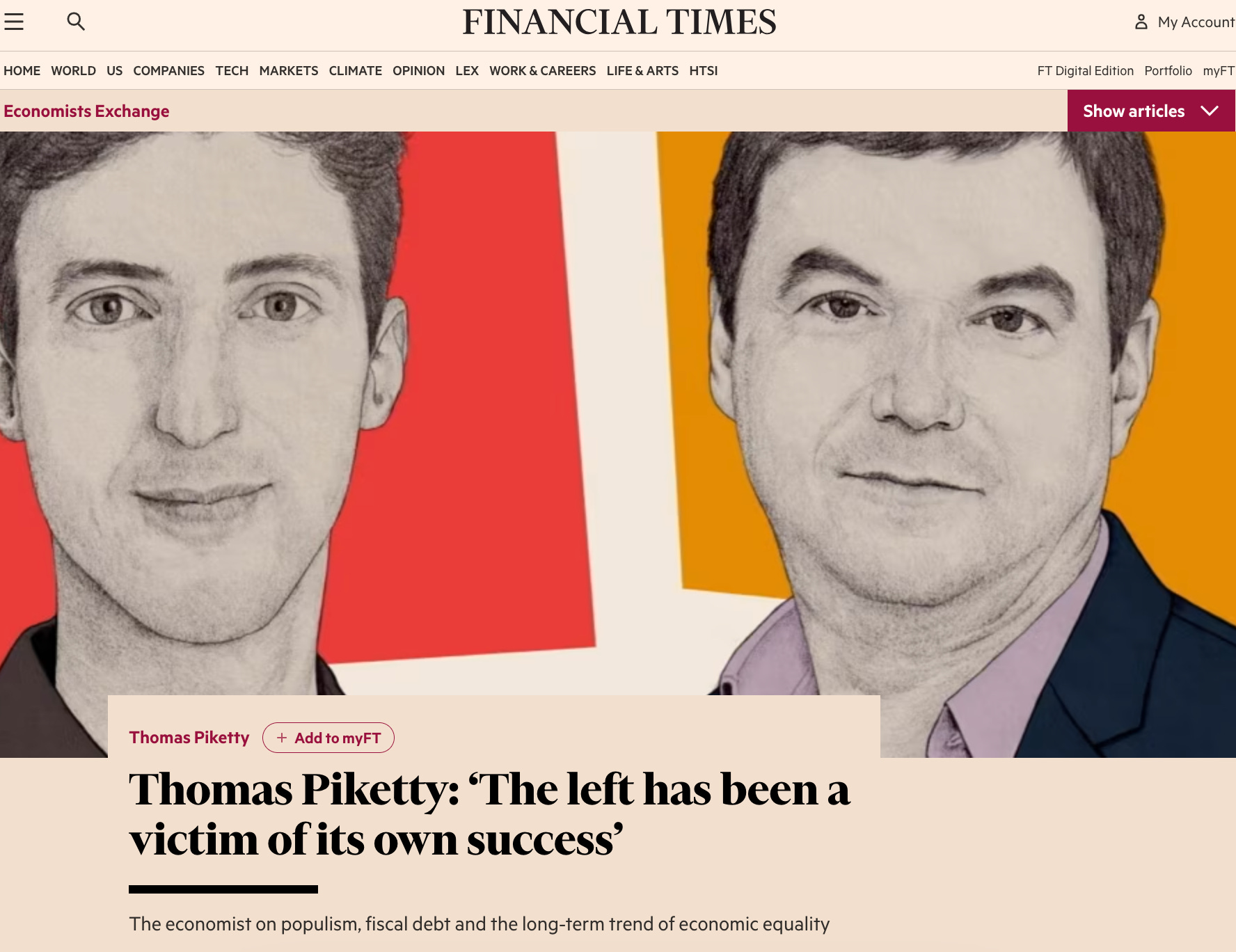
But then… we stumbled upon a recent FT interview with none other than il maestroThomas Piketty, everyone’s favorite rockstar economist, famous for his work on wealth inequality… and something in us finally snapped.
Time to finish what we started.
Source: FT
For context, Piketty is the modern-day Keynes. He’s a sharp, articulate thinker with deep economic insight… who, in our view, mistakes the symptoms for the disease.
Don’t take this as us bashing his ideas; we’re simply laying them out and quantifying them so you can see why we believe they, to be polite, miss the mark.
Also, don’t confuse the author with his oeuvre (fancy way of saying “body of work”). We genuinely think the guy is brilliant and well-intended, but we also think his diagnosis is about as close to 180º from reality as you can get.
To provide some context, he’s a major advocate of egalitarian measures designed to “fix” the economy (and society), or at the very least, alleviate today’s social tensions.
Inequality
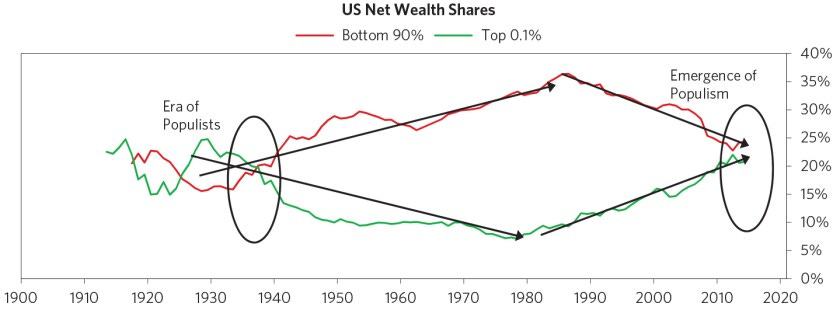
Inequality is widely linked to the rise of populism and internal conflict. We’d encourage you to read about it from the hand of Ray Dalio. Ray Dalio is a well-known proponent of this view and has published several notes and books that lay out the connection between the two.
Source: Ray Dalio’s Bridgewater Associates
Suffice to say, much of this ties back to the rapid rise in asset prices, especially intangible ones (you’d associate these with software, IP, tech, etc.), which have made a small group of people incredibly wealthy on paper.
There are also a number of asset managers, famously (or infamously) the BlackRocks of the world, that have amassed vast amounts of wealth through the indirect representation of both professional and retail investors.
We’re talking about assets that go well beyond intellectual property, including stocks, bonds, real estate, infrastructure, and more.
Quick note: This paradox is fascinating. On the one hand, people complain about the concentration of power in the BlackRocks of the world; on the other, it’s one of the greatest demonstrations of financial democracy. People literally voted with their money to build it… and now they’re upset about the result.
Cue the famous Bohemian (now Czech) golem turning on its creator.
We want the popularity contest we call democracy… but only the good parts
hahahahah 😅
Depiction of the Golem
For Context: The Bohemian golem, often called the Golem of Prague, is a legendary creature from Jewish folklore. In the 16th century, Rabbi Judah Loew is said to have created it from clay to protect the Jewish community from persecution. The golem obeyed commands but eventually grew uncontrollable. Fearing the destruction it could cause, the rabbi deactivated it, returning it back to lifeless clay.
The difference between tangible and intangible assets is critical here, as scarcity is much easier to visualize with tangible ones. For example, if I own plot of land X, only I can own that specific piece of land.
Now substitute “plot of land” with “building” or “home,” and you’ve landed squarely on the major talking points of most socialist politicians.
Thomas Piketty
Dr. Thomas Piketty’s rise began early. He’s a French academic prodigy who earned his PhD in economics by age 22 (Yes, nuts). After a bit of teaching at MIT, he returned to France to dig deep into something most economists weren’t obsessing over yet: wealth concentration over centuries.
His breakout came in 2013 with the publication of Capital in the Twenty-First Century, a 700-page econ text that became a global bestseller, selling over 2.5 million copies and translated into more than 40 languages.
In it, Piketty famously argued that when r > g (the return on capital exceeds economic growth), inequality inevitably rises.
Extensive historical data from France, the US, the UK, and other countries support this thesis.
It’s a bit of a bombshell; one that some people were quick to weaponize without much thought (or at least, without much depth to their thinking).
The book catapulted him onto the world stage. He became an advisor to governments, a frequent contributor to major outlets like Le Monde and The Guardian, and a staple in policy debates on progressivewealth taxes, heavier inheritance levies, redesigning property laws (as something closer to a basic human right), and, more broadly, capitalism’s future.
It’s really not a suprise that he’s often rolled out as the theorist behind your typical “tax the rich” movements.
Not content with just one global hit, he followed up with Capital and Ideology (2020), which expanded the discussion from economics to history, politics, and the moral underpinnings of inequality.
In this text, he pushed for what he calls “participatory socialism”, with bold ideas like universal capital endowments and voting rights for workers.
Piketty, Power and Politics (The Theory)
Behind all this theory are well-intentioned, and at least partially data-driven, arguments. However, there are some fundamental misconceptions when it comes to incentives, progress, and what actually leads to the betterment of everyone’s life.
For starters, let’s look at the formula:
if r > g, then inequality.
This may seem simple, but there are two major issues:
1. Capital Light Development
In terms of r, or return on capital, the tech world has created something close to an infinitely scalable return.
Why? Because the concept of scarcity doesn’t really apply here. The marginal cost of adding one more user to Microsoft Office (Word, Excel, PowerPoint, Outlook, etc.) is essentially zero, yet the revenue per user is currently around $20/month.
And that IP, while updated periodically, doesn’t require massive reinvestment to maintain. So… the return on invested capital for software like Office is theoretically limitless. One dollar spent can easily turn into $10, $100, or even $1,000.
Globalization has only amplified this effect: instead of selling to a few thousand users, you’re now selling to billions, again, at virtually no marginal cost.
So problem number one: Technology enables infinite return on capital, which means, in theory, this dynamic of inequality never really ends.
2. Government Expansion
Problem number two is the definition of g, which is commonly tied to GDP (Gross Domestic Product) essentially, the growth in material living standards.
That definition is rooted in Keynes’s aggregate demand function, which looks like this:
GDP (Y) = C + I + G + (X - M)
Where:
C = Consumption. You buyings stuff
I = Investment. Whatever money people don’t use to consume (C)
G = Government Spending. Pretty self-explanatory
(X-M) = Net Exports. Exports minus Imports of a country.
If you ask us, this formula is fundamentally flawed because, in theory, it doesn’t even allow for critical phenomena like inflation to occur.
It’s not that Keynes himself was wrong, but rather that modern economic academics keep repeating the same mistake: trying to turn the economy into a hard science.
That will never happen. You simply cannot translate reality into a clean formula.
The system has too many variables, too much human behavior, too much noise.
So all these simplifications ends up being wrong. Every single time.
Anyway, the problem with this formula is that consumption and investment are the result of countless individual decisions, a kind of economic democracy that no single person can truly control. Net exports are small and largely insignificant in the aggregate.
So problem number two: the default solution always ends up being… (surprise, surprise) government spending.
1 + 2 = 3. The Logical Outcome
If you believe inequality is a serious problem, then you’re left with two options.
You can either try to limit the growth of r, which is nearly impossible, since technology always finds a way to push returns higher, or, more realistically, you can increase government spending to correct the imbalance.
It’s the only logical conclusion within this framework.
The issue here is that the government isn’t actually producing anything. It sources its funds primarily through taxes, which are simply extractions from either consumption or investment.
So if you increase government spending, it might alleviate inequality in the short term, but you’re also dampening growth, especially if you’re pulling from investment.
In other words, by increasing government spending today, you’re creating even more inequality down the line.
Ironic, right?
The only real solution to this dilemma is debt. If the government can spend more money than it’s extracting, then yes, you’re boosting growth. But that’s really just inflating a bubble; you’re simply extending the party.
The real question is: can you keep the party going forever?
That’s a topic for another discussion, but we’d love to hear your thoughts in the comments.
Let’s Quantify A Wealth Tax
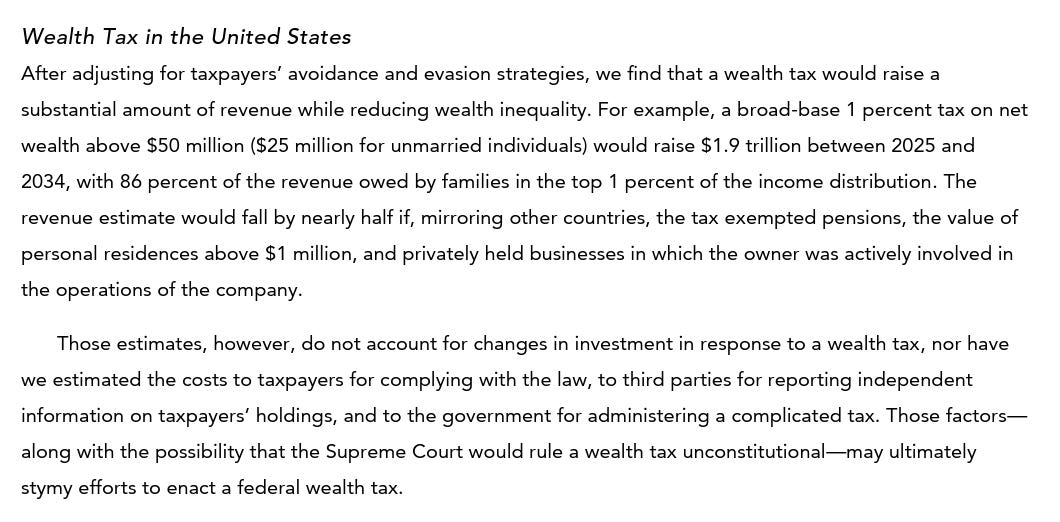
Now comes the fun part: many of these ideas sound great on paper, but in practice, they often produce some very undesirable outcomes. Before discussing any of those, let’s actually quantify the perfect scenario.
Let’s assume the ultra-rich have no access to tax loopholes and cannot leave the country before paying the tax, at least for the first year.
How much money would the government collect from this tax under those conditions?
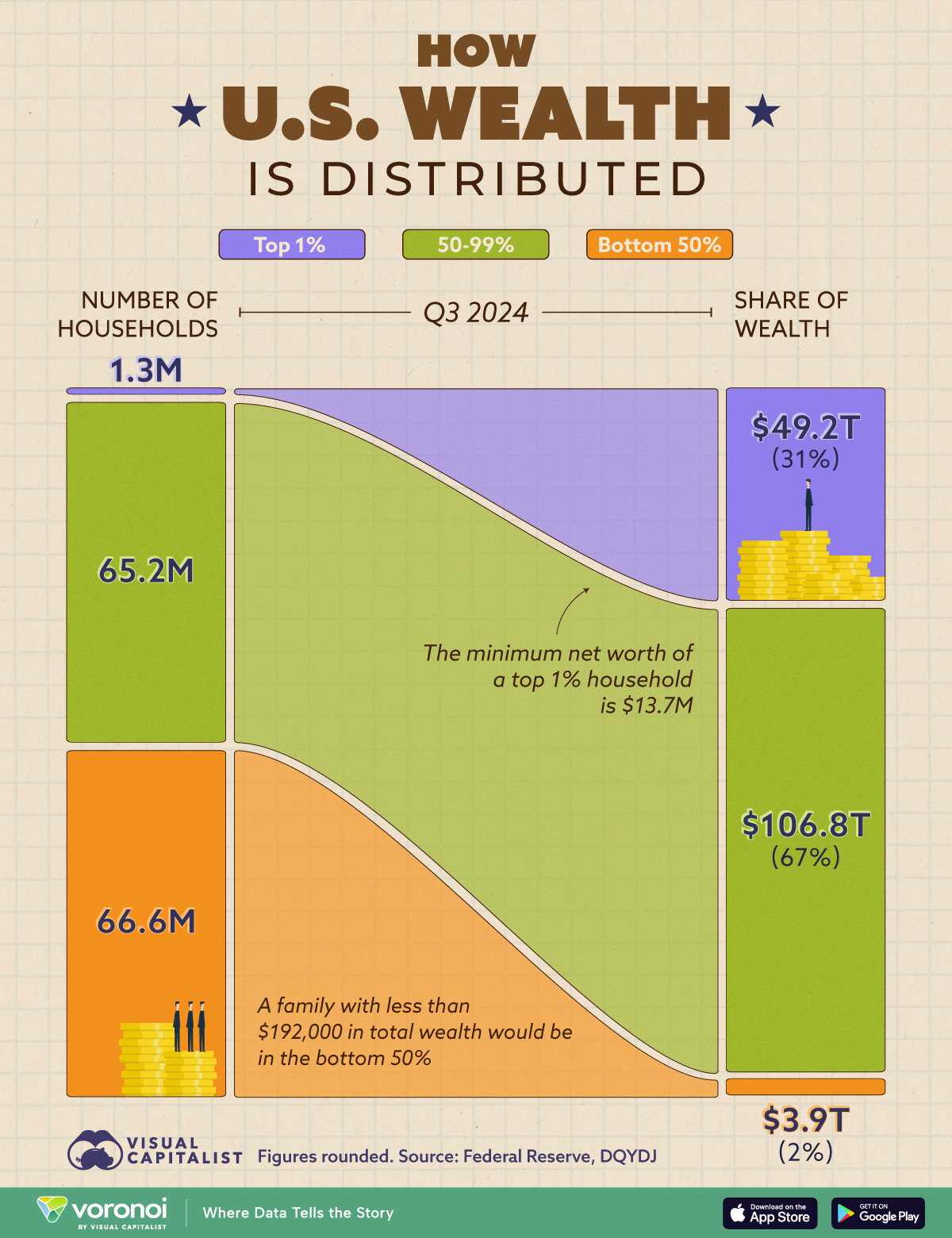
You can run through a few numbers. The total U.S. household wealth is around $160 trillion. Of that, about $156 trillion is held by the top 50%, and roughly $50 trillion is concentrated in the top 1%.
Assuming a 1% tax on high-net-worth individuals, we arrive at estimated revenues of $160–220 billion for 2025.
Here’s a detailed breakdown of the experiment:
The government budget for FY2025 is $7.01 trillion.
Taking the upper end of our perfect-scenario estimate, the wealth tax would add roughly 3% to the total budget. This, of course, assumes everything goes smoothly, without accounting for any of the downsides.
This quick calculation is intended to put the scale of what we’re discussing into perspective.
Yes, the figure sounds large in billions, but in the context of the federal budget, it’s relatively small.
And we haven’t even touched on how that money would be spent.
The State and Progress
For some not-so-random reason, human progress is often equated with the progress of the state. It’s not like there’s a permanent marketing campaign behind that or anything 😉. (Yes, that’s irony.)
This is a recurring theme. The state tends to associate positive developments with itself.
Take modern medicine, for example. It’s often credited to public funding, and to be fair, that’s largely true.
Roughly 3 out of every 4 genuinely useful drugs are subsidized in some way by the government: through grants, public universities, or direct research funding.
But… what makes it all work so well is not really the funding. It’s the engine of capitalism behind it.
Think about it:
Tools and technology have become exponentially more advanced, and are now produced cheaply at a massive scale.
We’ve industrialized the education of skilled, specialized minds, aka a mass production of alphabetized intellectuals.
And there’s relentless competition to discover the top molecules and treatments… between companies, research teams, and even nations.
This permanent race, this scale, is only possible through capital leverage. And that’s what capitalism really is: the use of assets, financed through capital, to expand productivity.
The question we ask ourselves is: what’s the core driver?
Would the system still function without capital leverage? Or without government?
To be perfectly honest, it depends.
In some places, without government, you get nothing… or worse.
But in most cases, the fundamental enabling force is the ability to leverage capital. That’s the real multiplier. That’s what makes the system work.
Origins
Proto‑capitalism is often associated with the Renaissance (1500s), but the real inflection point comes with the Industrial Revolution, when the use of capital truly drove productivity to expand exponentially.
So we’re talking roughly the 1800s.
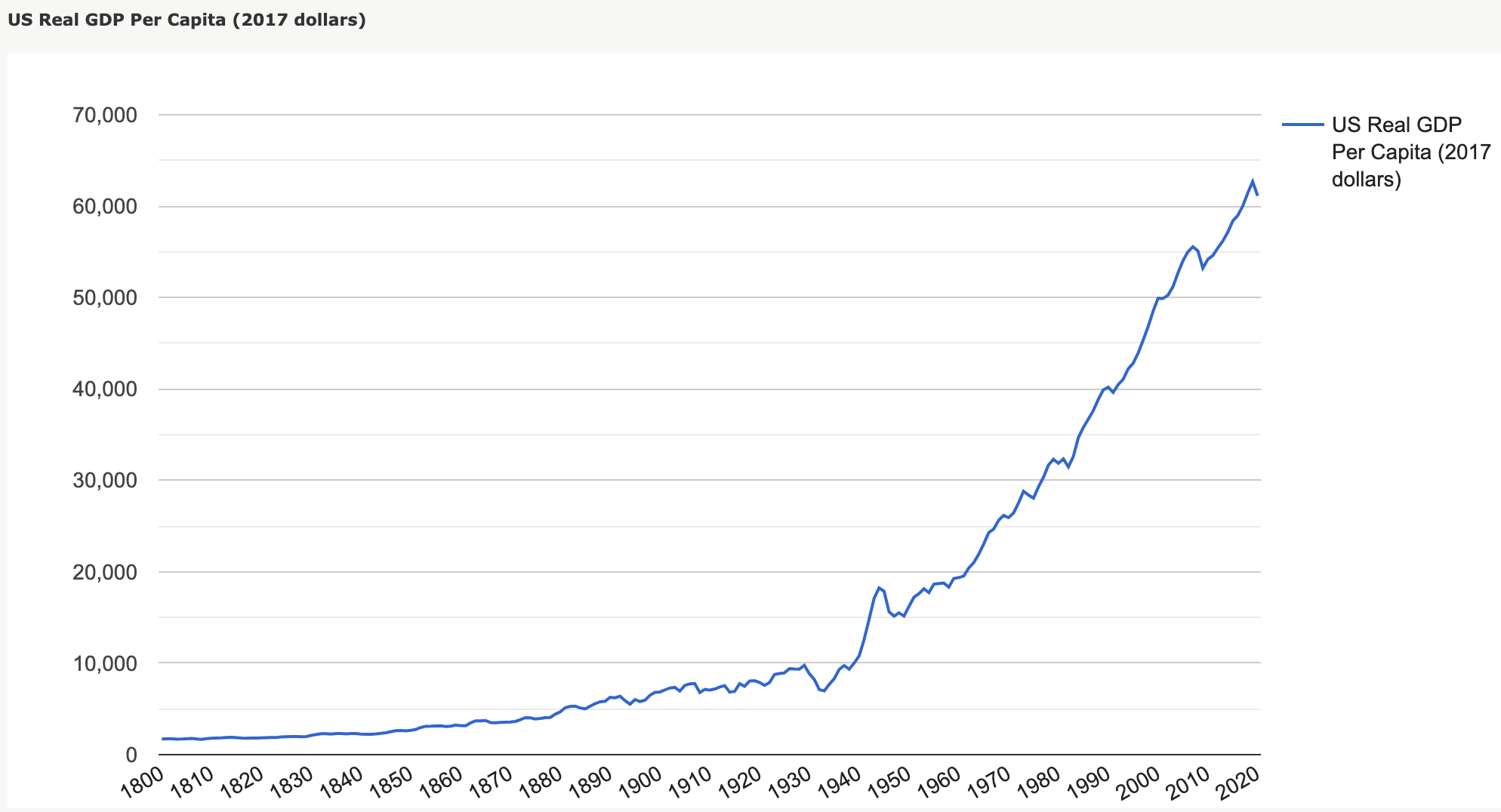
Note: All of our data comes from measuringworth.com (1800-1947) and fred.stlouisfed.org (1947-2020)
Source: Measuring Wealth
From the 1800s to about 1950, you see massive exponential growth. This is clearly visible in the rise of real GDP per capita (wealth per person adjusted for inflation).
But starting in the 1970s, the rate of growth began to decline, marking a clear slowdown compared to previous decades.
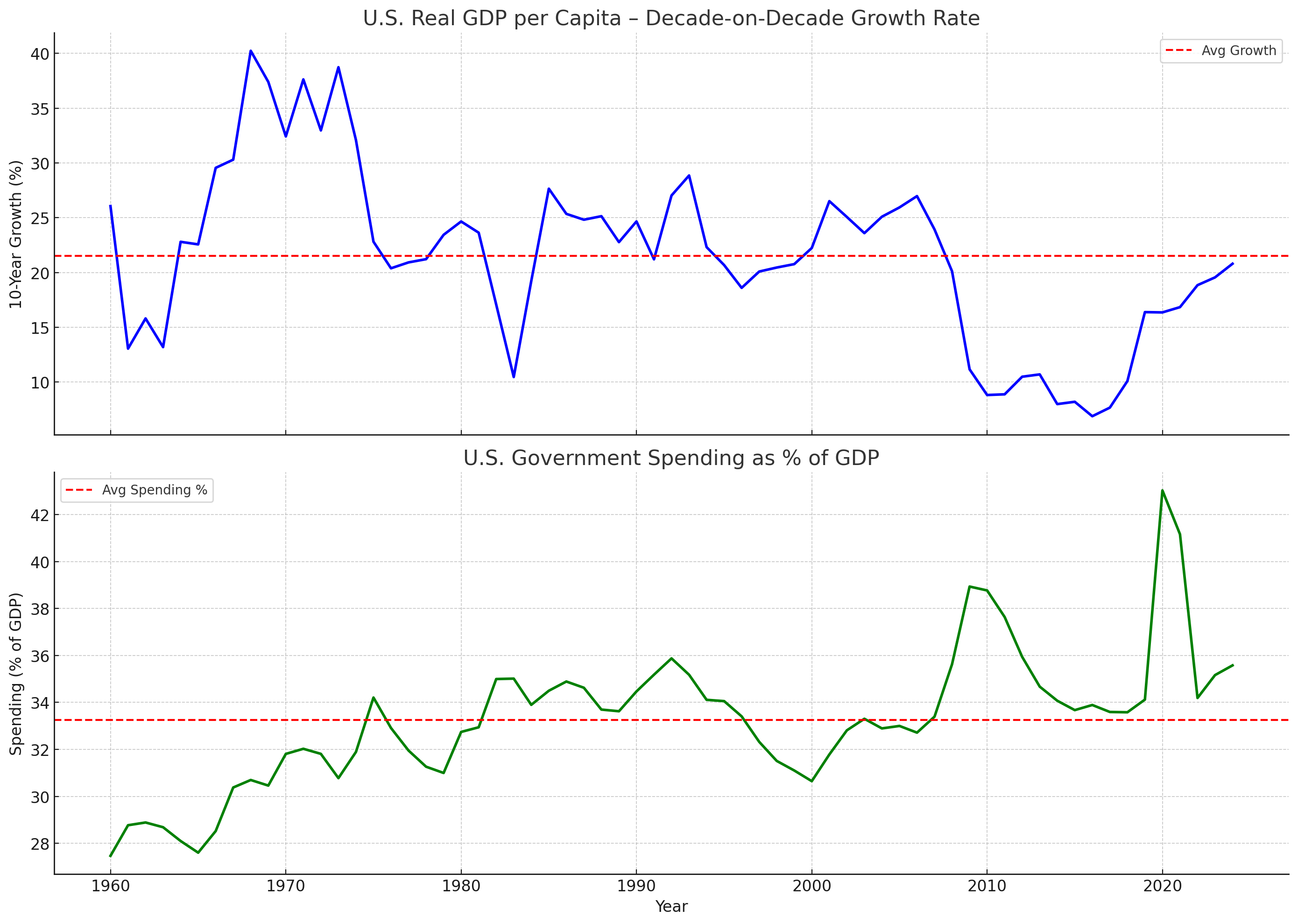
Source: FRED data
At the same time, the size of the state grows dramatically, from around 10% of GDP worldwide in the 1920s to roughly 30% worldwide by the 1950s. In our estimation, this expansion leads to increasing dependence on the welfare of the state (not to be confused with welfare programs).
Why? Because as the state grows, any reduction in government spending has a much larger impact on the broader economy.
For example, a 10% drop in US government spending in the 1920s might have caused a -1% decrease in GDP. By the 1970s, that same drop would translate into a -3% contraction.
And as the state’s share of US GDP exceeds 30% in the 1970s, what we observe is a steady decline in the rate of economic growth thereafter.
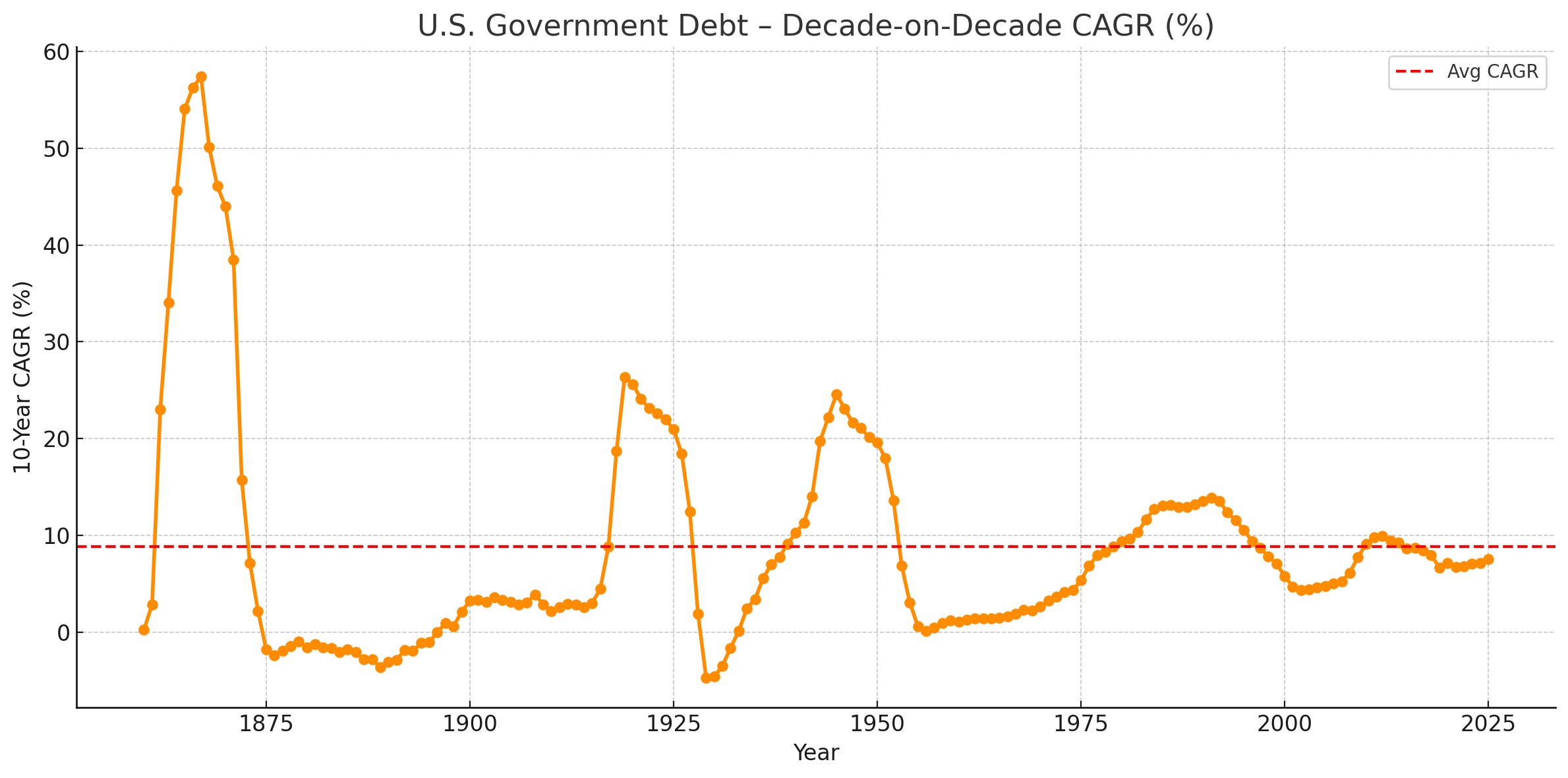
From that point on, the only fuel left was budget deficits. Whenever there’s a large bump in government spending, we typically see a lagged short-term boost in GDP per capita.
Source: Measuring Wealth data
Before the Second World War, these spending surges had little tangible impact on the average citizen. But as the government grew to represent a larger share of the economy, it’s gradually become the defining variable.
If you run the same analysis for France, the effect is even more pronounced.
To put it in perspective: while government spending in the U.S. accounts for around 36% of GDP, in France it’s closer to 59%. That difference dramatically magnifies the state’s influence on growth dynamics.
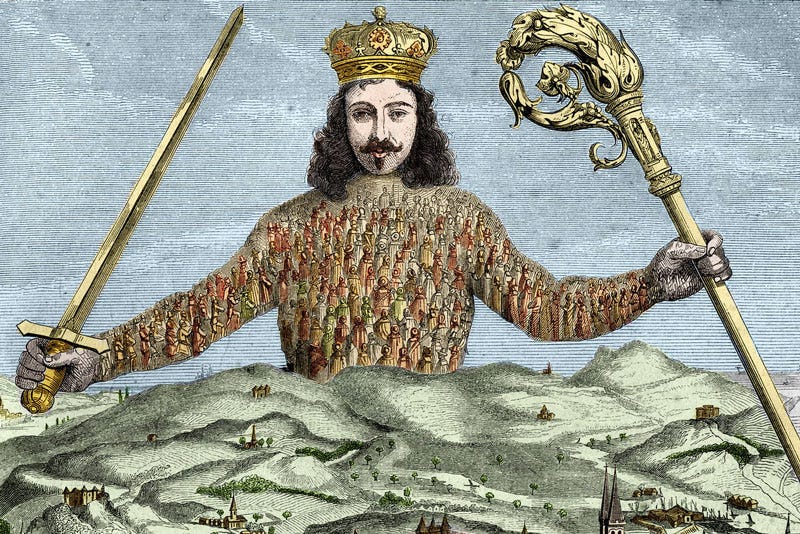
A depiction of the all powerful ruler
Infinite Competence
So far, we’ve only looked at the revenue side. More precisely, at the aggregate revenue and spending.
But the real story begins when we start breaking down competencies.
As Thomas Hobbes wrote in Leviathan, the state is a finely tuned machine, always ready to absorb every possible function it can. It gradually extends its reach into nearly every aspect of a citizen’s life.
The question we have to ask ourselves is: Does this make us better off?
Breakdown
Once again, we’ll focus on U.S. data, using 2024A (actual) and 2025B (budgeted).
Both are directly from the government’s own Congressional Budget Office (so, pretty official data).
Keep in mind that if we looked at any of the large European states, spending would lean even more heavily toward discretionary and mandatory subsidies (and entitlement programs).
Spending roughly breaks down to:
[22%] 🧓 Social Security. The largest single program, essentially mandatory payments to retirees
[16%] 🏥 Medicare & Health‑Related Mandatory. Includes Medicare, Medicaid, and other health-related entitlements
[16%] 📑 Other Mandatory Spending. Covers additional entitlements and mandatory programs not listed individually
If we look at the income side, revenue roughly breaks down to total Federal revenues of $4.9bn in 2024:
[49%]🧍♂️ Individual Income Taxes. The largest source of federal revenue. These are taxes paid directly by individuals on wages, salaries, investments, and other personal income
[35%] 📋 Payroll Taxes. Collected primarily to fund Social Security and Medicare. These are shared between employees and employers and deducted directly from paychecks
[11%] 🏢 Corporate Income Taxes. Taxes on profits earned by corporations. This includes both domestic and foreign earnings of U.S. companies
[2%] 📦 Customs Duties. Taxes on imported goods. These are tariffs imposed on foreign products entering the U.S.
[2%] ⛽ Excise Taxes. Targeted taxes on specific goods like gasoline, alcohol, tobacco, and airline tickets. Often used to fund related infrastructure (e.g., highways)
[2%] Other. A mix of miscellaneous sources, such as estate taxes, Federal Reserve earnings, and fees collected by federal agencies
As we now know, Trump’s premise is that tariffs should boost tax revenue, allowing income taxes to come down with no taxes on tips, overtime, etc.
That’s the theory.
In practice, though, it’s clear that replacing certain tax streams is extremely difficult simply due to their sheer scale. Now consider the 3% bump from a generalized 1% wealth tax… it just wouldn’t move the needle.
In fact, we’d need a 5% wealth tax (that’s five times larger) to cover the interest on the debt alone.
Diagnosis
All of this information serves one purpose: to diagnose where things went wrong.
We acknowledge that inequality is a significant issue, particularly the poverty side of things, aka when it impacts fundamental necessities such as food, shelter, and clothing. That is deeply concerning.
What we are saying is that there’s one major actor distorting progress, hindering broad-based prosperity, and (perhaps most dangerously) cultivating a citizenry that can no longer tell whether they’re the slaves or the slavers.
Perhaps what we really need is to let go of the idea that there’s a benevolent superintendent we must call “father” looking after us (Yes, we’re still talking about the government).
Sure, a small portion (maybe 1–2% of the population) will always be defenseless and deserve and require our support.
But that cannot be the case for over 50% of a population that no longer understands what “free X” really means (substitute X with housing, healthcare, education, etc.).
Nothing is free.
We’ve rambled on long enough. So… we’ll make this a two-part series.
Next week, we’ll dive into: What would a perfect state actually look like?
Just arrived here from a Notes repost, so doing the same.
This is great "economic baseline" reading - and I agree with all of the findings here.
I am doing something a bit more wide right now & calling it the "Goin' Bananas" series. Check it out if you have a min. Trying to work this from the "ground up" even further down to the essentials as in "asset values" and as you state, inflation as the key issue that is being dismissed in most of Keynesian's modern followers. Piketti has perfected this MMT think - as in Modern Monetary Theory and "debt is not an issue because it grows the economy..."
First part is here (part 4 goes live this Friday) - more to come on the same context, free for all.









Great post. Thx for sharing Ale! 🤯🤯
Just arrived here from a Notes repost, so doing the same.
This is great "economic baseline" reading - and I agree with all of the findings here.
I am doing something a bit more wide right now & calling it the "Goin' Bananas" series. Check it out if you have a min. Trying to work this from the "ground up" even further down to the essentials as in "asset values" and as you state, inflation as the key issue that is being dismissed in most of Keynesian's modern followers. Piketti has perfected this MMT think - as in Modern Monetary Theory and "debt is not an issue because it grows the economy..."
First part is here (part 4 goes live this Friday) - more to come on the same context, free for all.
https://funstack.substack.com/p/is-everyone-going-bananas