


Here are six fat pitches going your way.
Note that we would only pick the last company in this list with the information we have, and that’ll be reflected in the table below (for future posts).
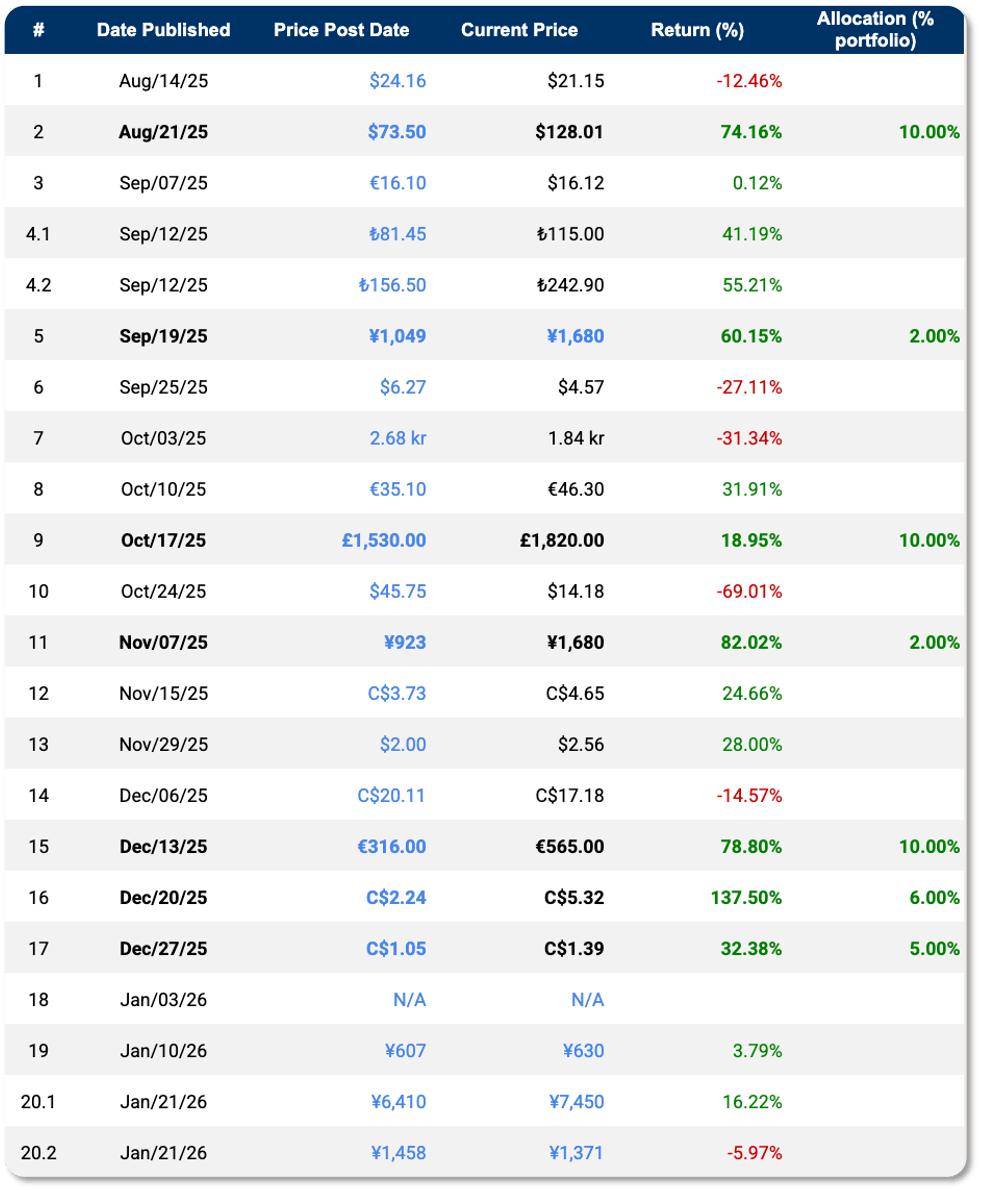
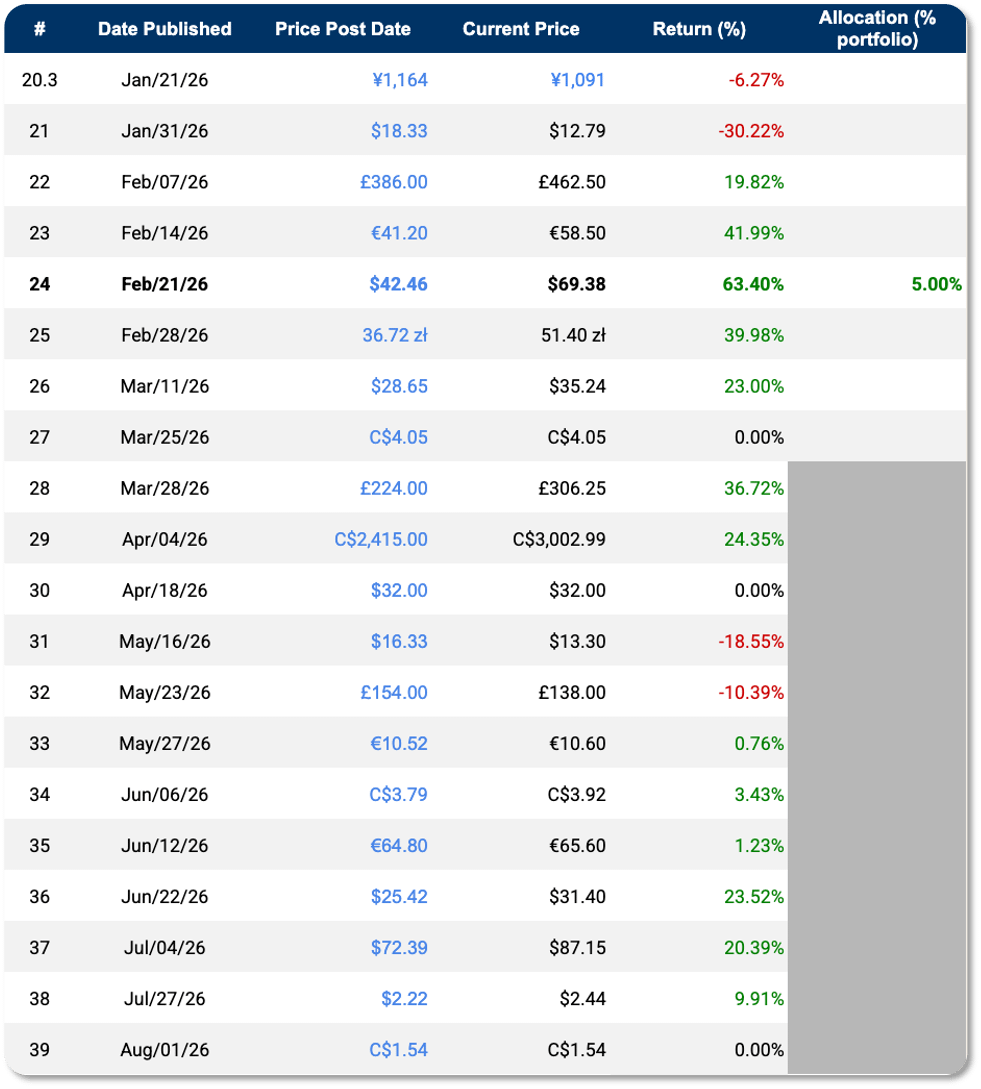
As we now do every week for transparency and to provide full value, here is our list of Pick of the Week posts and their returns since publishing:
All picks (equally weighted): +18.72%
Our picks (executed): +30.82%

Pick of the Week. A curated series of high-conviction research on companies currently under our microscope. We screen for specific dislocations where the market has mispriced the balance sheet or earnings power.
None of the following should be construed as investment advice. Please consult a financial advisor before making any investment decision. You will find a full disclaimer at the end of this post.

⛏️ Golconda Gold ($GG)
⭐ Overall Grade: 7.5 / 10
Golconda operates as a low-cost micro-cap gold producer. Unlike traditional gold miners that build expensive on-site processing facilities (like CIL or BIOX circuits) to turn gold into bullion bars, Golconda circumvents massive capex through the following concentrate model.
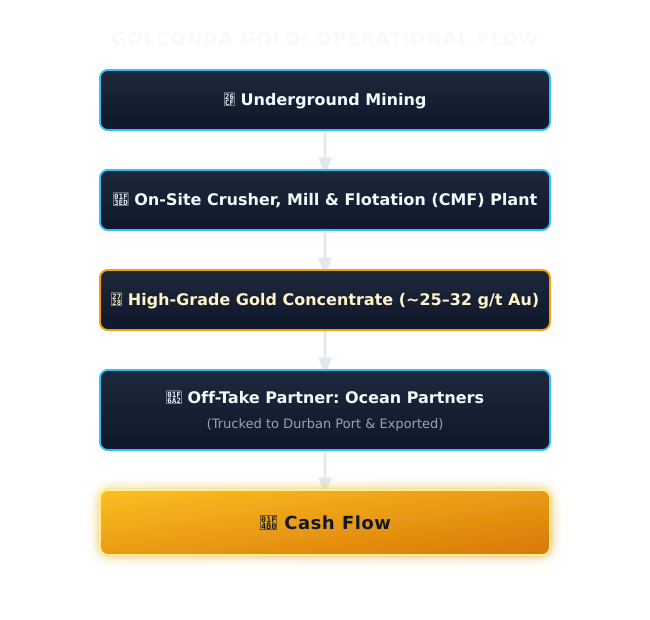
This is how it works:
Extraction & Underground Mining. They mine ore underground from their flagship Galaxy Gold Mine along the Barberton Greenstone Belt in South Africa.
(On-Site) Processing. The raw ore goes through an existing 50,000-tonne-per-month Crusher, Milling, and Flotation (CMF) plant to extract gold into a concentrated slurry.
Monetization: Instead of processing gold to 99.9% purity on-site using high-capex chemical processing (like Bio-Oxidation), they produce a heavy concentrate. This concentrate is sold directly to Ocean Partners under a multi-year off-take agreement, which ships it globally to smelters.
Unit Economics & Operational Breakdown
Golconda’s unit economics show pretty decent cash flow conversion, mainly driven by high gold prices. Whether this is temporary or a permanent feature is up to you to decide.
Key Production Metrics (Galaxy Mine, South Africa)
Throughput is ramping up from 15,000 to ~40,000-45,000 tonnes per month.
Their Grade averages 2.8 to 3.5 g/t Au across the core underground ore bodies (Galaxy, Princeton, Giles, and Woodbine).
Their output is made up of ~20,000-25,000 payable oz/year near-term, expected to ramp up toward ~40,000-45,000 oz/year at steady state.
Cost Structure & Margins (Q1 2026 Financial Results)
Realized Gold Price: ~$3,869 per contained oz ($5,025 per payable oz).
Operating Cash Cost: ~$1,819 per payable oz (excluding royalties).
Operating cash flows shift heavily to bottom-line net income at prevailing gold prices. In Q1 2026 alone, Golconda generated $13.85m in revenue and $5.53m in net earnings.
As of Q1 2026, Golconda paid off its remaining term loan, leaving the company 100% debt-free with $5.89m in cash.
Competitive Advantages & Moats
Low Capex / High Capital Efficiency
By electing to produce and ship a high-grade flotation concentrate rather than building an on-site refractory bio-leaching plant (BIOX®), Golconda bypassed $40m–$60m in upfront capital expenditure.
They upgraded their entire Galaxy processing plant capacity to 50,000 tonnes/month for a total investment of ~$4m.
High Insider Ownership & Alignment
Management and insiders own over 42% of the (basic) share float (with total related-party control >45%).
CEO Ravi Sood and the executive team treat dilution as a cardinal sin, opting to fund all plant expansions, underground development, and US asset restarts out of organic cash flow rather than dilutive equity raises.
Fully Permitted Infrastructure Moat (Summit Mine, USA)
Building a brand-new underground mine and processing mill in the United States requires 7–10 years of environmental reviews and permitting battles.
Golconda’s Summit Mine and Banner Mill in New Mexico are already 100% permitted with past-producer infrastructure in place. This drastically cuts time-to-market and capital cost for their US expansion.
Strategic Geopolitical & Jurisdictional Diversification
By operating the Galaxy Mine in South Africa and restarting the Summit Mine in New Mexico, the business shifts from a single-jurisdiction emerging market player to a multi-asset producer with North American precious metals exposure (adding both gold and silver stream revenues).
🎯 Catalysts: Why Now?
Summit Mine Commercial Restart
Mining contractor High Desert Mining LLC mobilized to the Summit Mine in New Mexico, delivering first underground ore to surface. Wet commissioning of the fully permitted Banner Mill and initial concentrate production are anticipated.
This event transitions Golconda from a single-asset operator into a multi-jurisdictional producer, adding a Tier-1 US asset alongside a precious metals stream that includes significant silver exposure (~6.5m oz Ag resource base).
Galaxy Fleet Enhancement and Production Ramp-Up
Golconda took delivery of a standardized underground mining fleet, including a new drill rig, loaders, and dump trucks, to accelerate development and waste movement across the Galaxy and Princeton ore bodies.
This fleet upgrade, combined with new access at the Galaxy 26 Level, allows the company to ramp up ore throughput to utilize the remaining capacity of its 50,000 tonne-per-month ball mill circuit with minimal additional processing capital expenditure.
Summit Standalone US Spin-Out
Golconda plans to execute a corporate spin-out of the fully permitted Summit Gold & Silver Mine into an independent, publicly listed US entity.
Unbundling the North American operations creates a pure-play US precious metals vehicle, allowing the market to value the asset at higher North American valuation multiples while returning equity directly to existing shareholders.
Free Cash Flow Allocation and Capital Returns
Following the complete repayment of its corporate term loan facility, Golconda is operating debt-free with expanding operating cash flows.
As capital expenditures for the Summit restart stabilize, management’s stated capital allocation strategy focuses on deploying excess organic free cash flow toward direct shareholder returns through share buybacks or dividends.
💰 What’s It Worth?
Bear Case [C$3.37]
The Bear Case models a stressed operational environment where key assumptions go against the company, serving as an ideological safety net. Under this setup, spot gold prices pull back significantly to $2,200/oz, and the company experiences minor underground operational bottlenecks in South Africa that limit production rates.
Furthermore, the restart of the Summit mine in the US faces delays or higher operating costs, preventing it from contributing significant cash flow in the short term.
To reflect these added operational and geopolitical risks, a harsher 11.5% discount rate and a 20% risk haircut are applied to the business, assuming zero long-term growth beyond its current mine life.
Base Case [C$7.51] (+243% Upside)
The Base Case assumes that Golconda Gold executes its business plan smoothly without any major operational or macroeconomic hiccups. In this environment, gold prices remain strong (averaging around $2,700–$2,800/oz), allowing the company to generate predictable, high-margin cash flow.
Operationally, the South African Galaxy mine steadily expands its output, while the fully permitted Summit mine in New Mexico re-opens on schedule in late 2026, transforming Golconda into a multi-mine producer with added silver revenues.
Because the business carries zero debt and generates reliable organic cash flow, management can eventually distribute cash back to investors through share buybacks or dividends.
Taking all expected future cash flows over the next 10 years, discounting them back to today's dollars at an 8.5% rate, and accounting for a mild 15% country risk discount, the company’s underlying business is worth C$7.51 per share
At a long-term gold price of $4,000/oz and silver price of $75/oz, the corporate Net Asset Value Per Share (NAVPS) is listed as C$8.71.
🛍️ EMERGE Commerce ($ECOM)
⭐ Overall Grade: 6.5 / 10
EMERGE Commerce operates as a consolidated acquirer and operator of profitable, niche e-commerce brands and B2B software assets across North America.
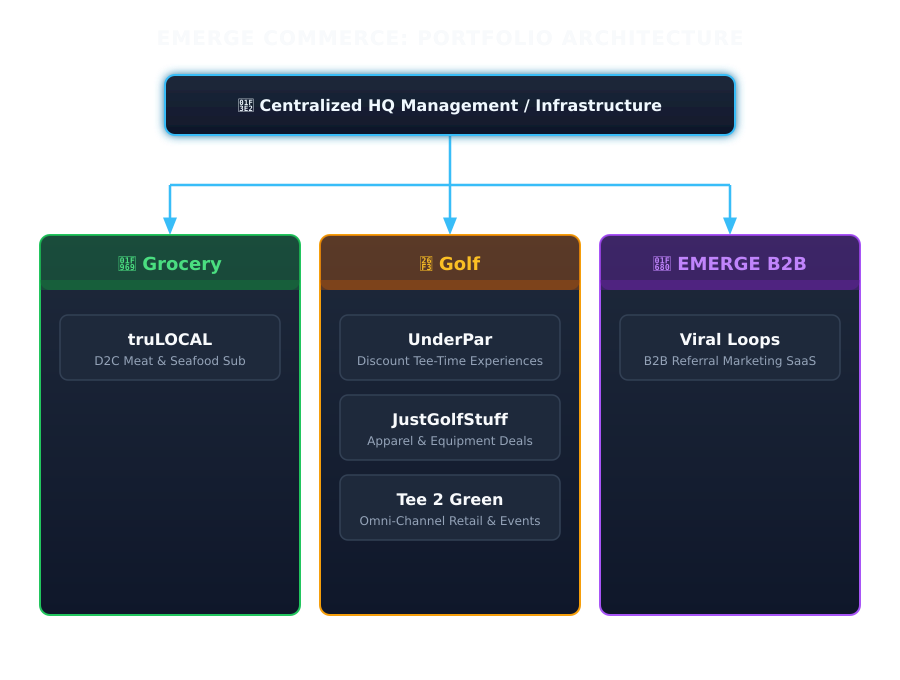
Following a multi-year restructuring (moving from “ECOM 1.0” aggressive leverage to “ECOM 3.0” lean, profitable ops), EMERGE abandoned the generic Amazon aggregator model to focus deeply on three core verticals:
D2C Grocery & Food Tech
EMERGE Commerce anchors its direct-to-consumer grocery vertical around truLOCAL.ca, Canada’s market leader in direct-to-consumer local meat and seafood subscriptions.
The segment operates as a predictable revenue engine powered by monthly subscription fees paid by loyal members for curated, locally sourced food boxes delivered straight to their doorstep.
Golf Products, Experiences & Omni-Channel Retail
The company's North American golf vertical combines three distinct assets: UnderPar.com (a leading marketplace for discounted golf tee-time experiences), JustGolfStuff.ca (a high-growth discount golf apparel and equipment e-commerce platform), and Tee 2 Green (T2G) (a 38-year-old golf retailer operating physical stores, roadshow events, and digital storefronts).
Together, these brands generate pretty diversified income through direct retail sales of golf apparel and equipment, marketplace commissions on golf course vouchers, and physical retail and pop-up roadshow events across key golf regions.
B2B Software / E-Commerce Enablement
EMERGE expanded its ecosystem into B2B e-commerce enablement through its acquisition of Viral Loops in March 2026 for approximately C$2.3m at an attractive ~2.9x EBITDA multiple.
This business unit monetizes through high-margin (~86% gross margin) recurring SaaS subscriptions sold to global B2B clients who utilize the platform to run viral referral marketing, contest campaigns, and brand waitlists.
Unit Economics
We have to look at EMERGE’s unit economics as understanding customer retention metrics and profitable acquisition is a must:
truLOCAL (Grocery Engine) Unit Economics
Customer Lifetime Value (CLTV): ~$2,027 per subscriber.
Customer Acquisition Cost (CAC): ~$100–$150 per new customer.
CLTV-to-CAC Ratio: Outstanding ~13x to 20x ratio (anything above 3x is considered strong in e-commerce).
Breakeven Horizon: Replaces acquisition costs in ~2 subscription boxes.
Retention: ~90% of revenue comes from returning subscription customers.
Average Order Value (AOV): ~$250 per box.
Competitive Advantages & Moats
Deep Vertical Integration & Shared Audience Synergies
Rather than owning disconnected niche sites, EMERGE aggregates complementary assets within specific niches. For instance, their golf portfolio commands a combined database of over 400,000 active golfers.
When they acquired Tee 2 Green (T2G), they cross-promoted roadshows and products across their 400k-member golf ecosystem, accelerating T2G’s revenue growth rate from 3% to over 30% YoY.
Proprietary In-House B2B Software Engine
By acquiring Viral Loops, EMERGE integrated a B2B referral marketing engine directly into its consumer brands.
They run customer referral programs and contest campaigns across truLOCAL and JustGolfStuff without paying third-party SaaS fees, simultaneously lowering overall CAC across the entire portfolio.
Hyper-Disciplined “Boring is Brilliant” Acquisition M&A
Following the collapse of high-leverage e-commerce aggregators, EMERGE enforces strict M&A underwriting hurdles:
Target acquisitions must be bought at 1.0x to 3.0x EBITDA (e.g., T2G bought at ~2.2x EBITDA; Viral Loops at ~2.9x EBITDA).
Structure deals with multi-year earnouts and extended vendor inventory payment plans, allowing acquisitions to pay for themselves out of operating cash flows within 90–120 days.
Macro Tailwinds (”Buy Local” + Value-Seeking Consumers)
truLOCAL benefits from structural shifts toward Canadian-sourced, local food supply chains (”Buy Canadian” movement).
UnderPar and JustGolfStuff operate discount marketplaces, making them counter-cyclical benefactors when economic belt-tightening pushes consumers toward deal-hunting.
🎯 Catalysts: Why Now?
Senior Debt Refinancing and Interest Expense Reduction
EMERGE extended the maturity of its senior credit facility to October 2027 while bringing total debt down from $25m originally to $5.85m.
However, the facility carries a variable interest rate of 11% (TD Prime + 6.55%). Operating on a TTM of over $2m in adj EBITDA and growing cash balances ($4.8m as of Q2 2026), management is actively engaging Canadian financial institutions to refinance the facility at lower rates.
Securing a standard commercial rate (targeted savings of 3% to 5%) would immediately drop between C$180k and C$300k directly to free cash flow.
Full Year Integration of High-Margin B2B SaaS (Viral Loops)
The acquisition of Viral Loops for C$2.3m introduced EMERGE’s first recurring B2B technology vertical. Viral Loops brings approximately $1.3m in annual revenue, 86% gross margins, and $800k in adj EBITDA with near-zero capital expenditure requirements.
The inclusion of a full 12 months of Viral Loops results through late 2026 and 2027 will obviously expand EMERGE’s gross margins, reduce quarterly revenue seasonality across the broader portfolio, and accelerate (organic) customer acquisition across its core direct-to-consumer grocery and golf brands.
Organic Scaling and Cross-Selling Across the Golf Ecosystem
Following the acquisition of Tee 2 Green (T2G), EMERGE expanded its golf portfolio across UnderPar, JustGolfStuff, and T2G, establishing an audience network of over 400k active North American golfers.
By leveraging its digital marketing playbook and cross-promoting T2G’s physical retail roadshows across its digital subscriber base, EMERGE accelerated T2G’s organic growth rate from 3% to over 30% in its first year.
Continued operational optimization, expansion of pop-up retail events, and shipping cost reductions across the combined golf portfolio provide a high-margin organic growth runway through the 2026 and 2027 peak golf seasons.
Disciplined M&A Deployment in the ECOM 3.0 Pipeline
Under its updated M&A underwriting strategy, EMERGE targets small, cash-flow-positive consumer and tech assets priced between 1.0x and 3.0x EBITDA, using seller earn-outs and inventory payment plans to minimize upfront cash outlays.
Management maintains an active deal pipeline of targets generating between $700k and $2m in individual EBITDA.
Executing one or two bolt-on acquisitions in adjacent food-tech, golf, or B2B SaaS verticals over the next 12 to 24 months (funded organically) will compound overall portfolio EBITDA while lowering leverage multiples.
💰 What’s It Worth?
Bear Case [C$0.07]
Under the Bear Case, organic growth flatlines across the D2C portfolio as consumers pull back on discretionary golf spending and local meat subscriptions. While the company remains operating cash flow positive thanks to cost cuts made during its restructuring, it fails to execute additional accretive M&A deals.
Because market conditions remain tight, EMERGE is forced to keep its high-interest debt facility in place for longer, eating up cash that would otherwise go to shareholders or new acquisitions.
The stock remains largely trapped in its current penny-stock trading range, valued strictly as a slow-growth micro-cap.
Base Case [C$0.25] (+194% Upside)
Under the Base Case, EMERGE’s "ECOM 3.0" playbook works exactly as designed. The company generates steady, highly cash-generative revenues from truLOCAL subscriptions and discount golf sales, while using the software acquired via Viral Loops to keep customer acquisition costs low.
Crucially, as the company proves its financial health by delivering $3m–$4m in annual operating cash flows, Canadian banks agree to refinance its expensive debt, cutting interest payments significantly.
The market stops viewing EMERGE as an over-leveraged micro-cap startup and re-rates it as a durable, profitable compounder trading at a reasonable 8x–10x cash flow multiple.
🛢️ PHX Energy Services ($PHX)
⭐ Overall Grade: 8.0 / 10
Longtime readers will recognize this name… we’ve highlighted them before
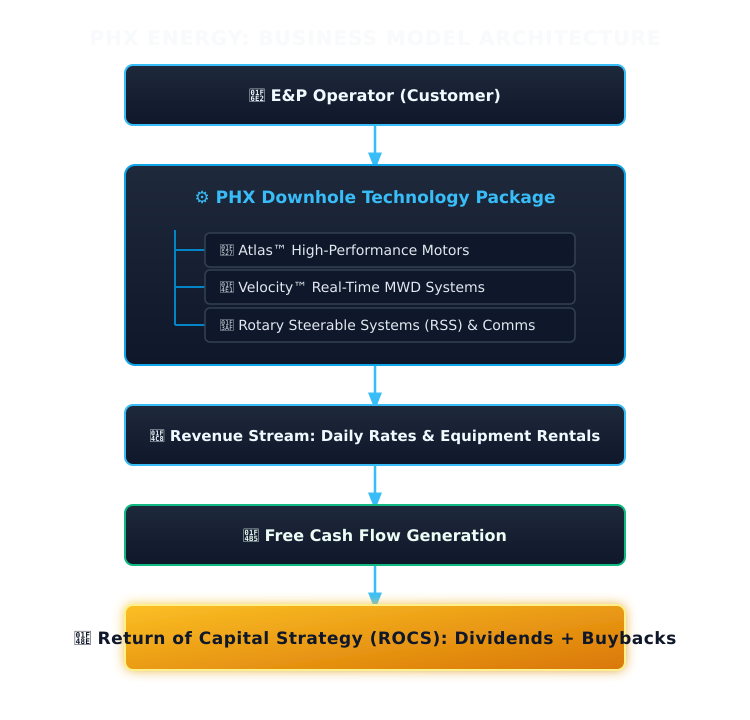
PHX Energy Services is North America’s largest independent provider of horizontal and directional drilling services and downhole technologies. Rather than owning or operating heavy surface drilling rigs, PHX operates a high-margin, equipment-light ‘picks and shovels’ rental model.
When oil and gas producers (E&Ps) drill modern horizontal wells, they require precise guidance systems and downhole power to steer the drill bit miles underground and horizontally along targeted rock formations.
PHX engineers, manufactures, and rents specialized downhole technology packages to E&Ps across major North American basins… most notably the Permian Basin (which accounts for ~85% of its US revenue) as well as the Montney, Duvernay, and Bakken.
Primary Revenue Streams
Directional Drilling Services. Represents the vast majority (~93%) of consolidated revenue. E&Ps pay PHX a daily operational rate (Revenue Per Operating Day) for downhole tools paired with technical field personnel on site.
Motor Rentals. Renting proprietary Atlas™ high-performance drilling motors to third parties without requiring full PHX field personnel.
Equipment Sales & Lost-in-Hole Recoveries. Selling motor parts and receiving contractual replacement cost payments from operators when tools are damaged or permanently lost downhole.
Competitive Advantages & Moats
Tier 1 Technology Barrier to Entry
Modern horizontal drilling requires extreme speed and precision. PHX owns a fleet of 962 Atlas™ High-Performance Motors, 127 Velocity™ Real-Time MWD Systems, and 110 Rotary Steerable Systems (RSS).
The massive capital required to build or license this level of technology creates a major barrier to entry for smaller Tier 2 competitors.
Efficiency & Time-to-Depth Advantage
PHX’s proprietary RSS and motor setups enable operators to drill 10,000+ foot lateral wells in ~3.8 days compared to 8.7 days using conventional technology.
Saving E&Ps 5 drilling days per well provides immense pricing power because rig day-rates are expensive.
Vertically Integrated In-House R&D
PHX designs and manufactures its own proprietary downhole tools, allowing them to iterate fast, maintain tight quality control, and protect operating margins against third-party equipment suppliers.
Independent Scale & Customer Base
PHX works for 18 of the top 20 energy producers in North America. Being the largest independent provider allows them to capture ~22% market share in Canada and ~10% in the US without being tied to a single rig operator.
Shareholder-Obsessed ROCS Framework
Under its Return of Capital Strategy (ROCS), PHX targets returning up to 70% of annual excess cash flow directly to investors via base dividends, special dividends, and aggressive share buybacks (retiring ~28% of total share float since 2017).
🎯 Catalysts: Why Now?
Premium RSS Fleet Expansion and Permian Adoption
PHX Energy continues to aggressively expand its Rotary Steerable Systems (RSS) fleet, including the rollout of its 7⅞-inch RSS tools targeted directly at the high-volume Permian Basin.
Operating as the largest independent RSS provider in North America, PHX is seeing high-margin RSS jobs represent an increasing percentage of its overall consolidated activity.
As North American operators drill longer, multi-mile lateral wells, the increased adoption of PHX’s high-spec RSS and proprietary Real-Time RSS Communications technology commands higher daily service rates, driving margin expansion even in a flat rig-count environment.
Atlas Motor Rental Market Share Gains
The expansion of PHX’s standalone Atlas high-performance motor rental division provides a high-margin, capital-light growth runway that scales independently of traditional full-service directional drilling contracts.
By expanding its client base across both US and Canadian basins, PHX is capturing additional market share from producers who manage their own directional operations but require premium downhole power.
Capex dedicated to expanding the Atlas motor fleet generates immediate rental cash flows that stabilize direct operating margins against broader drilling industry volatility.
Aggressive Capital Returns Under the ROCS Framework
Under its Return of Capital Strategy (ROCS), PHX is committed to returning up to 70 percent of annual excess cash flow directly to shareholders.
With capex front-loaded into the first half of the year, net capital spending is projected to taper off, accelerating excess cash flow generation in subsequent quarters.
This structural cash generation provides management with the flexibility to maintain its regular quarterly dividend, distribute opportunistic special dividends, and execute share buybacks under its renewed Normal Course Issuer Bid (NCIB), compounding per-share intrinsic value across a shrinking share count.
💰 What’s It Worth?
Bear Case [C$7.25]
Under the Bear Case, a broader energy downturn forces oil and gas producers to trim drilling budgets, causing rig counts across Texas and Western Canada to fall. Lower daily operating days hit PHX's top line, while persistent inflation on specialized equipment replacement parts erodes profit margins.
While the company's low leverage keeps it fully solvent and operating cash flow positive, excess cash flow dries up enough to force a reduction in special dividends and buybacks.
The market penalizes the stock for its commodity sensitivity, re-rating PHX down to traditional trough oilfield service multiples.
Base Case [C$18.24] (+38% Upside)
Under the Base Case, PHX proves that it isn't just a commodity oilfield service provider tied to overall rig counts, but a technology-driven market share gainer.
As E&P operators push for longer lateral wells in the Permian and Montney, they are forced to hire Tier 1 directional drillers with premium RSS and high-torque motor fleets. Because PHX commands superior daily rates and collects cash reimbursements whenever equipment is damaged downhole, cash flow conversion remains exceptionally high.
Management uses this cash to pay its ~6% dividend, fund growth Capex internally, and buy back its own cheap stock, steadily driving up per-share intrinsic value.
These are some of the most interesting businesses from a previous Vegas edition of the event we attended.

We’re saving up the 3 fattest pitches for our members. Here’s your chance to level up your portfolio with our highest-conviction ideas.