


Going a bit “off-brand” here, but you know how I am:
If I’m using a platform, I have to optimize it.
Funnily enough, I’ve gone down this torturous path three times already.
In 2020, before AI was a thing, I started with LinkedIn…
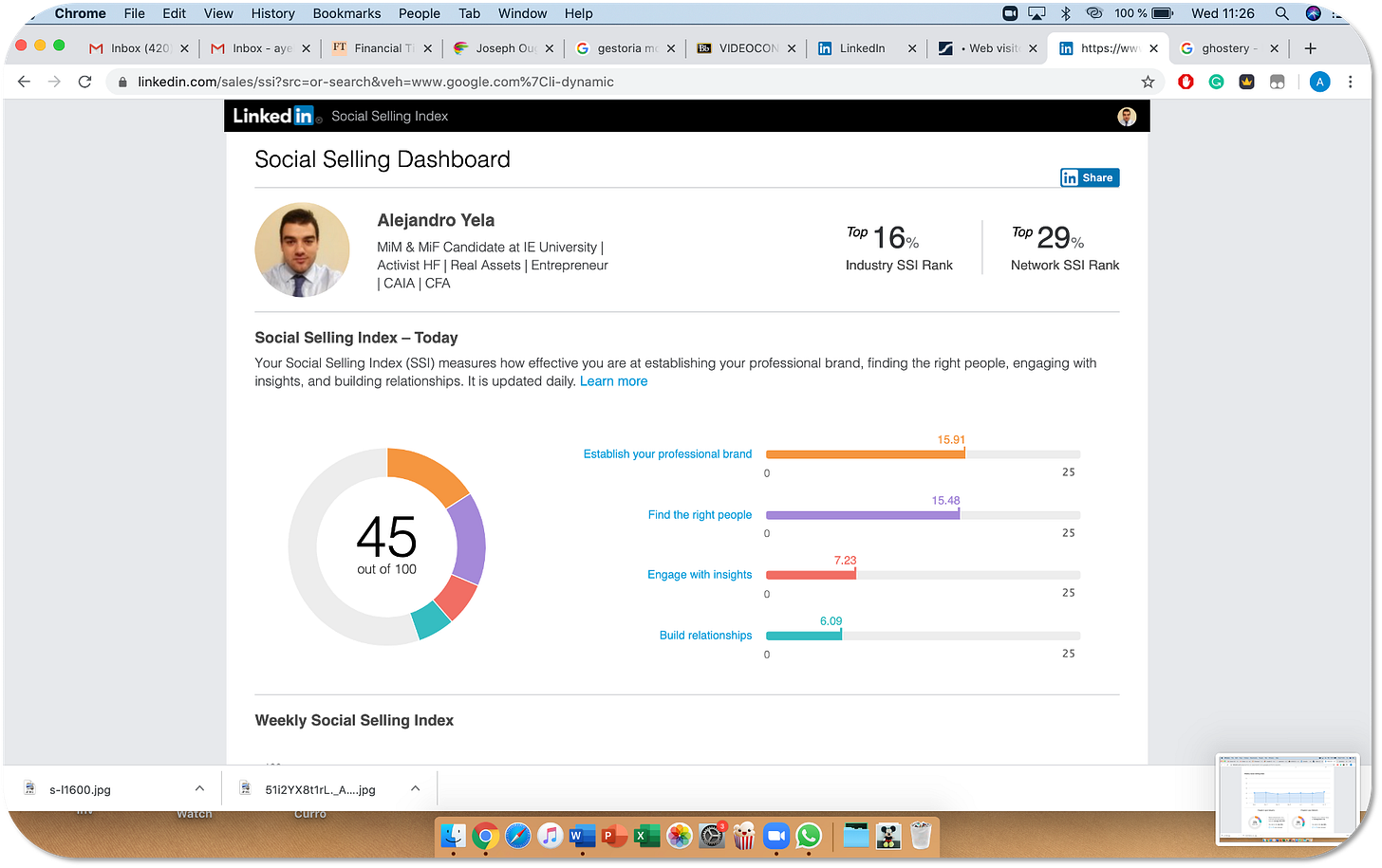
SSI — June 17th, 2020 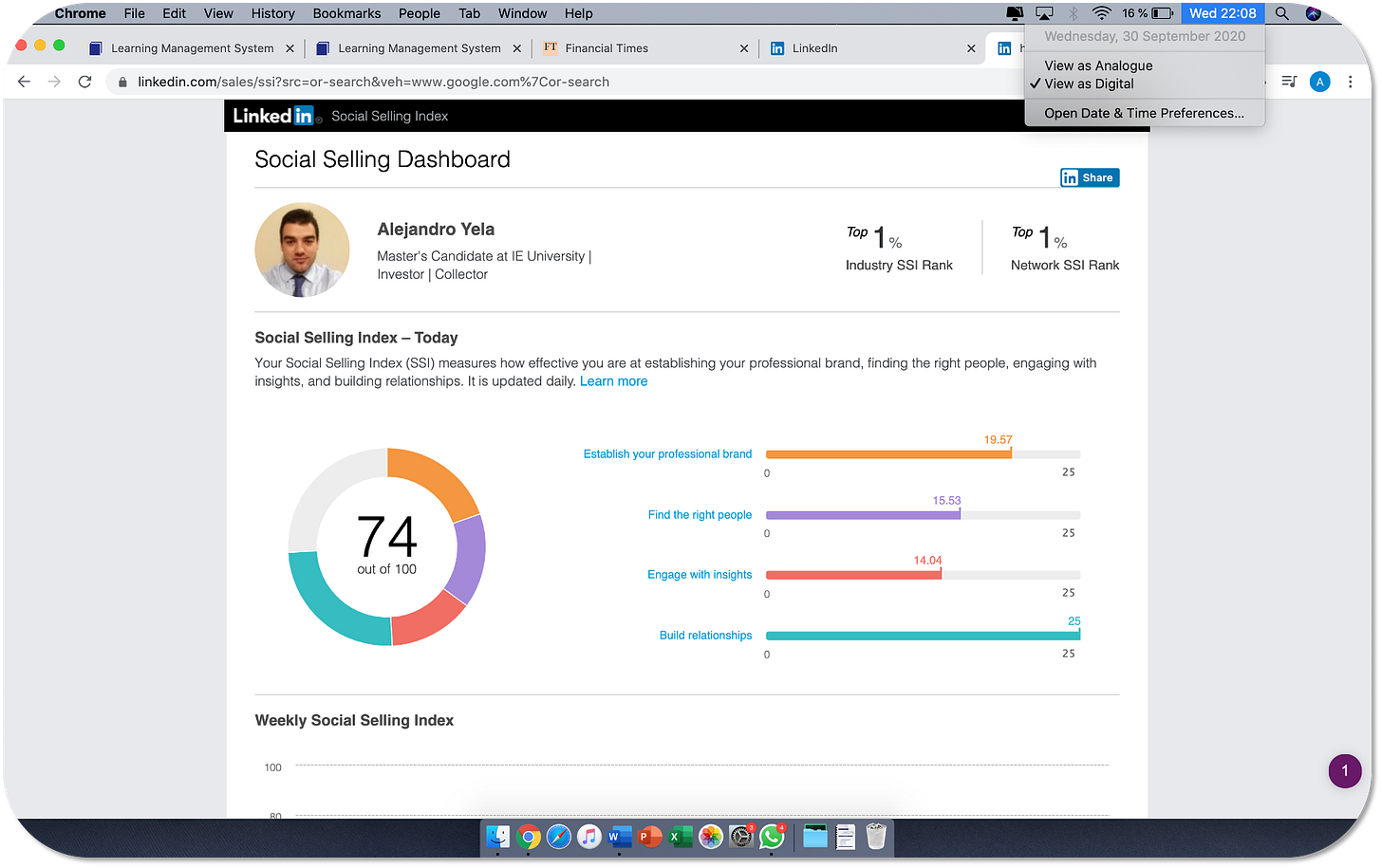
SSI — September 30th, 2020 (profile pic maxxing btw) I did it with Tinder a few years later. (I keep telling my friends I should do a live presentation on this, but I only ever get pushback. I wonder why?)
I won’t be showing that one as getting banned isn’t high on my priority list. But suffice to say, I averaged (receiving) two DMs a day for three months straight once it was fully optimized.
And, as you probably know, I’ve been constantly tweaking Substack since 2023/24.

About a month ago, I decided it was time to tackle Twitter / X.
So, if you want to follow along, here’s what I’ve learned so far and how it’s going.
I’m going to break down the algorithm and what I’ve been testing. Don’t expect an overnight “zero to hero” transformation; I’m committing to at least a 6-month test to see if X is actually a viable discovery engine.
The theory behind this is vetted, but real testing takes time. If you want to see where things stand right now, scroll to the bottom; you’ll find a one-page summary of all of my metrics.

So let’s start with some borrowed knowledge and the basics. I won’t bore you with how it was started in 2006 by a group of smart individuals (Jack Dorsey, Noah Glass, Biz Stone, and Evan Williams) or how it was controversially taken over by none other than Elon Musk a few years ago.

I think we should skip the blah blah and jump right into...
How the Recommendation Pipeline Flows
Every time you pull down to refresh, X takes a pile of ~500m daily posts and shrinks it down to a custom batch (around 1,500), and then ranks them and slaps them on your screen (browser/app) in under 200ms.
The system running the show for this “For You” page is the Phoenix engine.
While it streamlined a lot of the old multi-step pipeline, the core journey hasn’t changed much and is now integrated into Grok (X’s AI).
Here’s how it actually works:
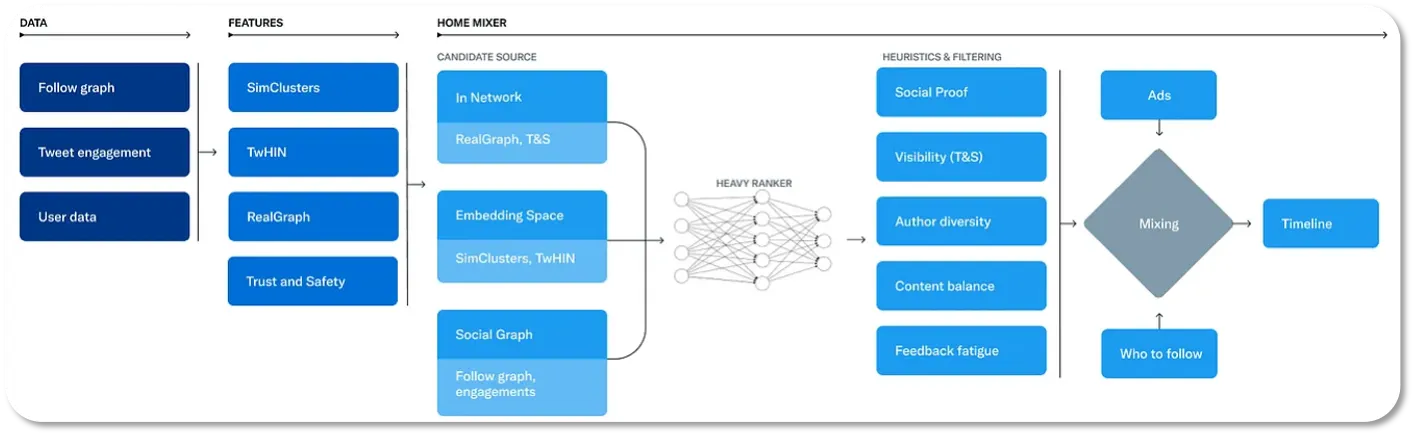
Where does your feed come from? Half of what you see comes from accounts you follow. The other half comes from total strangers across global Twitter.
How does it pick the strangers? Phoenix takes your past activity, turns it into a digital profile, and uses some very smart math (vector matching) to find random posts that match your taste(s).
The main engine. Phoenix doesn’t just guess if a post is “good” or “bad” for you. It calculates the exact probability of 19 different actions at once in the process predicting whether you’ll like, reply, repost, bookmark, or ignore it.
Evaluating posts in a vacuum. To keep things fair, the algorithm rates each post strictly between you and that specific post. That way, a viral, super-mega-spicy tweet won’t completely drag down a mediocre post sitting next to it in the pipeline.
In-Network distribution. In addition to Phoenix, the system has memory in the form of the Thunder algorithm, which stores 48h of interactions and prioritizes what in-network posts your followers receive.

Exactly How Content is Weighted
Once Phoenix predicts the probability of how you will interact with a post, a Weighted Scorer combines those probabilities into a final number.
The exact values in the live production system are highly proprietary, but the open-source code reveals the relative mathematical weightings that determine what explodes and what vanishes.
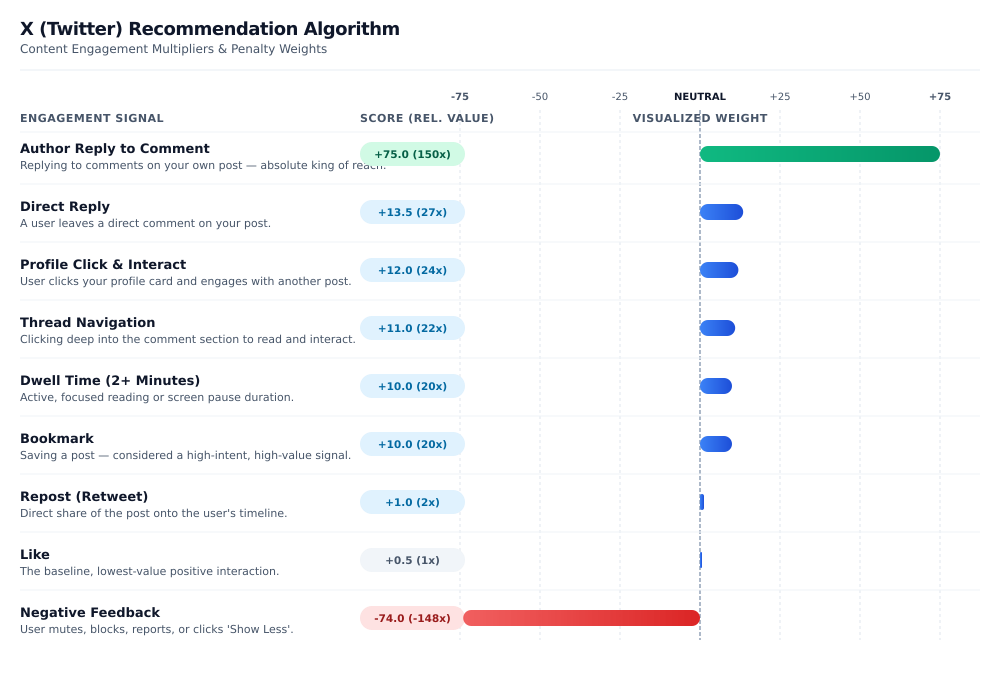
Notice the massive gap between passive and active engagement.
A post with 100 passive likes (+50 total score) is actually worth less to the algorithm than a post with just two replies where you engage back in a real conversation (2 x +75 = +150 score).
Naturally, every action has a ripple effect. A repost, for example, triggers the algorithm all over again, pushing the post to that person’s followers. But for now, let’s stick to the core scoring system.
Golden Rules of the Algo
If you are trying to maximize reach, the open-source code reveals four strict boundaries you must navigate.
Velocity
When you post, X doesn’t show your tweet to all your followers. It drops it into a test pool, a slice of your audience plus a tiny handful of strangers. The subset of followers varies, but the figure can reach up to 10%-ish.
Then, the algorithm watches what happens next like a hawk.
The first 15 to 30 minutes are the golden window. The algorithm re-scores your post in real time based on speed and reaction:
High engagement predictions —> X pushes your post to a broader audience.
Low engagement predictions —> The post gets deprioritized immediately.
The Amplification Threshold (~10 Engagements)
You have to know that reach doesn’t scale linearly. There is a bit of compounding based on velocity:
~3 quick engagements (first 10 mins): Proves that what you’re posting is not spam. This pushes the post to 2–3x more of your existing followers.
~10+ engagements: Crosses the threshold to push your post out-of-network into non-followers’ “For You” feeds.
50+ engagements: This would be the viral loop trigger, which means broader distribution.
Note that it’s a bit more complicated than this, but assuming everything else is normal, this should be your rule of thumb. Again, refer back to the weighted score part; each of those items counts as 1 engagement.
But as you know, not all engagement is created equal.
Quality beats quantity.
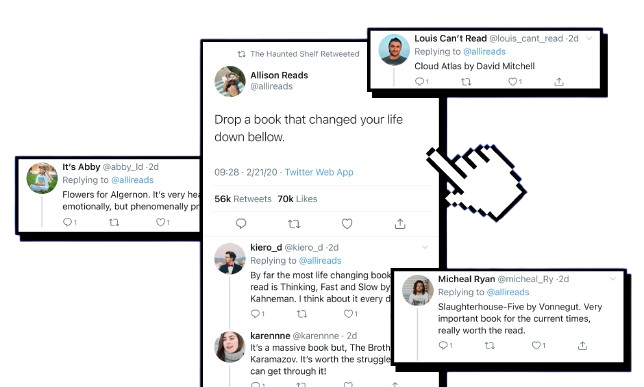
Like we pointed out before, two real replies carry way more weight than dozens of passive likes. Even better, your own replies as the creator count heavily. Replying to early comments is essentially free algorithmic fuel.
What Happens if a Post Flops (<3 Engagements)?
If a post gets zero traction early on, it stays trapped in the test pool. It will still sit in the chronological “Following” tab for people who actively scroll past it, but it’s dead in the water for discovery.
It doesn’t matter if you get a ton of engagement 2h after you post; organic distribution will not be triggered.
Most of what I’ve done sits in this no distribution pool, and it’s frustrating as hell.
External Link Suppression
The platform aggressively discourages you from sending users elsewhere.
If you put an external link in your main post, expect a 30-50% drop in reach (or worse).
Why Links Tank Your Reach
X’s ranking engine wants one thing, and that’s to keep people scrolling on the app. All of these social networks heavily rely on ads, and those are a product of eyeballs.
For you, external links cause users to leave, which tanks your post’s dwell time. The algorithm notices people clicking away and immediately stops showing your tweet to new audiences.

Note that recent changes make it so that even if you click links, you don’t leave the app itself… but you’re still penalized
Does Premium help? Paying for Premium gives you a baseline reach boost that cushions the hit. Our take is to stick to X posts. These will outperform link posts every time.
Workaround (A Classic)
So say you really want to funnel people towards your latest and greatest post on Reddit. How would you go about it?
Post pure native content first (text, images, or a short thread). Let the main post gain momentum and engagement on its own.
Put your external link in the very first reply.
Pro tip: don’t post your comment immediately, wait 3-5 mins as it will count towards improving engagement more.
This lets your main post get full algo distribution while still giving interested readers a direct link right below it.
Btw, despite periodic claims that X has “fixed” how links are treated, our testing and that of people we know proves the link penalty is still very real. And it’s especially true if you aren’t paying for Premium (it turns into a double whammy).

So treat any external link in your main post as a reach killer, and always stick to the reply thread strategy.
Text and Native Video over Threads
Going beyond the obvious, X’s ranking system takes into account dwell time (how long people pause on your post), conversation depth, and keeping users inside the app.
If you can hold someone’s attention, X will reward you.
Naturally, that’s changed how we format posts.
I haven’t really found any great guides on short-form formatting, but this document has a bunch of proven, formula-style templates that usually work:

What I will say though is that…
Long-Form Posts Are Beating Threads (for the time being)
So, in the old Twitter, multi-post threads were king. Splitting a story into 10 tweets gave you multiple chances to hit the feed and pull readers through a chain.
However, with new changes, single long-form posts (up to 25k characters for X Premium) now routinely outperform equivalent threads for broad reach.
Unified Engagement. Instead of 50 likes scattered across 10 separate tweets, every like, reply, bookmark, and share hits one single post. That concentrated signal tells the algorithm…
“This post is hot and you should totally show it to more people.”
Dwell Time Bonus. Opening a long post and reading for 60-120 seconds gives X a massive dwell time signal.
Zero Drop-Off: Readers don’t have to scroll through 12 nested replies to get the full story, eliminating thread fatigue. But do note that (as to the prvious point) time counts, so expanding long form with replies is always encouraged.
My question is…
Are threads dead?
Well, it seems like the answer is… No?… Not entirely at least.
They still work great for specific posts like step-by-step tutorials or interactive Q&As. But if you want maximum reach for a story or essay, it’s way better to stick to a single long-form post.
Native Video Rewards High Completion Rates A Ton
I’ve yet to get this one right, but I’ve seen this story play out multiple times. X is pushing video hard to compete with TikTok and YT Shorts, and all that good dopamineic 💩.
However, in the case of X, completion rate matters way more than view count.
Here’s my testing so far:
Watch time drives distribution: A 45-second video where 60% of people watch to the end gets boosted far more than a 3-min video where everyone swipes away after 5 seconds. Note that I still need to test with more lengths between 30 secs and 2 mins before I can conclude what the ideal length is.
Always upload natively: Never post a YouTube link. Upload the raw video directly to X so it plays inline. These perform way better
Pro tip: If you want to embed someone else’s video on X (instead of just sharing a plain link), long-press the video and tap Post Video.
Alternatively, you can add
/video/1to the end of the post’s URL to get the same result.Example… combine [x.com] + [/YelaHRMT/status/2078858399132106920] + [/video/1]

Hook them in FAST (3 secs): As with any other short form stuff, you must use bold visuals, add captions (most people scroll on mute), and cut out zero-value intros if you want to get rewarded.
TweepCred
Note: This is probably the most important section of the entire text. Read it carefully.
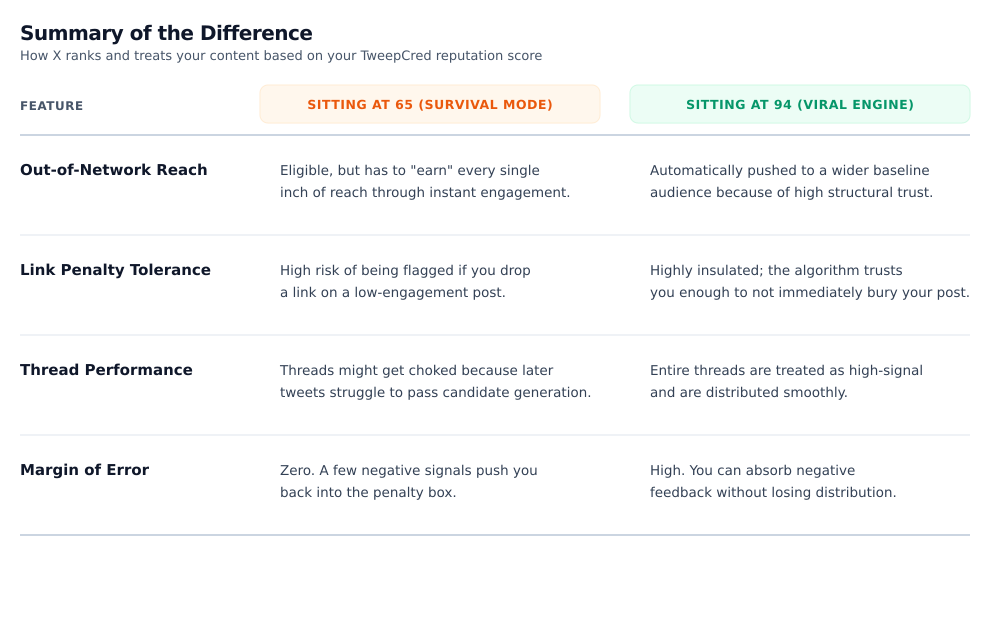
X calculates a daily PageRank-style score (from 0 to 100) for every user, called TweepCred. If your score falls below 65, the algorithm caps you.
Specifically, only 3 of your posts will even be considered for out-of-network distribution per cycle, effectively locking you out of the “For You” feed.
Let’s break this down slowly, but before we do… I know what you’re thinking: what the hell is a cycle?
Well, before we dive into TweepCred, here’s a bit of context for you.
TweepCred Update Cycle = 24 Hours
The batch job on X’s servers (historically called the UpdatePageRank job in the Scala code) runs once every 24 hours.
The User Session Cycle = Instantaneous (<200ms)
When the code says “accounts with a TweepCred below 65 have only 3 tweets considered for distribution per cycle,” it refers to a User Feed Refresh Cycle.
Every single time a user pulls down to refresh their “For You” feed, the pipeline spins up.
If your TweepCred is under 65, the algorithm will pull a maximum of 3 of your posts into the candidate selection pool for that specific user’s refresh session.
The rest of your posts are completely locked out of that generation cycle.
The Post Lifespan or Decay Cycle = 6 to 24 Hours
X applies an aggressive time-decay multiplier to posts.
6-Hour Half-Life: A post loses roughly half of its score weight every 6 hours. By score, I mean the sum of all effective engagement for distribution.
24-Hour Death: After 24 hours, a post’s algorithmic score drops to effectively zero. No matter how viral it went on day one, it will stop appearing in the “For You” feeds of out-of-network users.
Estimate Your TweepCred (Max 100 Points)
You can grade your account across the six vectors X’s code uses to build your reputation score.
Again, the target is 65 or higher to escape the algorithmic throttle; however, note that this is algorithmic, so the higher the rank, the exponentially better the distribution.
Follower-to-Following Ratio (Max 30 Pts)
X wants to see that people find your content valuable enough to follow you back.
If you follow more people than follow you, you get penalized. If your “following” list is over 500 and your following-to-follower ratio is greater than 0.6, the code triggers an exponential penalty.
From our testing:
High ratio (1.5 or 2.0 to be safe) = 25-30 pts.
Flat/negative ratio = 0-10 pts.
Example
Followers: 10,000
Following: 600
Is Following > 500? Yes (600)
Is Ratio > 0.6? No (600 / 10,000 = 0.06, which is safely below 0.6)
Maximum points (25-30 points). X would trust this account because they have high authority but keep a highly curated timeline.
Engagement Quality (Max 25 Pts)
This is your average interaction rate per post (likes, replies, bookmarks, etc.).
A healthy average engagement rate on X is between 1% and 5%.
If your followers passively ignore your posts, X assumes you are a low-quality or broadcast-only account.
Platform-wide averages are typically lower (around 0.1–1.7%, varying by account size and calculation method), but large creators can still see solid algorithmic distribution at 0.5-1% with consistent quality signals.
We’ve seen good distribution with 0.2% to 0.6% visual engagement (which only accounts for the public engagement metrics).
Our findings include:
Consistently getting replies and bookmarks relative to your follower size = strong positive signal (20-25 pts).
High follower count but dead silence on posts = weak signal (5-10 pts).
Example
For every 1,000 impressions, you need 10 total engagements of any kind (clicks, likes, replies, bookmarks, or reposts).
What the post actually looks like:
6 Likes [1x]
2 Profile clicks (people clicking your name to see who you are) [2x]
1 Reply [8-13x]
1 Bookmark [8-10x]
Total Engagements: 10 (1% rate)
Total Weighted Score: ~29
This is a baseline, acceptable post. It’s not viral, but it’s not spam. The algo will see this and think:
“We will keep distributing this creator’s content normally.”
If we made this 50 engagement on those same 1,000 visualizations, we would see the out-of-network distribution get triggered.
Again, note that engagements are not created equal; we want to encourage behaviors like dwell time and replies to max out the weighted score.
Account Age (Max 15 Pts)
Trust is built over time to prevent spam bots.
Brand-new accounts are heavily penalized. The full age trust benefit kicks in once your account crosses ~30 days old.
We’re not entirely sure whether reactivating a dormant account has the same effect, but from our baseline calculation is should not. This seems like a pretty straightforward if/then command.
Score works pretty simply:
>30 days old = 15 pts.
New account = 0–5 pts.
Pay-to-win Premium Subscription (Max 16 Pts)
A direct, artificial boost to bypass the cold-start problem.
It works out the following way:
Premium+ = +16 pts
Premium = +10 pts
Basic = +4 pts
Free Account = 0 pts
What this essentially means is pay-to-win is active now. Arguably, having it creates normal conditions, but not having it creates a major debuff to distribution.
Activity & Consistency (Max 10 Pts)
X rewards active daily participants.
Posting at least 1 to 3 times a day and actively replying to other accounts in your niche boosts this score. You can easily max this out, but it usually takes about 2 weeks of daily posting.
We would recommend 2/3 posts and 8+ replies per day.
Here’s the math for the TweepCred score:
Daily activity = 10 pts.
Posting once a week or ghosting the platform = 2–4 pts.
Pro tip: You should not spam as all of these are also filtered through the engagement metric.
App Usage (Max 4 Pts)
As a last side note, X’s code gives a tiny trust bump if you use the official mobile app.
If you post and scroll from the iOS/Android app = 4 pts.
If you only use scheduling tools or third-party APIs = 0 pts.
1 or 2 sessions a day will do the trick. A session is classified as 2-5 mins of active engagement (scrolling feed, liking posts, replying to commments, etc.).
My TweepCred Score Explained
Well, by the time I started tracking this figure, I’d already gone through several rounds of optimization, including pruning followers, deleting low-engagement posts and replies, and grabbing Premium.
My best guess is I was sitting around 20 when I took over the account.
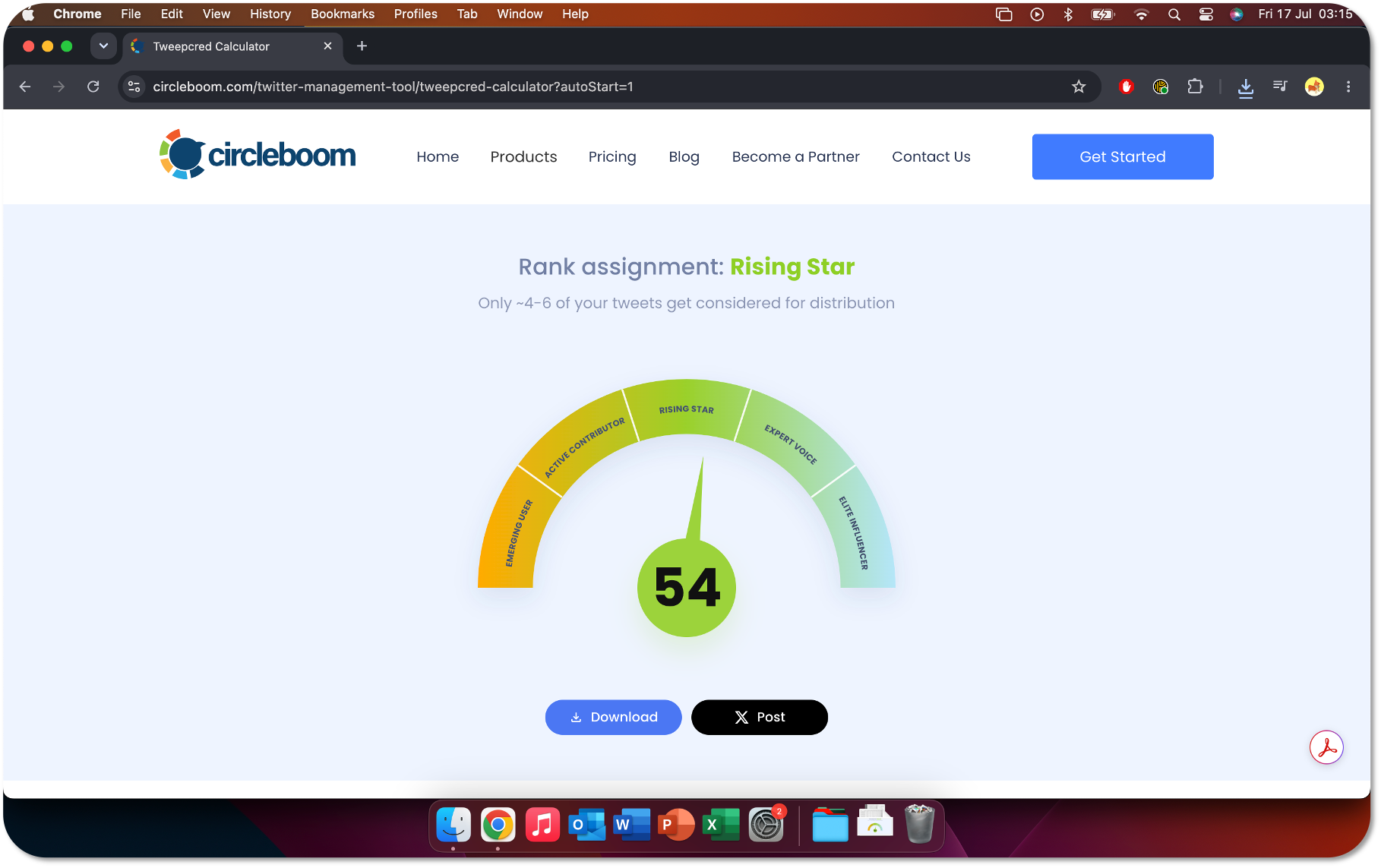
Also, fair warning: I get ridiculously obsessive with this stuff. And yes, it was 3 a.m. when I took this screenshot. Stop judging my sleep schedule, close this tab, and go optimize your own profile.
My latest score as of the posting of this on July 22nd is:
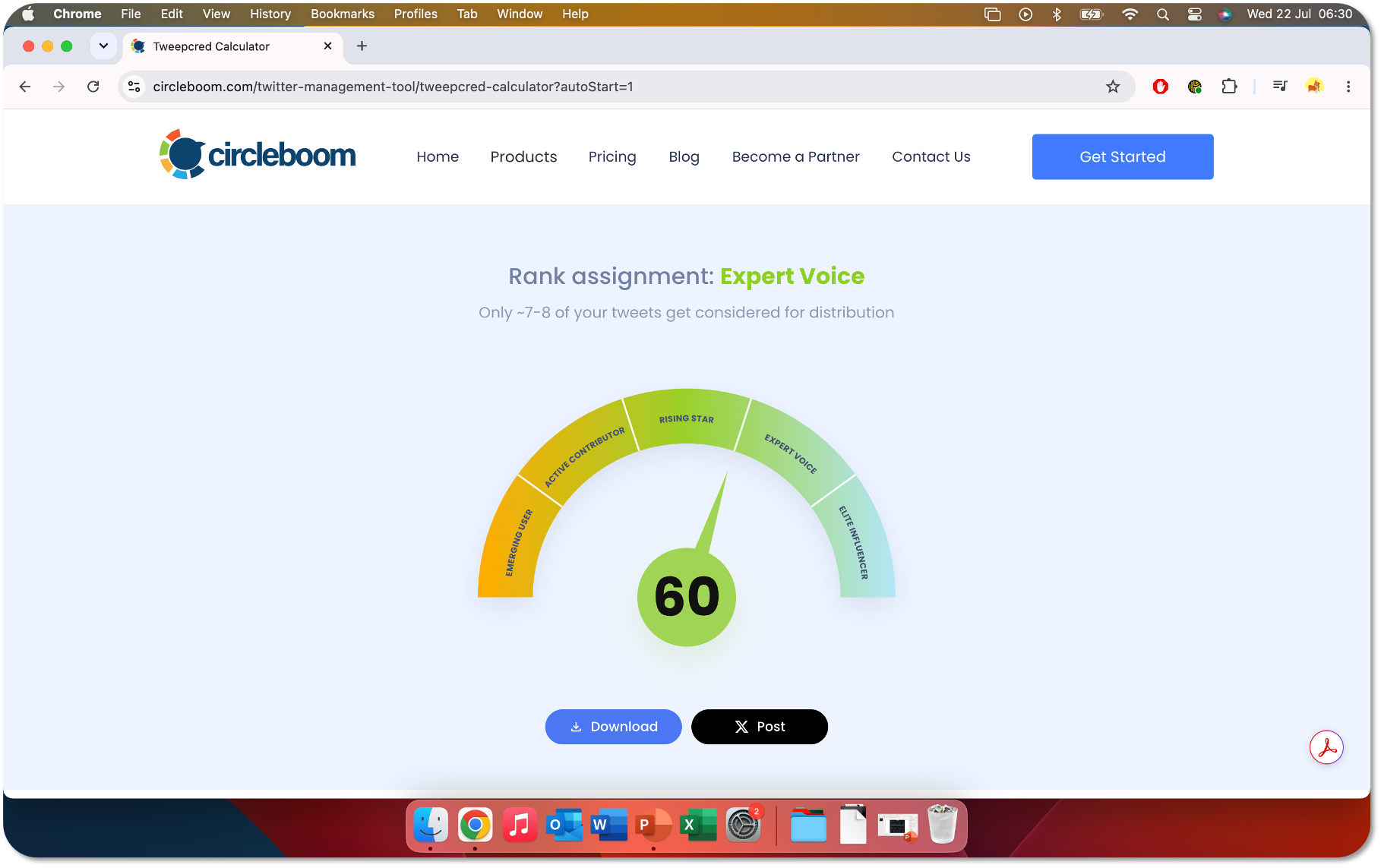
You can check your own score with this tool; it’s free and validated by X.com
Here is my estimate, though it may not be perfectly accurate.
My Follower-to-Following Ratio (Max 30 Pts)
Probably very high with a 0.3 ratio, plus about 20% of them are verified. However, given the low count, it’s probably penalized, so +20.
My Engagement Quality (Max 25 Pts)
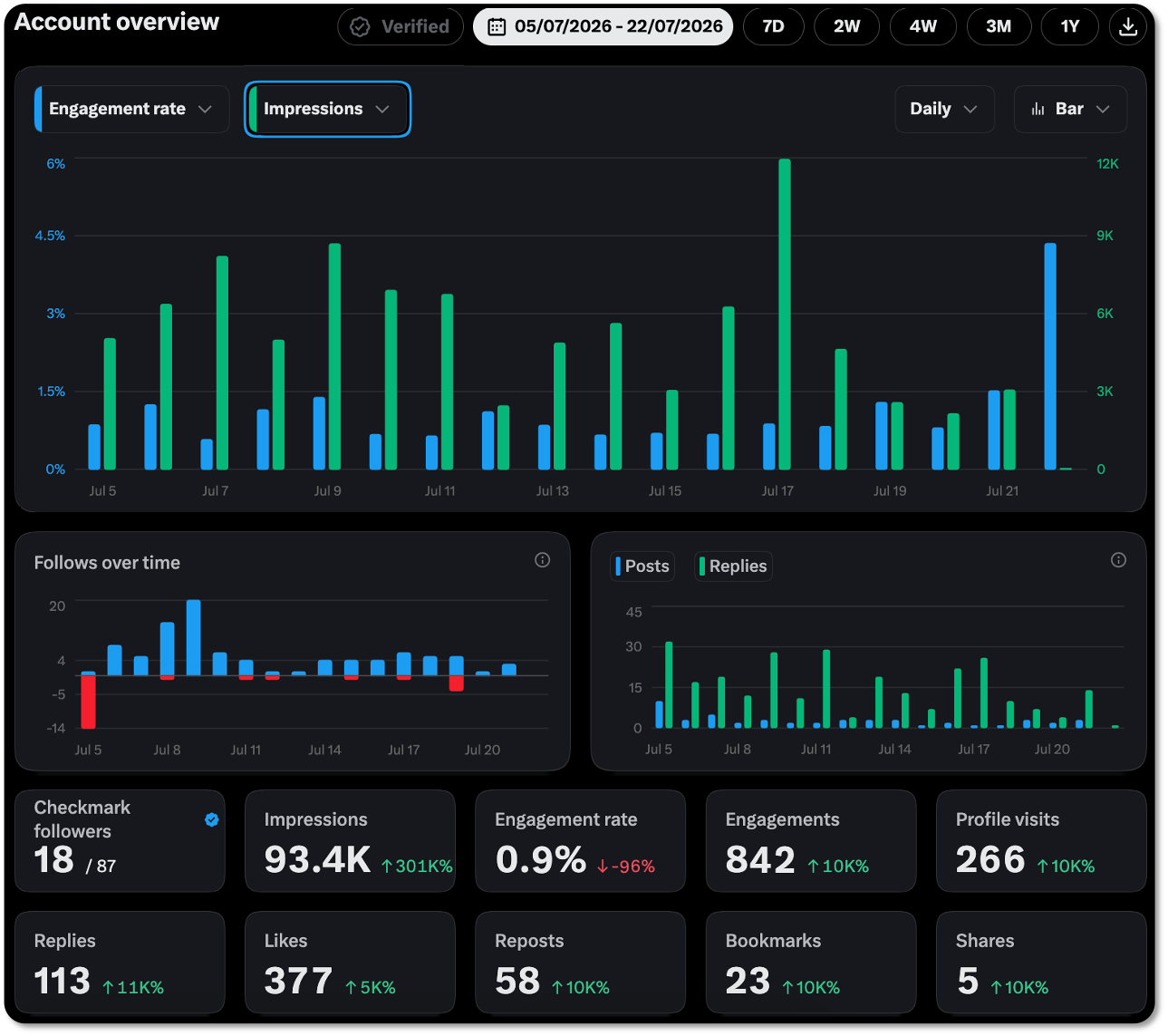
Even though the number is not updated after the pruning, 0.8% is okay, the low absolute numbers do work against me, so +7.
I will note that the average engagement rate shown in the dashboard right now should sit between 2-3%, once updated (in 2 weeks-ish) this component will receive a massive boost (+20 expected)
My Account Age (Max 15 Pts)
Room for improvement but high, so +13.
My Premium Subscription (Max 16 Pts)
We added +10 with this category and reduced max TweepCred from 100 to 94.
My Activity & Consistency (Max 10 Pts)
Room for improvement but high, so +7.
My iOS App Usage (Max 4 Pts)
Room for improvement but high, so +3.
TweepCred Score Takeaways
There’s not much left unsaid here. Perhaps, to highlight two major things: using your phone for a few sessions can be the difference maker to get to 65, and you can tweak most of the score with some smart high-quality engagement.

However, the system is a bit "pay to win," especially given how the score acts as an exponential trampoline for your content.
Note that I do pay about 5 bucks per month at the moment (got an entry offer thingy), which makes me Premium, and Premium is a must if you want distribution.
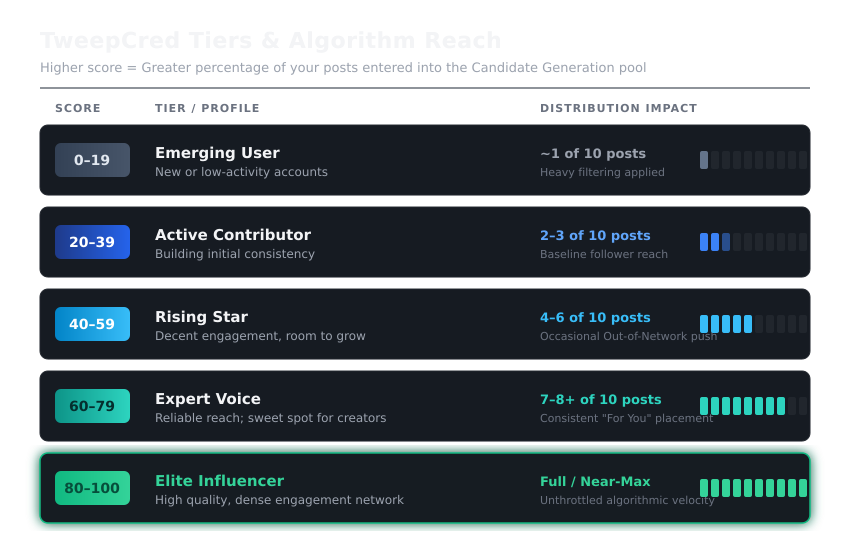
Even with Premium, the max score I can get is 94… So that sucks.
I’ll likely upgrade to Premium+ eventually just to test it. Early on, the math really works in your favor.
Past 500k followers, it’s probably not worth the money, but for early growth, it makes total sense (on paper).
Distribution In and Out of Network
Beyond TweepCred (which, btw, is intrinsically connected to this metric), your scale is sadly a product of size, and there’s nothing you or I can do about it.
So, the larger the account, the larger your distribution.
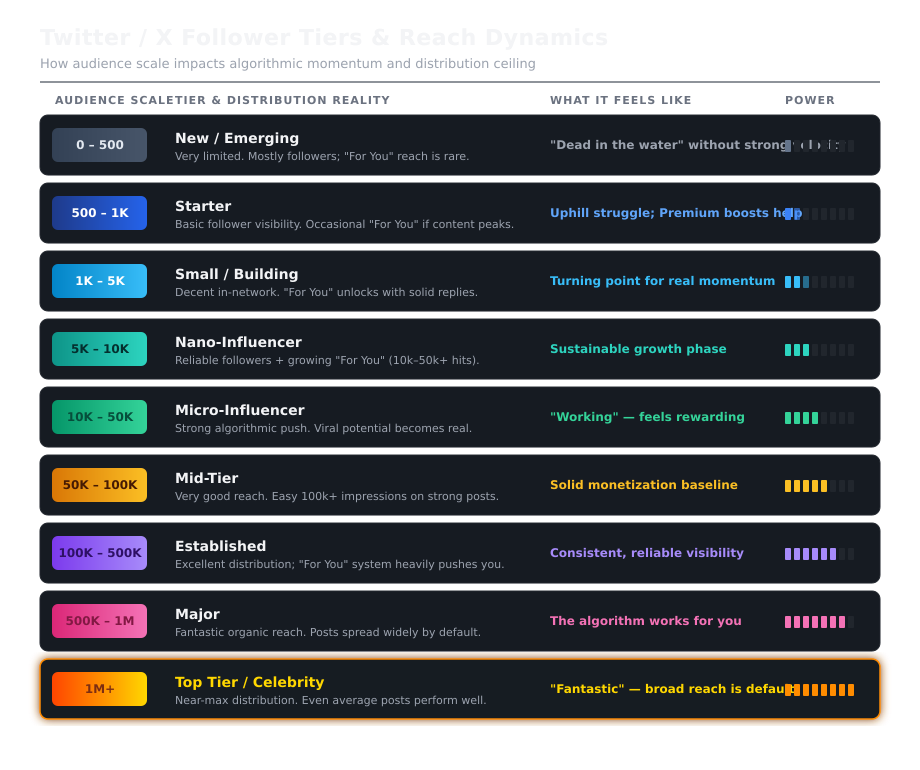
How you can play around this... well, individually you can do basically nothing. If you’re a small creator, you cannot overcome this gate directly.
What you can do, though, is ask larger creators to vouch for you in the form of reposts and engagement. Reposts will retrigger the distribution calculation, as the author’s followers will get notified and shown the post.
We won’t get into monetization, which requires 500 followers and 5M views in the last 90 days, but eventually, I’m sure I’ll get to test that out.
To be candid, it won’t be a priority for me at any point. Direct revenue isn’t my goal here; what matters to me is respect and the ability to execute on my main project: Hermit Ventures.
On this completely parallel topic… In my view, having resources is just like having more soldiers in your army; it helps with the mission.
In any case, as my former McKinsey boss used to say:
“We’ll cross that bridge when we get to it.”
I can literally hear him in my head, and it reminds me of how much I detested when he said that. 🤢
Shadowbanning Explained (w/ an example)
Okay, so when you behave like “poo poo” according to the algorithm, you get… well, let’s call it what it is: Shadowbanned.
While X prefers polite corporate euphemisms like “visibility filtering” or “reach limitation” (under their motto “Freedom of Speech, Not Reach”), the reality is the same.
Your account looks fine to you, but X has quietly turned down the volume on your voice. Speech suppressioooooon activated!
What It Looks Like
So yes, I’ve tested this, of course I have. And it sucks, for the most part.
When X puts you in the penalty box, your content gets buried. You are actively hidden or deprioritized.
There are zero notifications associated with it.
Impressions and engagement just suddenly drop off a cliff, usually by 50% or more, and it becomes almost impossible for new people to discover you. So yeah, profile visits and new followers fall.
Common Ways X Chokes Your Reach
The Grok-powered algorithm scores you in real-time, looking for “safety signals.” If you trigger the algorithm, it usually results in one of these restrictions:
Search Ban: Your posts don’t show in search results, and your
@handlewon’t autocomplete in the search bar. You can actually test for this, but it’s easier said than done. Since X rarely allows you to search without logging in, you’ll need a friend who’s logged in to check it for you.Reply Deboost: Your replies get hidden from non-followers. This is a reach killer for authors trying to network in comment threads. Testing this also requires another person’s account, as you can’t see comments without it.
General Throttling: X simply demotes your content across the board, ensuring it reaches far fewer people. So out-of-network distribution effectively becomes zero.
How Did This Happen?
It’s almost always the algorithm flagging “bot-like” behavior, not a manual penalty. Big triggers include:
Spammy habits: Blasting identical posts, repetitive replies, or mass follow/unfollow sprees.
Link spam: Putting too many external links in main posts (stick to the reply-thread strategy!).
Controversial topics: Content that gets frequently reported by other users. This includes faulty language.
Low follower quality: If your audience looks like fake bots or you’re part of engagement groups.
How to Fix It / Recover
The good news is that most restrictions are temporary and will lift if you stop the bad habits:
Go silent: Pause major posting and replying for 24 to 72 hours. Stubborn cases might need a week of inactivity.
Delete and scrub: Get rid of recent spammy posts or link spam, but do it carefully and methodically (more on this later).
Build better habits: Once you return, stick to consistent, high-quality content and zero external links in main posts (at least for a while).
Engage authentically: Focus on conversational replies rather than rapid-fire “great post” comments.
Recovery time varies. It took ours 48h to recover, which probably means mild cases resolve in days, but repeated offenses take longer.
Not every drop in reach is a shadowban. Normal algorithm shifts or audience fatigue can also reduce visibility.
If you are experiencing this, I really don’t know what to tell you other than… quality wins with this algo.
On that note…
Don’t Delete Everything at Once
This is how I got shadowbanned. Pruning is good, but the algo considers you spam if you delete more than 50 posts/replies every 15 mins.
So don’t go ham. Just check every two to three days for stuff that didn’t perform past the 48h mark, and you’re good.
Each cycle (24h) is important, but the overall one- to two-week metric is really what determines your score, so if you keep that high, you’re golden.
If you want to go on a pruning session, I recommend you split it up into daily sessions and delete approx 5-10 posts every day just to keep the spam bot flag away. Maybe making it a habit is a better practice, but again, I’m still testing.
Just don’t delete 100 posts in about 2 hours. That’s what I did, and it’s definitely not a smart move.
Other Useful Stuff We’ve Learned So Far
Replies outpace posts, at first
Because your initial algorithmic distribution is going to be pretty rough, you really only have one option:
Leave smart replies under larger accounts in your niche.
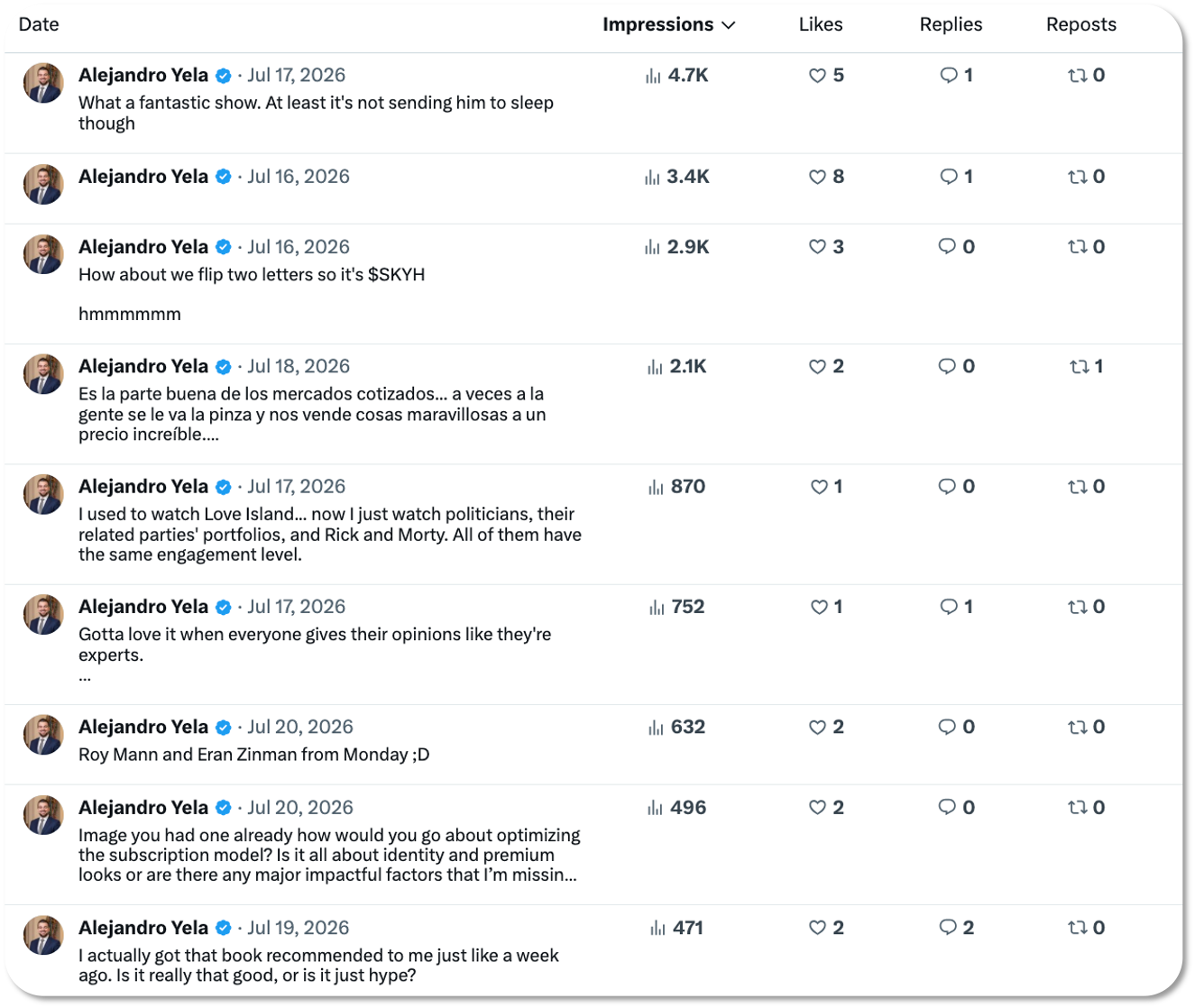
You’ll probably notice that all of these examples are from the last few days, and that’s no coincidence.
Like most things, as you iterate, you get better at it. I filtered these by impressions here, but ideally we’d filter by profile visits.
That’s the north star metric for understanding follower conversion.
Optimize your profile
On that note, when people visit your profile, they need a proper place to land… and that comes down entirely to you.
Using your real name is generally recommended since you want to build trust.
Your profile picture and header image should be curated for your specific audience (in my case, finance professionals and people interested in finance).

Same goes for your bio: it should establish authority quickly and, more importantly, clearly state what you write about so people can decide within 5 seconds if following you is worth their time.
Your pinned post matters a lot, too.
While many creators pin a post that went viral, I chose one that breaks down my main project in detail. This deepens engagement and gives readers instant confirmation of who I am and what I do.
Treat your profile as a top-down funnel (literally) where people skim from top to bottom for anything that catches their eye.
Note: Take my link, for example. It used to be
hrmt.substack.com, but it’s moving towww.hermitresearch.com(by the time you read this, it probably already has).This is a prime example of serial optimization. If I hadn’t pointed it out, you likely wouldn’t have noticed, and this single change isn’t a game-changer on its own. But as these tiny upgrades stack up over time, the overall jump in perceived quality becomes very obvious.
Reposting a successful post 24h later
Okay, so look at the first 48h of this post.
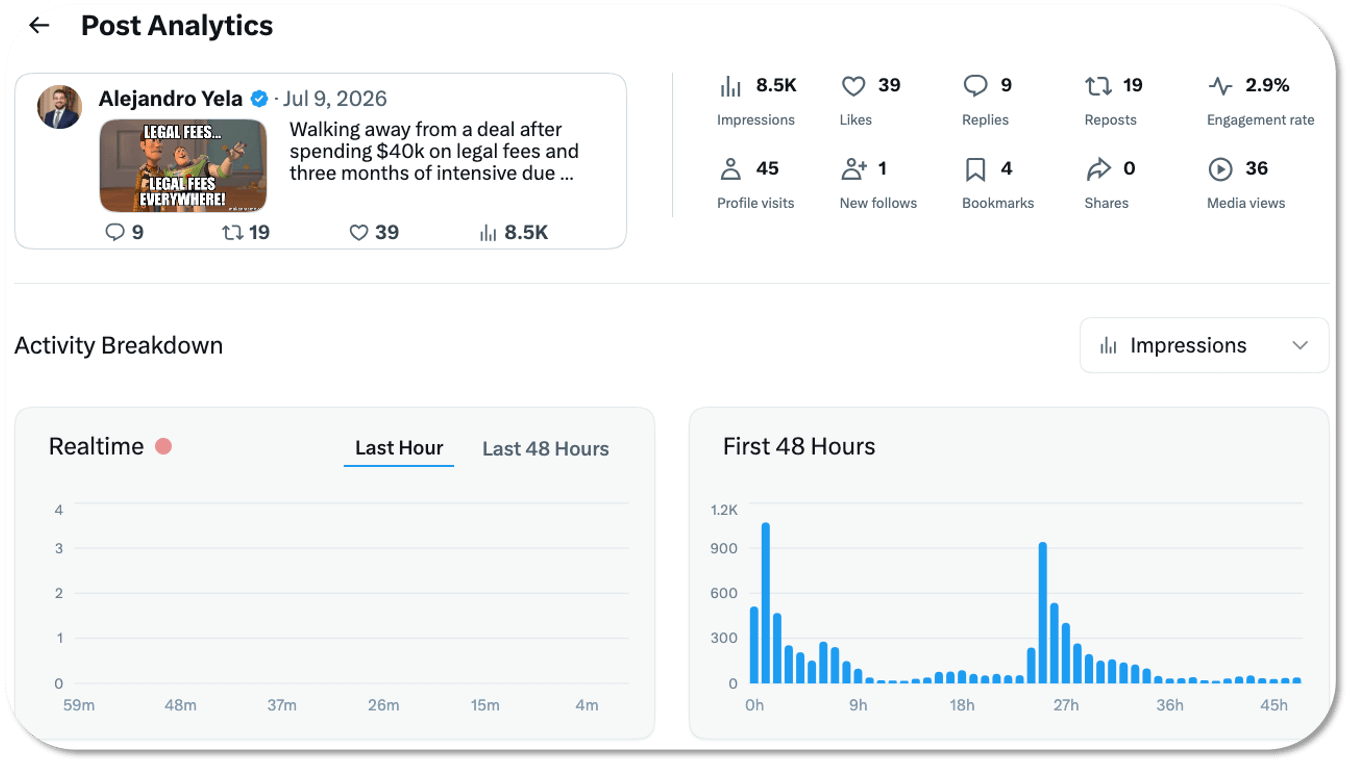
When you restack your own post after 24h, you get a little bit of that distribution boost again.
A self-repost mainly pushes the tweet back to the top of the feed for your existing followers and helps revive the decay mechanic that we discussed previously, but it doesn’t trigger fresh out-of-network distribution.
Deleting non-engaged works
Okay, so here’s what actually happens when you delete posts from the last 14 days.
On your frontend dashboard (the one you see on the analytics screen):
Cumulative stats (Impressions, Likes, Replies, Reposts) will drop. X’s analytics is basically a simple calculator. So, when you delete a post, it subtracts those impressions and engagements from your 14-day total (there’s a delay).
Engagement rate (like your 0.8%) will usually improve. You’re removing silent impressions. Denominator effect. The ratio goes up.
On the backend algorithm (the part that actually matters for future reach):
The algorithm cares only about density and consistency.
Deleting dead posts erases “engagement debt.”
Every ignored post signals “low-interest content,” which debuffs your future reach. By removing them, you clean up your history and reset your profile so the algorithm starts seeing you as a higher-quality creator again.
Don’t stress if your total impressions or likes dip a bit after cleanup; overall, that’s just vanity metrics. You’re trading a little historical volume for better future distribution.
Expected timeline:
Daily recalculation. X updates your reputation (TweepCred) roughly every 24 hours. The refresh occurs at 00:00 UTC plus a lag of up to 4h.
Partial real-time effect. Some positive signals can show up quickly.
Full recovery. Expect 3-7 days of consistent high-quality posting to really see the difference in reach.
What I’d do is delete the dead-weight posts methodically. Remember, slow and steady wins the race here.
Then spend the next few days feeding the algorithm fresh and engaging content. By next week, your baseline reach should start opening up nicely.
Views are just a vanity metric
To continue on the point above, like with most things, views are just a way to boost your ego. Losing views by eliminating low-engagement content is a massive net positive.
Views really only act against you via the denominator effect, so take that as a lesson.
Narcissism and all that good stuff.
Replies don’t count, but they count
So on the one hand, good or bad replies aren’t really reputation-damaging on their own, because most of how X classifies you has to do with quantity, frequency, and good faith.
However, there is one metric that gets affected… and that’s engagement. Remember, poor engagement does hurt your stats and therefore your TweepCred.
This is especially true with negative feedback loops meant to filter spam:
Downvotes & Hiding: X uses downvotes on replies as a training signal. If your replies are consistently downvoted, hidden, or ignored, your account reputation takes a major hit.
Mutes & Blocks: If you leave spammy, copy-paste, or overly aggressive replies that cause people to mute or block you, it triggers strong negative penalties that tank your TweepCred.
Just like you should prune your posts, you should also prune your replies.
My best guess is anything with an engagement rate lower than 1% should be removed (though this is still a guess; I haven’t fully tested the exact threshold).
Engagement and time matter here, so aim for at least 1-2 Likes or 1 Reply from someone else within 48 hours. If you don’t get that, just prune it once the time has passed.
Blue checkmarks rule the tweetosphere. Period.
If your followers have high TweepCred, that’ll increase your visibility as well, especially by maintaining a strong verified follower ratio.
5% to 15% — Good general interest
Active creators in broader niches (e.g., general tech, fitness, lifestyle).
15% to 25% — High-Trust Expert (I’m at around 20%)
Highly specialized, professional niches (finance, micro-caps, investing, SaaS).
Anything below 5% usually signals a bot-heavy audience.
Anything past 25% means you’re a Twitter giga chad or catering heavily toward B2B accounts.
Note: All serious B2B accounts have check marks, so catering to these Premium and Premium+ massively boosts your authority within the network at the expense of probably having a lower follower count.
Reply Triggers, Bookmark-Bait formatting, and Dwell-Time optimizations
Because these things are so important, you should redesign around them.
Direct replies are nice, but multiple back-and-forth exchanges are great as they compound time spent. If someone starts a session and comes back later, the clock doesn’t reset, so you can hit that valuable 2-minute mark much easier.
Example
Someone reads your post and replies (35 seconds). You reply, they come back and spend another 60 seconds. The algorithm sees 95 seconds of dwell time + bonus signals from the two replies (including your reply to their reply).
Smart self-replies are also powerful, but use them smartly to add context, follow-up thoughts, questions, polls, or links.
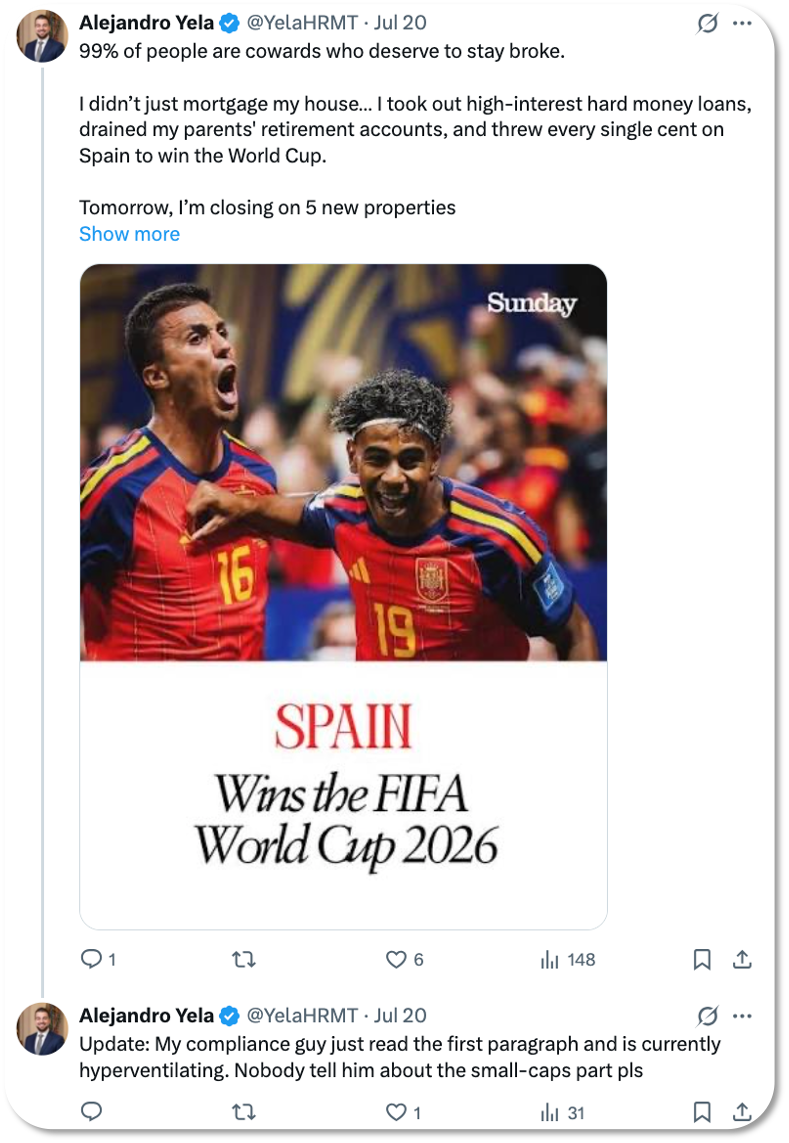
Do not just post a comment that will be ignored, as again replies don’t count… but they do.
Again, these increase both engagement and dwell time. Just be smart about it. Quality always matters.
Ad processing and placement is not very good
Organic distribution and paid distribution follow two different algorithmic paths. Don’t mix them up.
If you want to boost a post, use one that already performed well during the first 24h, but never sooner than that.
I haven’t tested this enough though to have a opinion on what do do to maximize it. However, I’m quickly learning about what not to do.
Overall, it doesn’t work out too well, especially for niche creators, because targeting just blasts your stuff to a broad audience. This often depresses your engagement metrics.
Also, ads are freaking expensive. I’ve spent about €200 testing. So far, they have not worked nearly as well as just asking a bunch of my buddies to engage with the posts… especially the high-TweepCred ones.
Closing Thoughts and Insights
Please note that after reading all of this, I hope you put it to practice and actually go down the trial-and-error rabbit hole.
Note that I am in no way an expert on this topic. I’ve still got a lot to learn. But after reading through the Phoenix engine procedures and now Grok’s smart positioning, I’d say I’m probably in the top 90%.
The question is… what has to happen to get to the top 99%?
Well, that’s simple. It’s just more iteration.
Expect a post in a few months where I show you results based on TweepCred improvement and overall distribution gains.
I’ll likely opt for the pay-to-win strategy and succumb to our lord and savior Elon Musk for that beautiful instant +6 point boost. We’ll see.
For now, my metrics look like this:

If you found value in this analysis, please hit the ❤️ button and share your thoughts in the comments. It helps us bring institutional-grade research to a wider audience.
And if you liked this post, we’re confident you’ll love this:

Another update.
If you have less than 100 followers, you can't test for statistical significance... which means your TweepScore with Premium is hard-capped at 60.
No way around it unless you get Premium+.
A funny thing happened. I just changed my bio 3 times in about 15 mins and I received this... "We’ve added a temporary label to your account which may impact its reach. Learn more here"
Don't do that hahahahaha