



Given the recent shaky sentiment around SaaS, we wanted to dig a bit deeper.
That’s exactly why we’ve put together a thorough write-up on one of the industry's heavyweights.
In case you don’t know my collaborator yet, here is a quick introduction to a fantastic Spanish stock researcher and an all-around great guy.
If you are looking for a serious senior analyst who actually understands the operations of a tech company, look no further than Alejandro Guadalajara.
He is the founder and author of Quality Value Research, a highly respected investment research platform followed by over 17,500 investors.
Before launching Quality Value, he spent eight years at LaLiga, where he led product development and steered their OTT streaming platforms (LaLiga+).
This was a hands-on live lesson on scaling digital infrastructure, optimizing user engagement, and managing complex subscription models.
Because of this experience, when Alejandro analyzes software and subscription-based companies today, he looks at them through the lens of a builder, and not just a modeler.
He understands user acquisition, churn, product-led growth, and tech stacks because he has actually designed and run them at scale.
We think, Alejandro is great at bridging tech operations and rigorous financial analysis. He’s extraordinary at breaking down complex enterprise businesses into digestible insights in layman’s terms.

Investment Thesis is our core series where we break down standout public companies so you understand exactly how they make money, where the risks lie, and why the opportunity exists long before the market agrees.
This content is intended for informational purposes only and should not be taken as investment advice. The author does not represent any third-party interest, and he may be a shareholder in the companies described in this series.
Please do your own research or consult with a professional advisor before making any financial decision. You will find a full disclaimer at the end of the post.

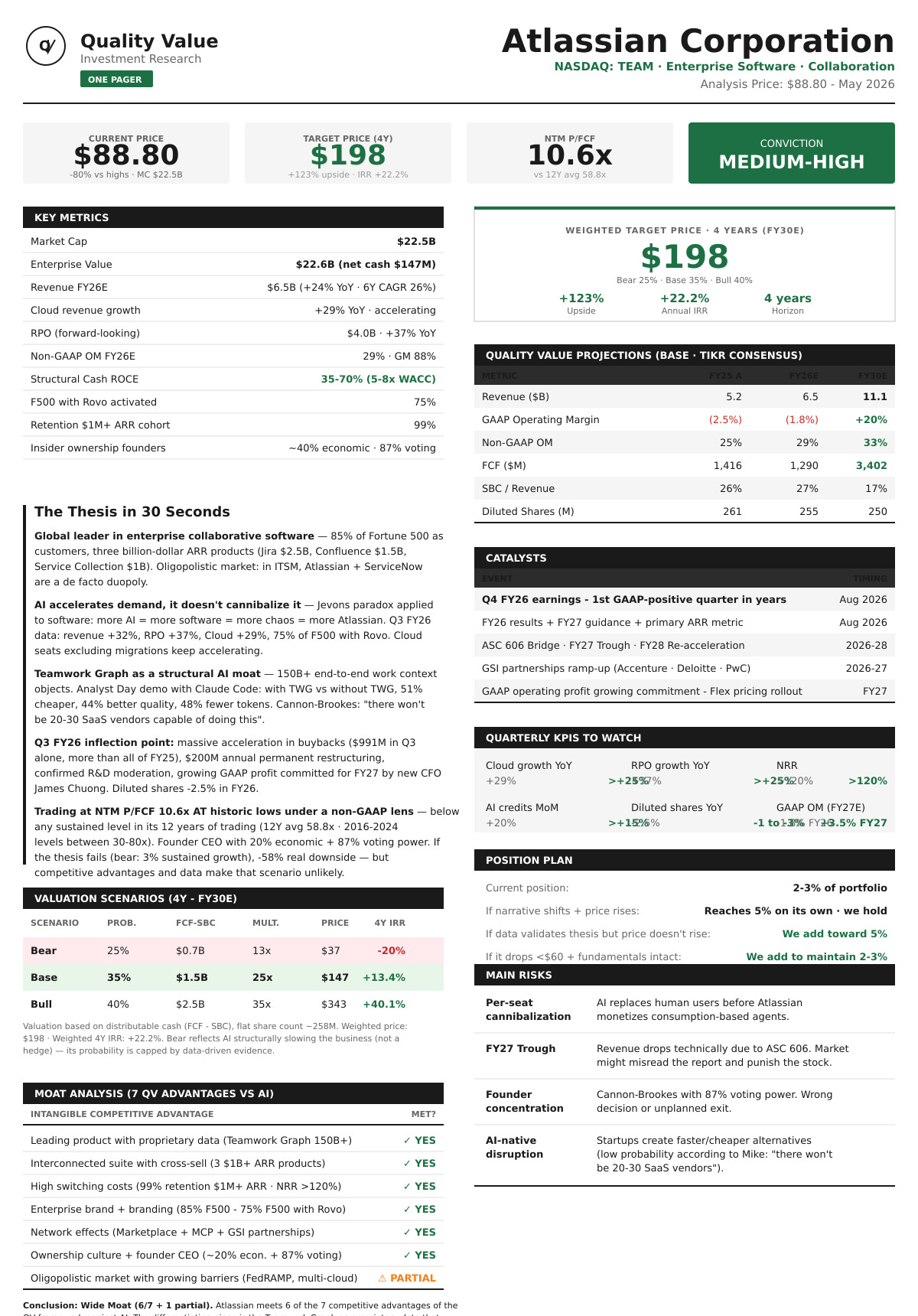
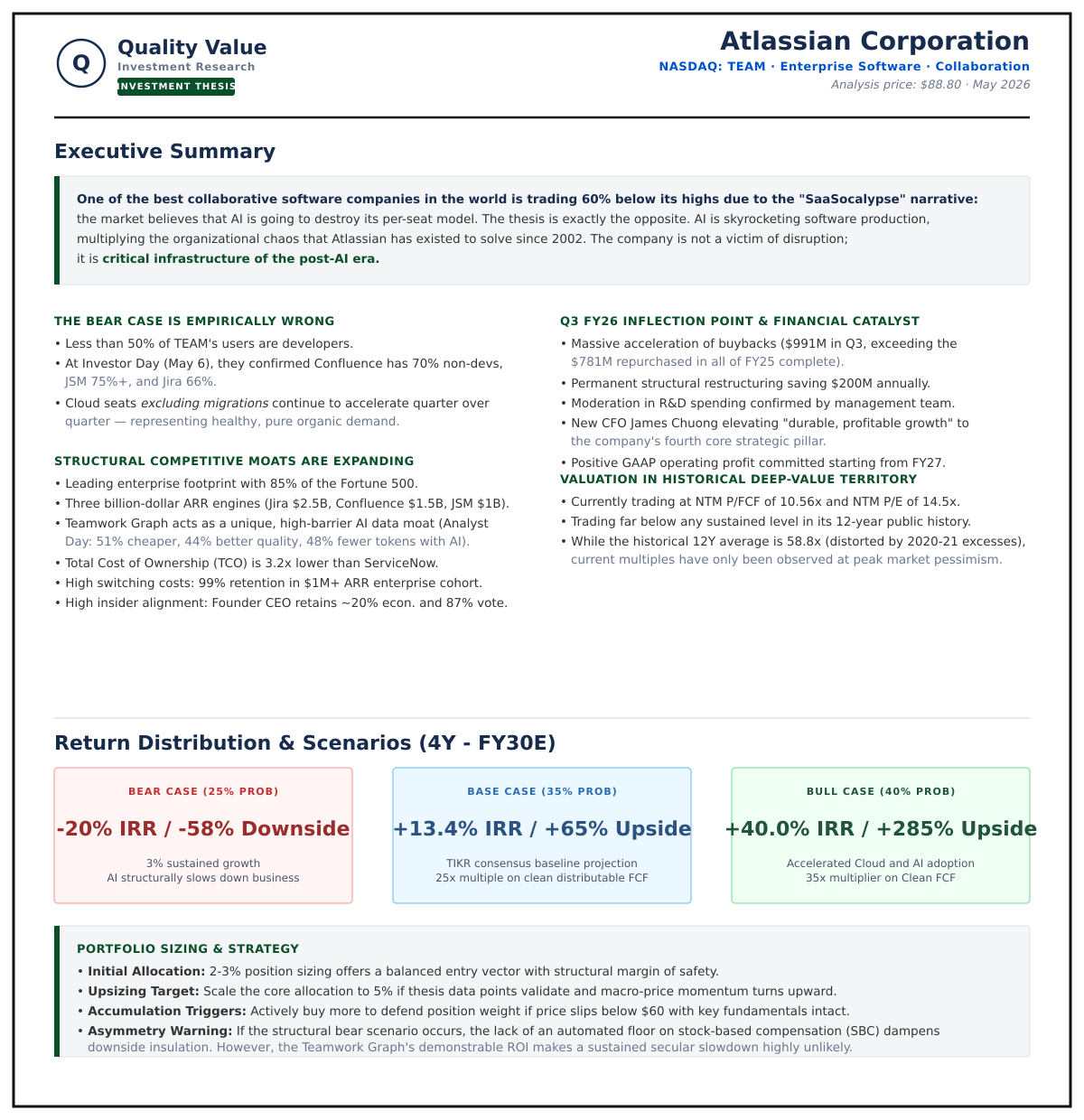
One-Pager — Visual Summary
The cover page with key metrics, valuation, and scenarios all in one image. Built for anyone who wants a quick look at the thesis fundamentals.
Executive Thesis
The Bearish Consensus and Why It’s Wrong
The Bullish Thesis (& Competitive Advantages)
The Numbers Challenging The Narrative
Three Scenarios for 2030 and Target Price
Our Action Plan
Full Thesis (Downloadable PDF)
One-Pager
When the market punishes high-quality companies based on a narrative that the data contradicts, you get as an output a set of excellent opportunities for the coming decade.

Key Atlassian data points:
The product continues to win enterprise deals at record levels
The Teamwork Graph is a demonstrable AI differentiator with quantified ROI
The capital allocation has already changed; buybacks exceed SBC in FY26
The founder continues at the helm with 20% economic and 87% of the vote
The culture has led to the adoption of hard but critical decisions (10% layoffs) to accelerate GAAP profitability
The new CFO has elevated “durable profitable growth” to an explicit strategic priority
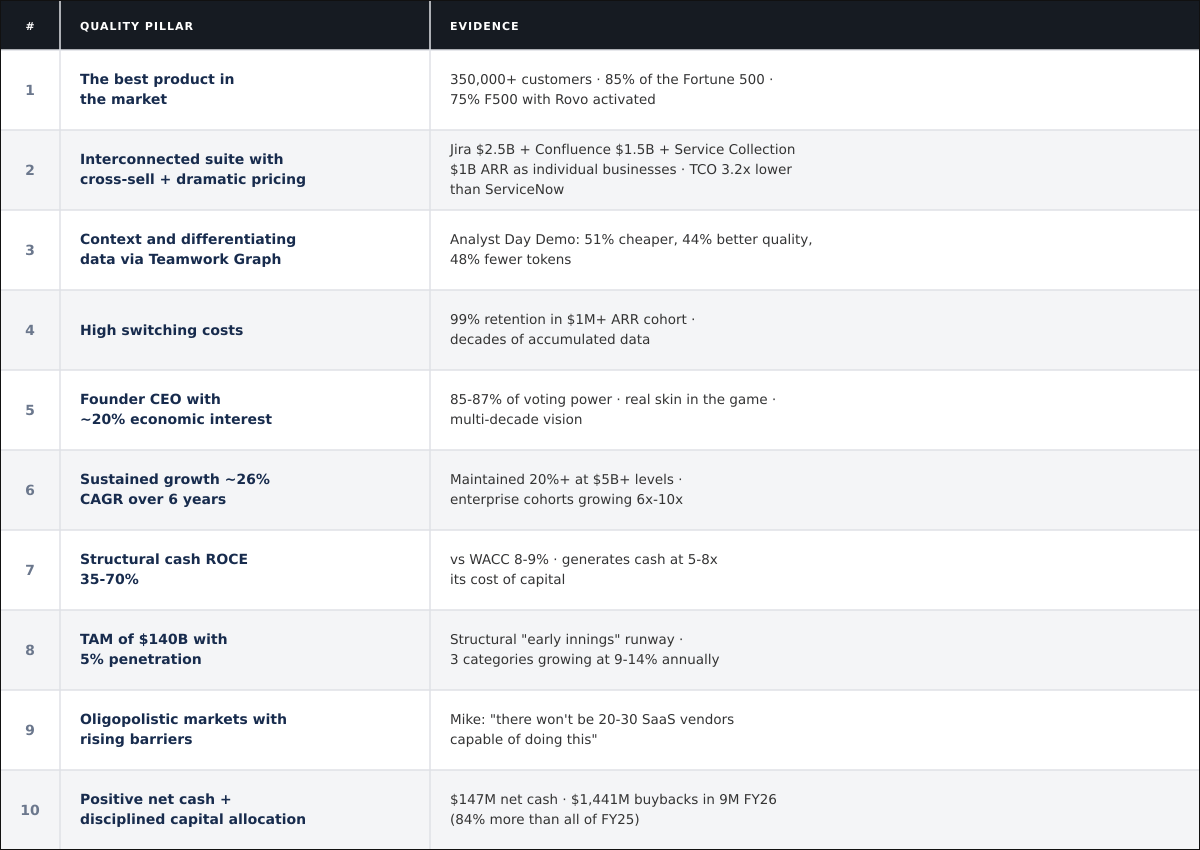
The 10 pillars that support the thesis:
What worries the market and what do we think about it:
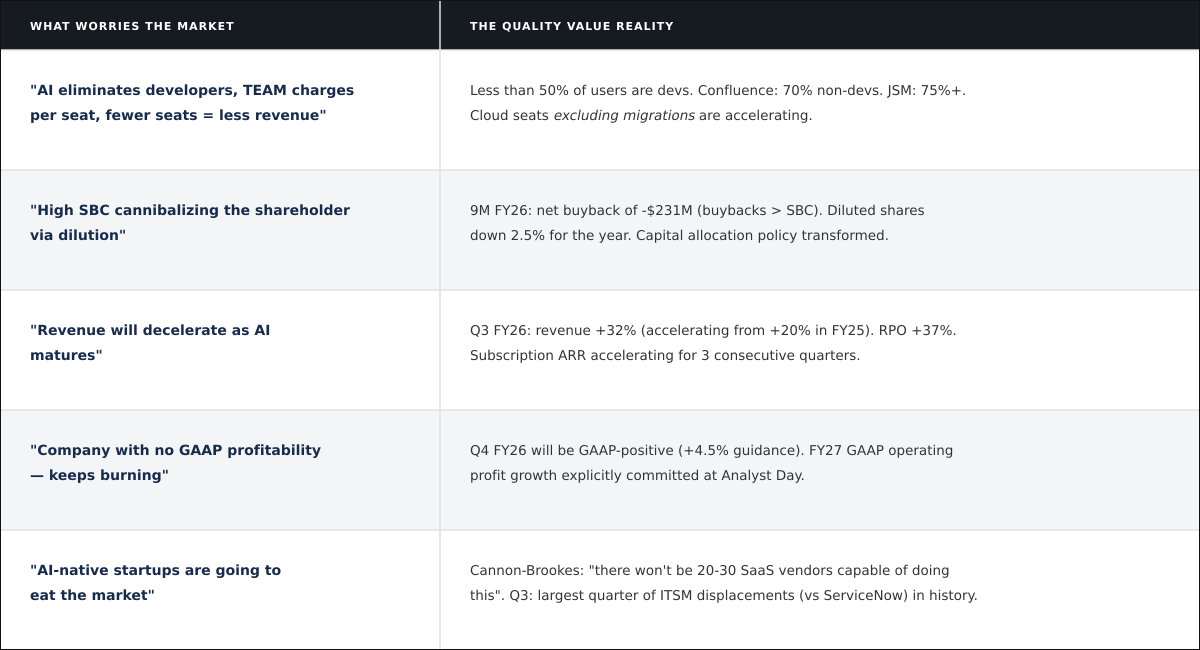
Executive Thesis
The Bearish Consensus and Why It’s Wrong
The Bullish Thesis (& Competitive Advantages)
The Numbers Challenging The Narrative
Three Scenarios for 2030 and Target Price
Our Action Plan
The Bearish Consensus and Why It’s Wrong
The bearish thesis the market holds today regarding Atlassian can be summarized in a single sentence:
AI is going to eliminate developers; developers are the ones who use TEAM; their model charges per seat; fewer seats = less revenue.
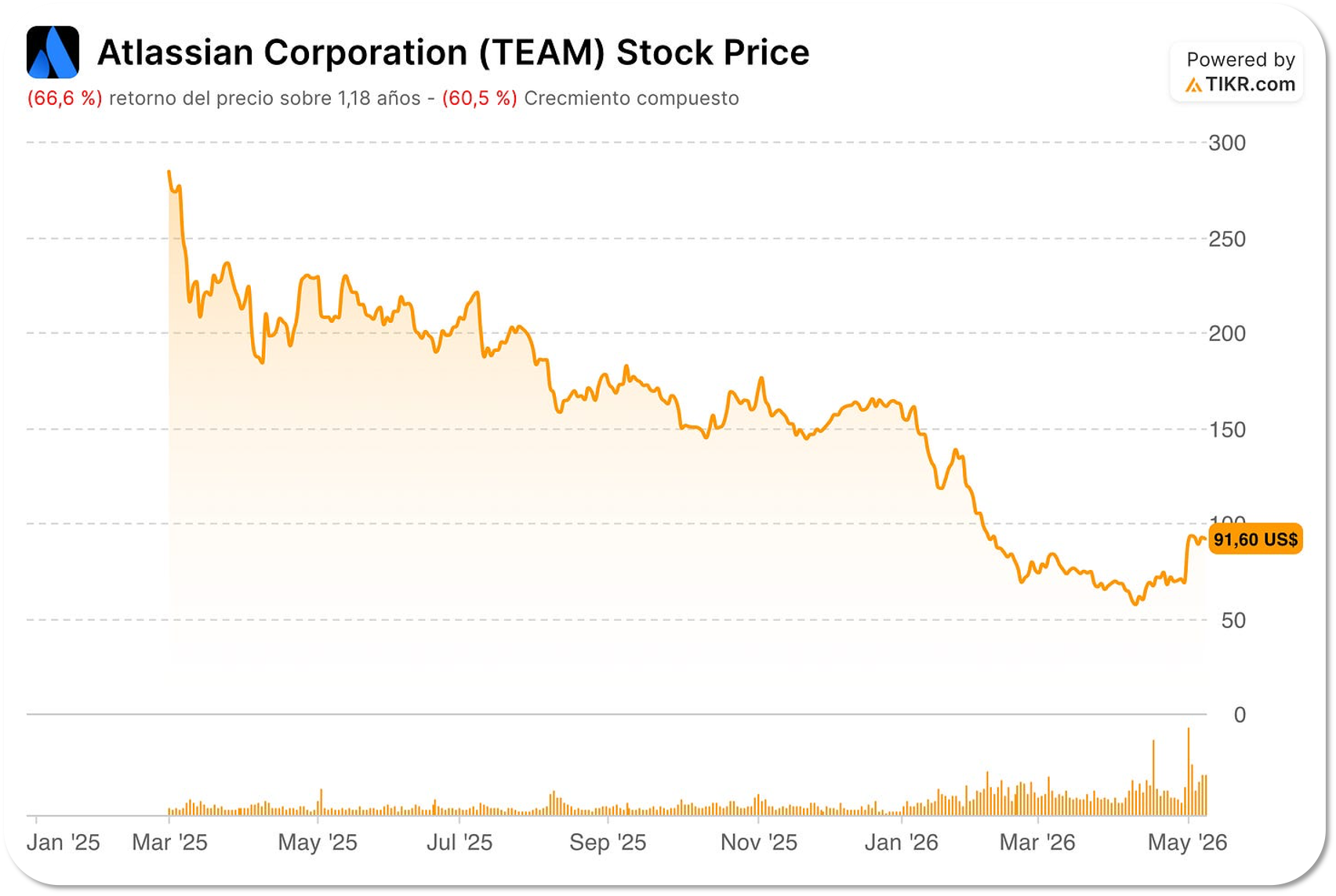
This narrative has driven the stock down more than 60% from its highs of a year ago, as part of what has been dubbed the SaaS-pocalypse.
Mike Cannon-Brookes, CEO of Atlassian, listed this bearish thesis word for word at the Analyst Day on May 6:
“AI will make devs redundant, they only serve devs, seat growth is going to die, seats are going to disappear, AI agents are going to make everything less critical, people can make their own SaaS, AI-native startups are going to kill everyone.”
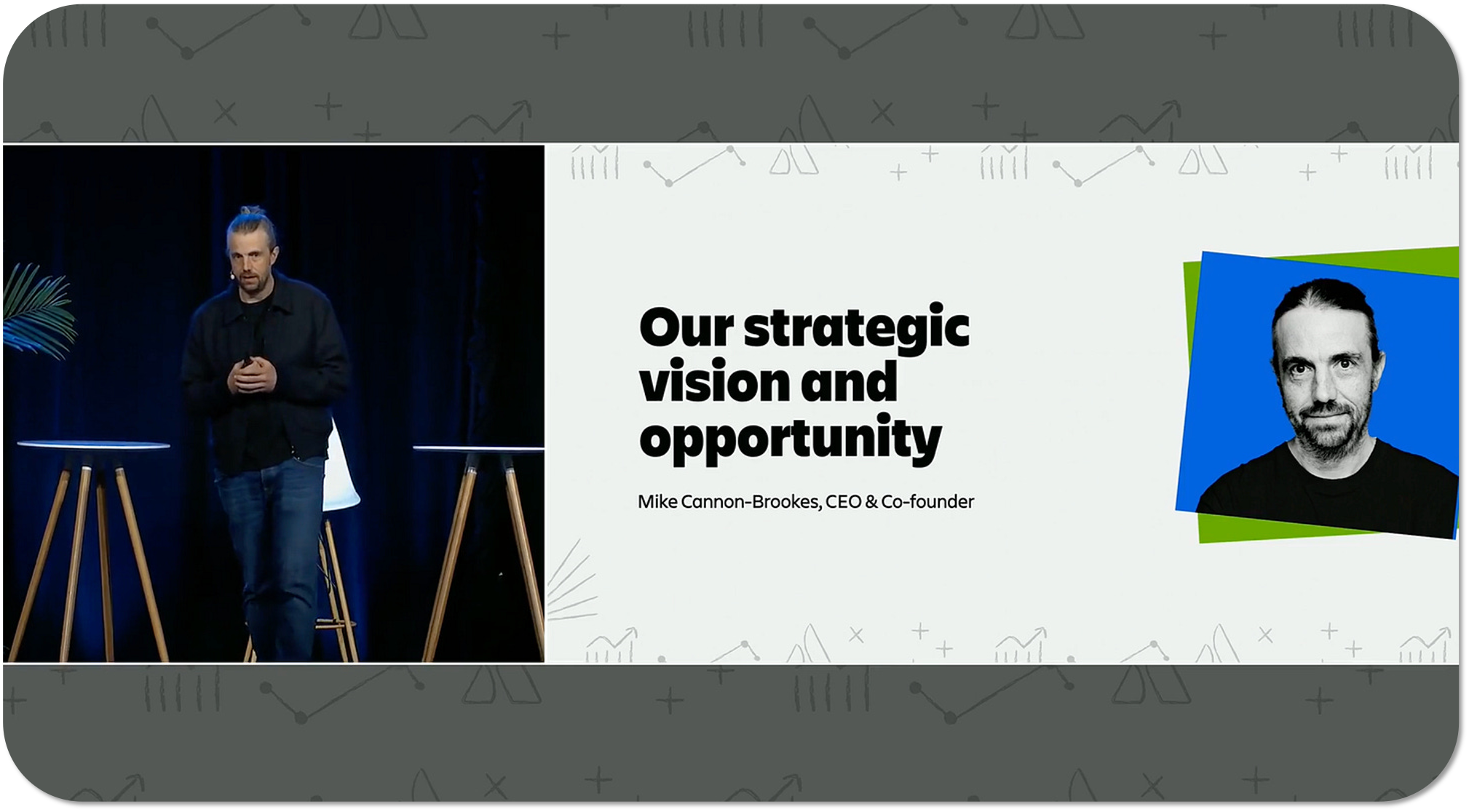
His literal response:
“It’s a ‘looking backwards’ thesis… it assumes that Atlassian is a static company, when we have been evolving for 24 years.”
The problem with the bearish thesis is that it stems from an empirically false premise.
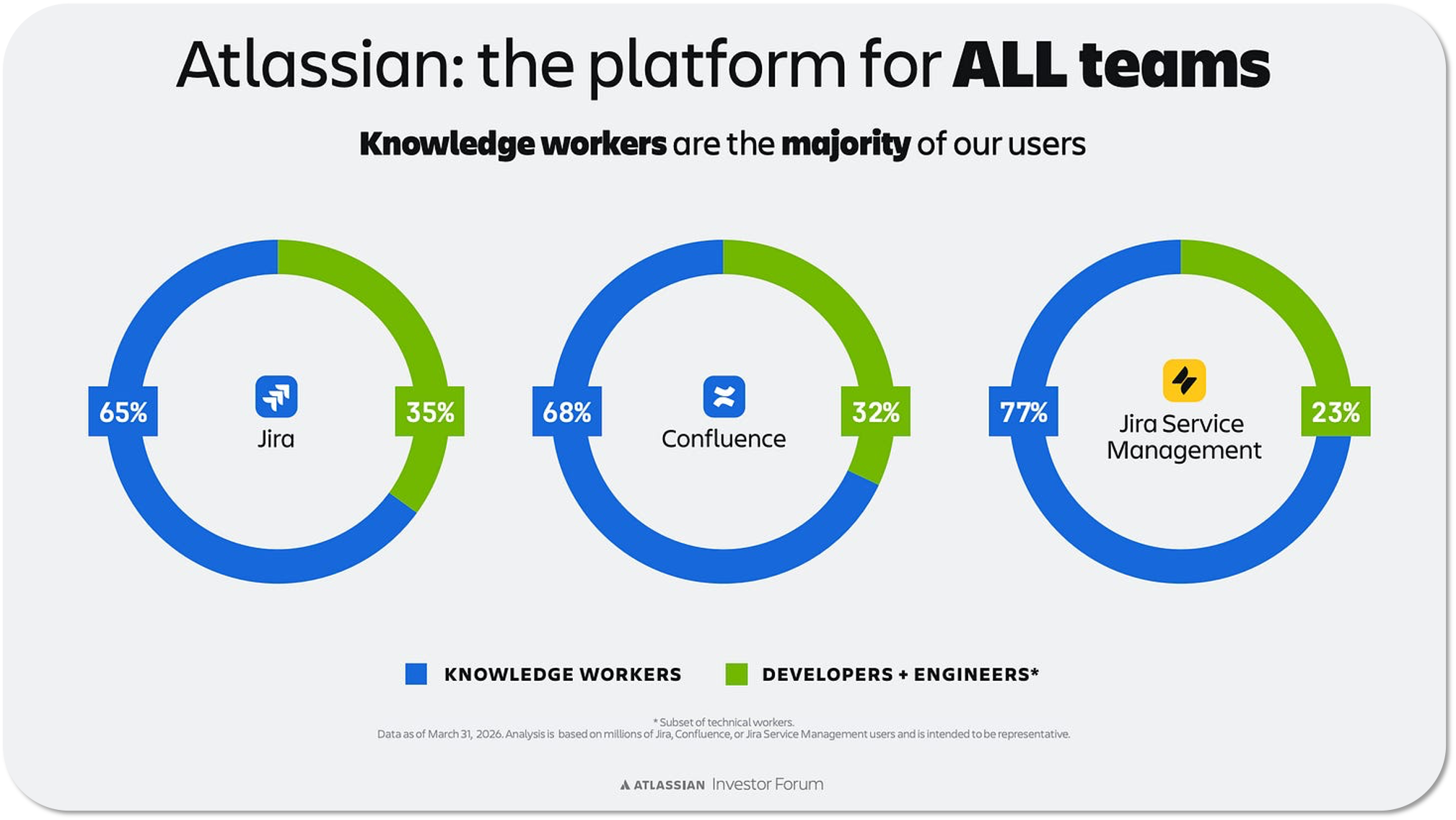
Note: Less than 50% of Atlassian’s product users are developers.
And the data they provided at the Analyst Day is highly revealing:
Confluence: 7 out of 10 users are non-developer knowledge workers (70%)
Jira Service Management: more than 75% are non-developers
Jira (the alleged “dev tool”): approximately 2 out of 3 users are non-developers (HR, finance, legal, marketing, operations, design)
Quality Value (QV): From personal experience using these tools in private companies developing software for millions of users, Atlassian’s products are the best in the market for collaboration. And that’s not just for developers, but for any role within an organization.
This market confusion is precisely what creates the opportunity we are going to look at in detail today.
The Bullish Thesis (& Competitive Advantages)
Core thesis: the software explosion demands more organization
We already shared this core thesis in our analysis of Nagarro and the IT sector, where practically identical dynamics and the same AI narrative apply as with Atlassian.
Our view is based on the prediction of British economist William Stanley Jevons.

The Industrial Revolution had dramatically improved the efficiency of steam engines: the amount of coal needed to produce a unit of work fell steadily for decades.
The “obvious” prediction was that total coal consumption in the UK would drop. The exact opposite happened: coal consumption skyrocketed. When a productive input becomes radically more efficient, its effective price drops, unlocking use cases that were previously unfeasible. Aggregate demand explodes.
The software footprint that the world needs to maintain, integrate, secure, and redesign is expanding faster than ever.
AI is dramatically lowering the barriers to creating software while simultaneously improving product quality.
More product + better product + lower cost = software demand hitting overdrive
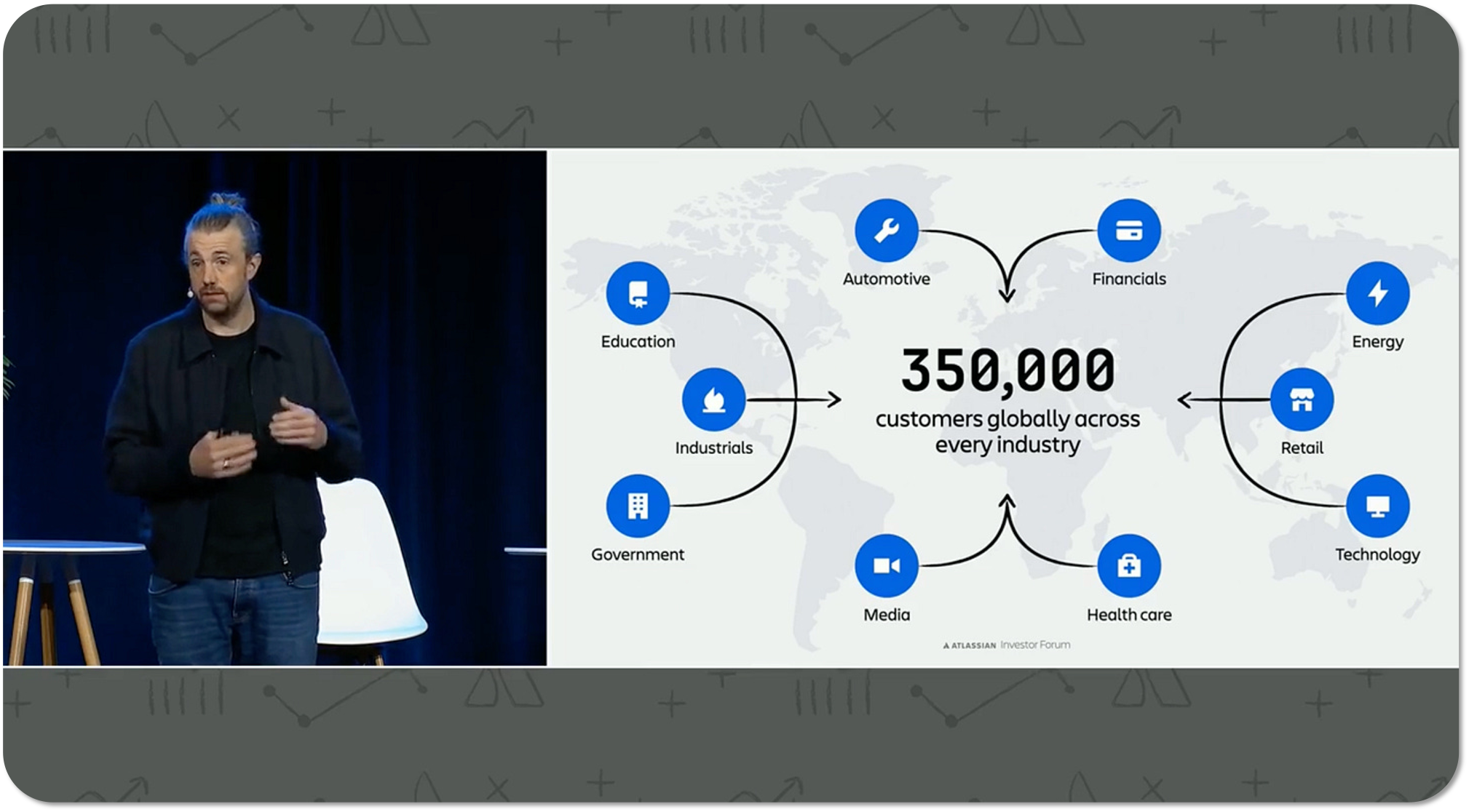
Mr. Cannon-Brookes expressed this in provocative terms at the Investor Day: he argues that there will be more developers in the AI era, not fewer.
The current triad of Product Manager + Developer + Designer (and this is our opinion), will evolve into a single multidisciplinary profile, supported by AI, with a vision for product, business, and design. The engineer of the future orchestrates agents, validates outputs, and makes product decisions.
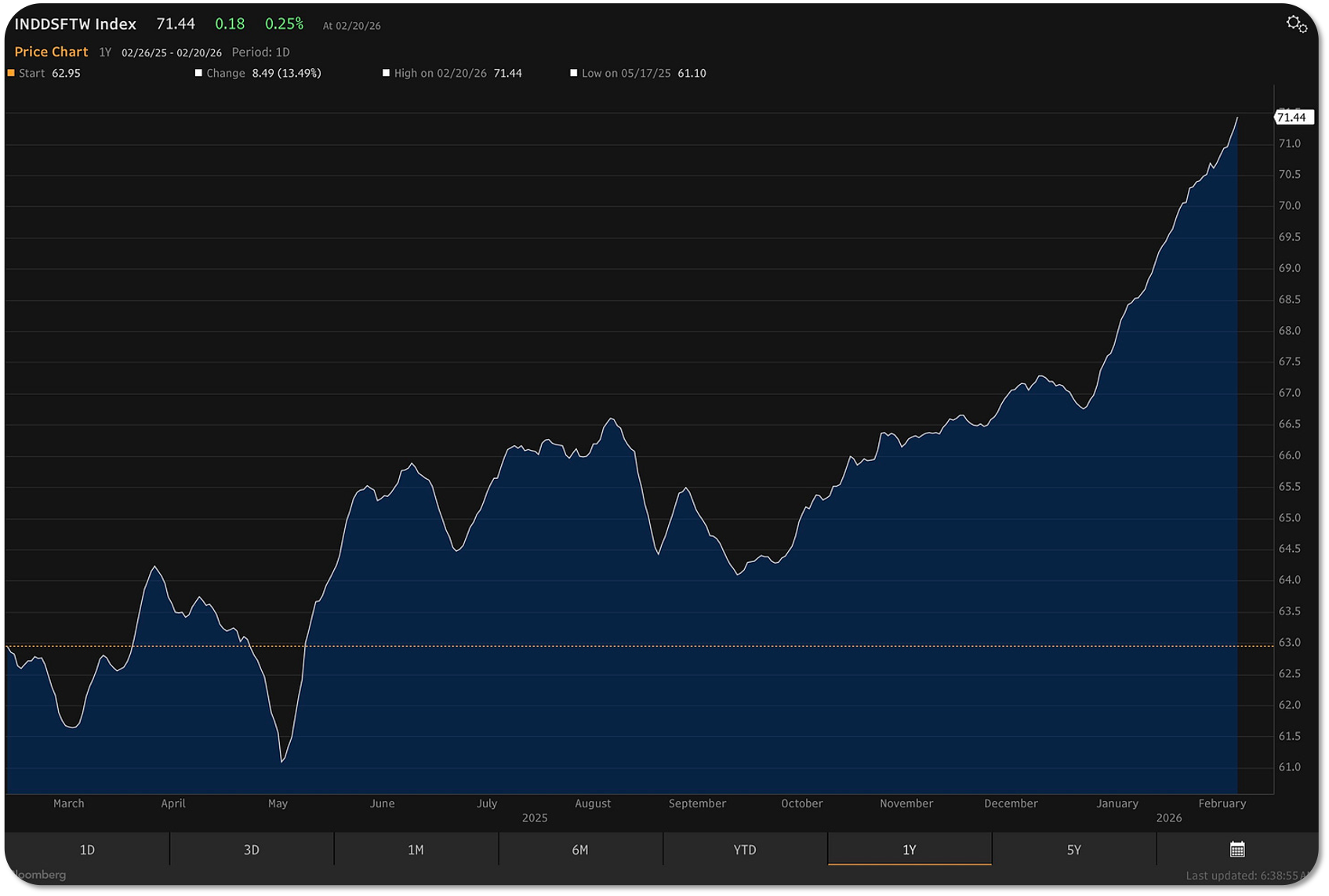
To support this view, look no further than the Bloomberg Software Labor Demand Index (INDDSFTW): it hit record highs in February 2026 (71.4 vs. 62.9 a year ago). This is sector-wide data, not company-specific. It is the best quantitative refutation available against the bearish software thesis.
Atlassian Will Reign in the Chaos
If software creation accelerates, the associated organizational chaos multiplies.
Every new feature generates tickets, decisions, dependencies, specifications, conversations, reviews, tests, deploys, incidents, and postmortems.
That work needs to be channeled and organized, and that is exactly the problem Atlassian has existed to solve since 2002.
The company is not a victim of AI disruption; it is critical infrastructure for the AI era.
Cisco’s testimony at the Analyst Day articulated this perfectly.
Cisco manages 25k-30k networking engineers on Atlassian’s platform. They saw a 5% productivity uplift just by adopting the System of Work, and a 40% reduction in the Total Cost of Ownership (TCO) of managing the platform itself.

The platform is not becoming less relevant; it is becoming mission-critical. And this, as we will explain later, is one of Atlassian’s key competitive advantages.
The Part Where We Talk About Quality
Pricing model: from pure per-seat to a mix of seats + consumption
The nuanced objection of the bear case is legitimate: if tickets previously handled by a developer are now done by an AI agent, the customer theoretically needs fewer human seats.
The most compelling data point from the Analyst Day:
Mr. Cannon-Brookes showed a chart of cloud seats excluding all migrations, aka pure organic demand. The curve continues to accelerate quarter over quarter.
It is the most direct visual proof against the narrative that “seats are going to evaporate.”
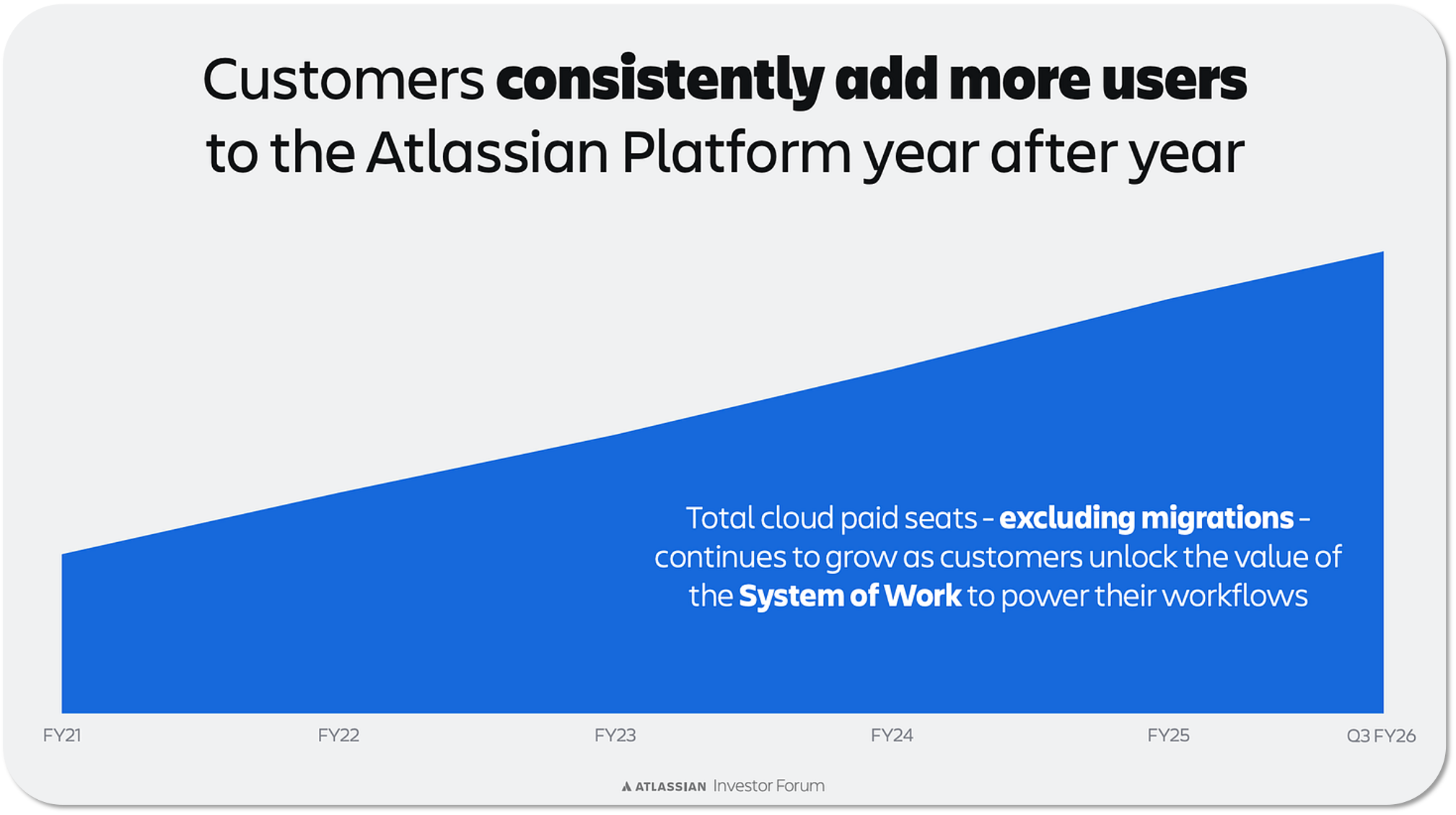
Our hypothesis is that the AI agent will end up being just another user, a virtual seat with its own recurring cost.
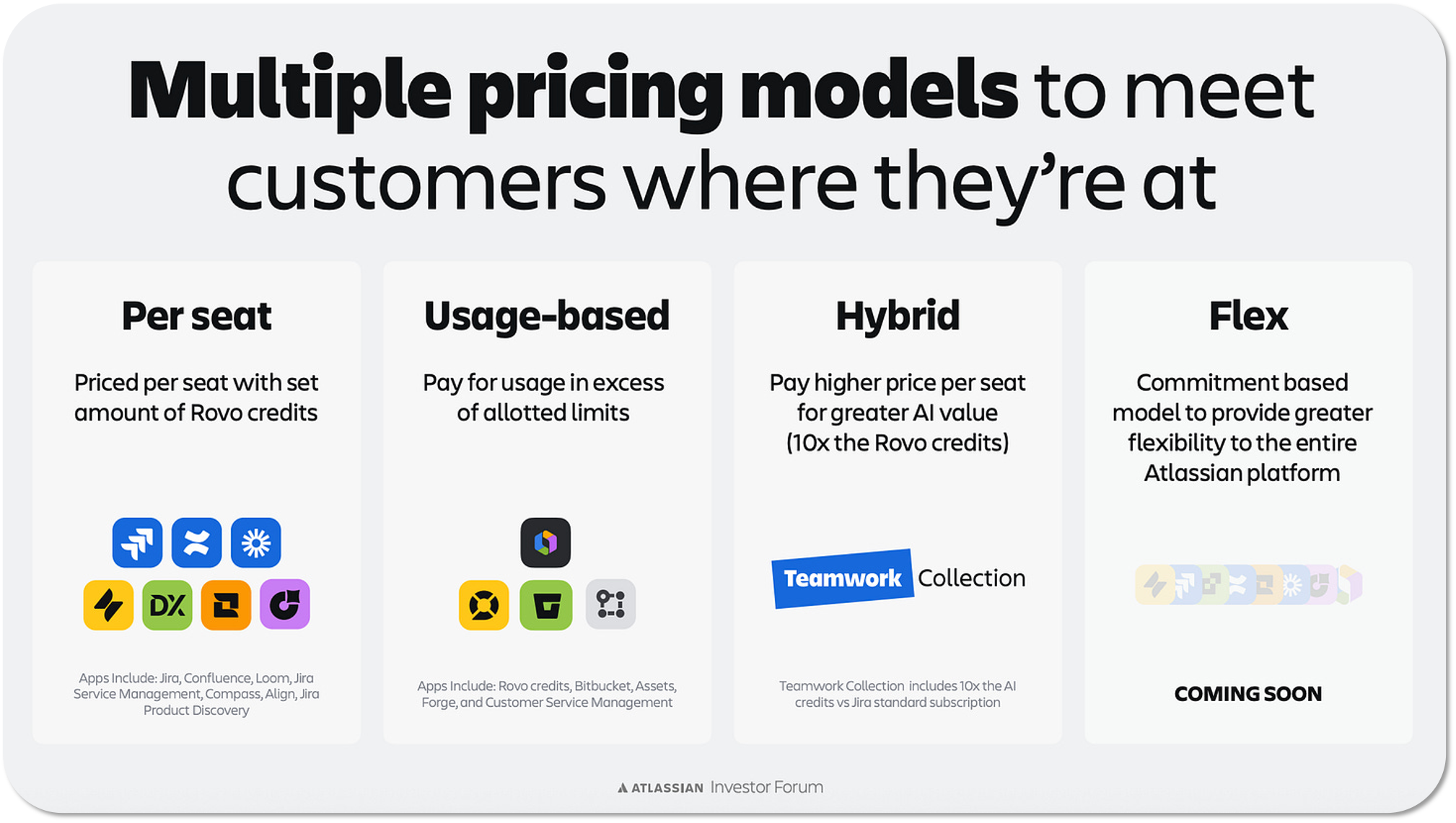
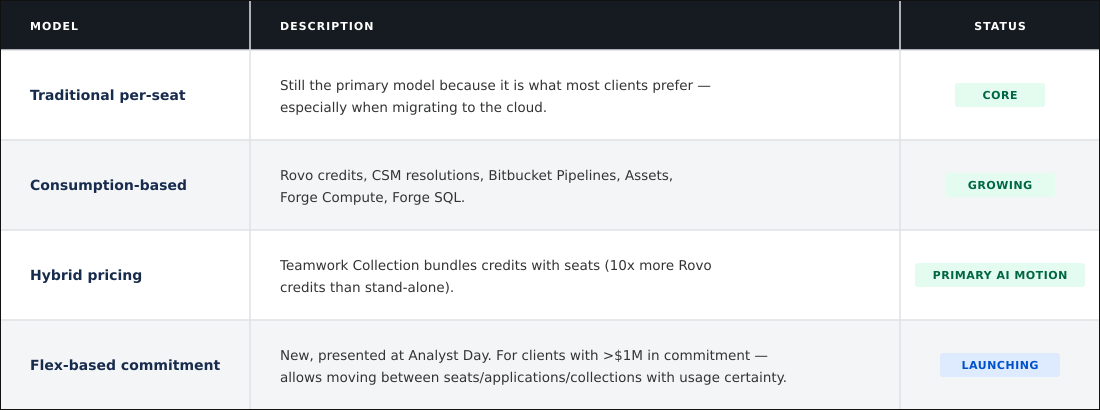
Atlassian is already building this hybrid future with four pricing models operating in parallel:
Traditional per-seat remains the primary model because it is what most customers prefer, at least for now. This is especially true when they migrate to the cloud.
Growing consumption-based Rovo (their chatbot) credits, CSM resolutions, Bitbucket Pipelines, Assets, Forge Compute, Forge SQL.
Hybrid pricing w/ Teamwork Collection bundles credits with seats.
Flex-based commitment model (new, presented at the Analyst Day) for customers with >$1M in commitment, allowing them to move between seats/applications/collections with usage certainty.
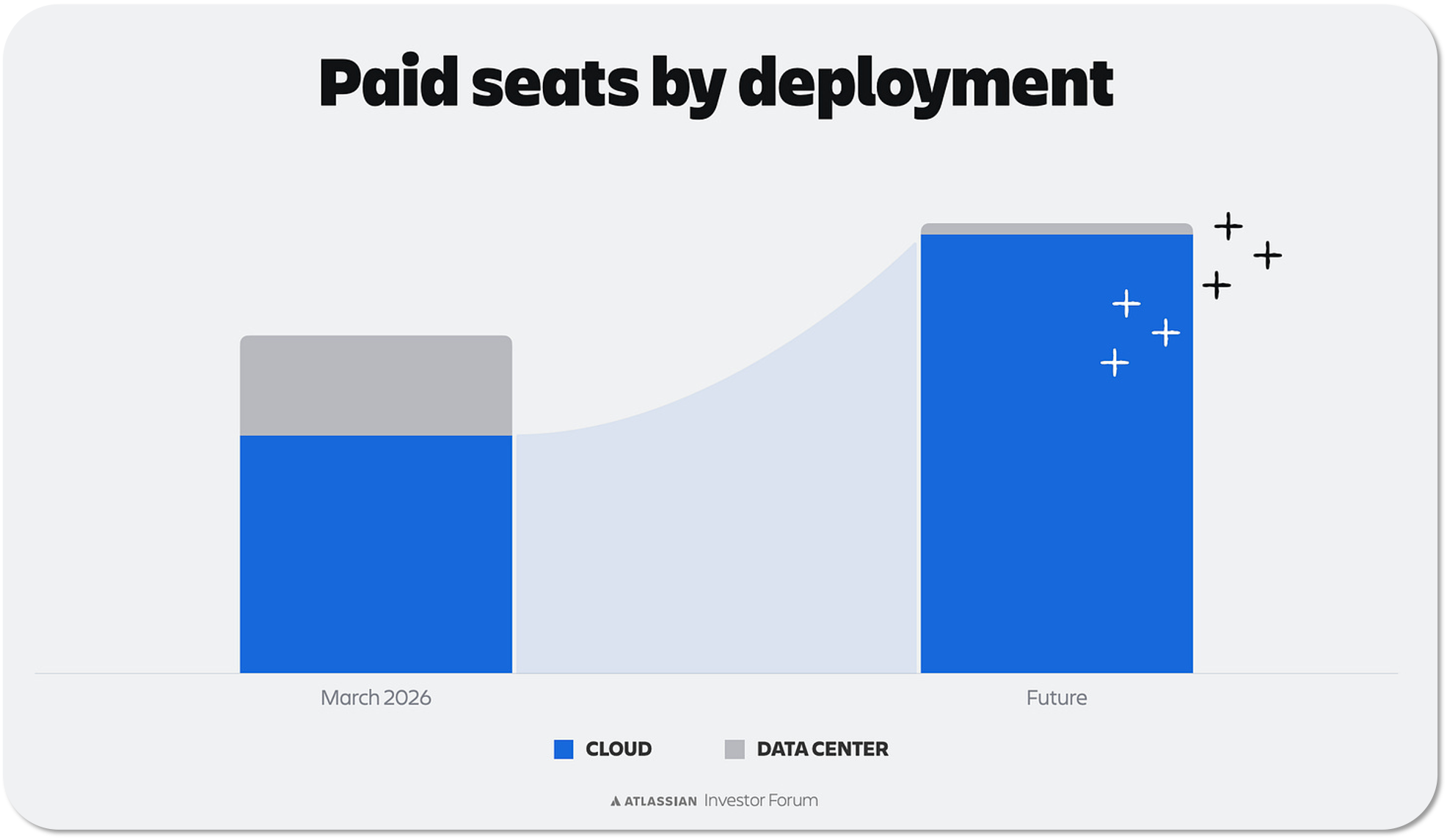
Ultimately, at the Analyst Day, Cannon-Brookes confirmed that this pricing flexibility is deliberate, not improvised. It allows them to adapt to whichever direction the AI market takes without having to reinvent the model.
Revealing metric: customers using MCP grow at 2x
A metric from the Analyst Day that deserves attention: customers using MCP server grow their ARR at 2x the rate of those who do not use it. This suggests that the “agentic + consumption” direction works economically. It is much more than just a theory, as it already has demonstrable data backing it up.
Note on MCP (Model Context Protocol): an open standard created by Anthropic in 2024 that acts as a "USB-C for AI agents", allowing any AI tool (Claude, Cursor, ChatGPT, etc.) to access Atlassian's Teamwork Graph in a standardized way. Every external agent that queries the Teamwork Graph via MCP reinforces the centrality of the graph in the customer's workflow.
The strategic paradox: by opening the Teamwork Graph via MCP, Atlassian increases its moat instead of reducing it. Every external agent that reads from the graph also writes back, creating classic network effects. The company positions itself as neutral infrastructure for the agentic era, not a walled-off garden.
The Data Validating Our Vision
The data published by the company points in a single direction: more AI usage on the platform leads to more consumption and higher revenue.
Here are some of the key data points validating this thesis:
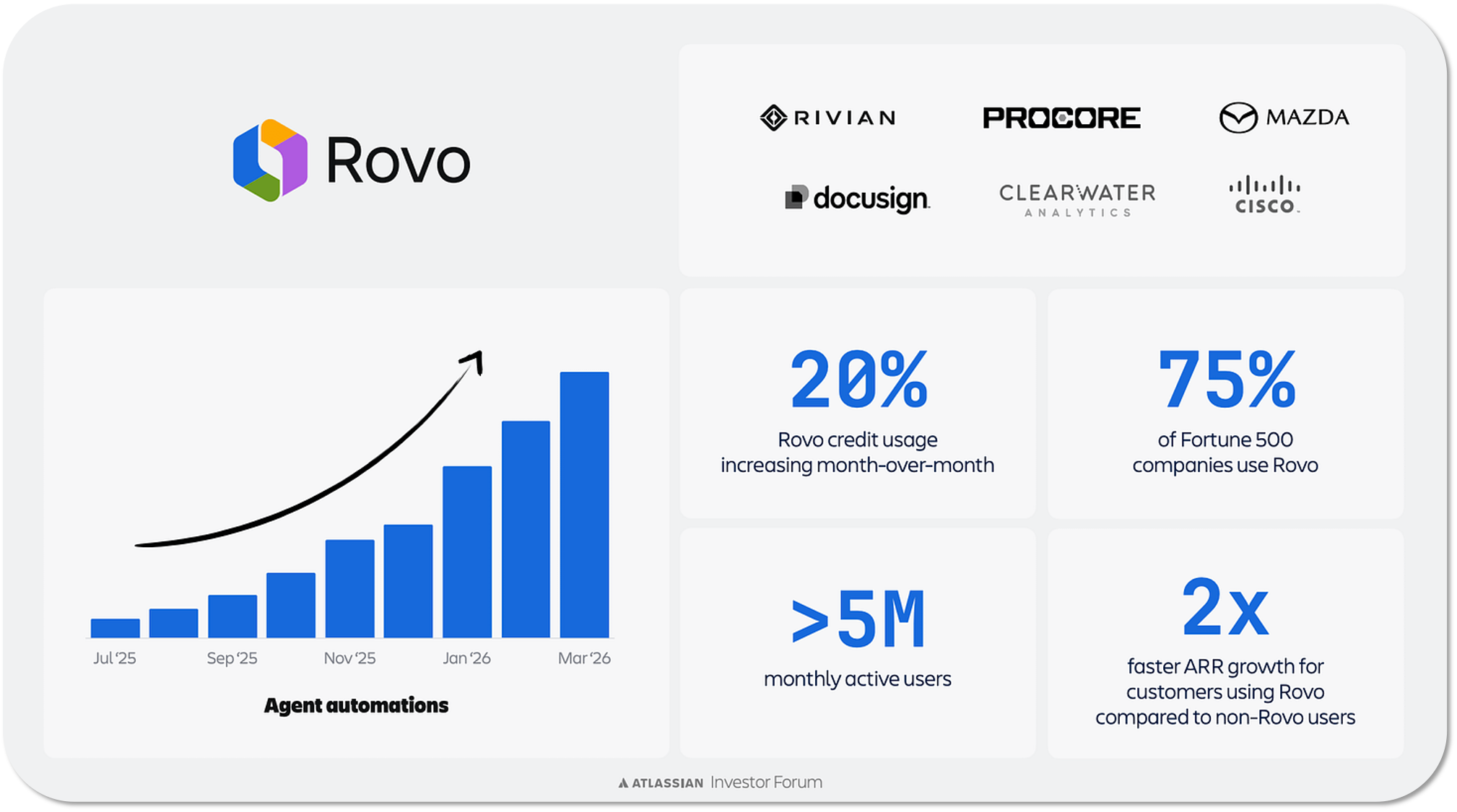
Customers adopting Rovo grow their ARR at 2x the rate of non-Rovo customers.
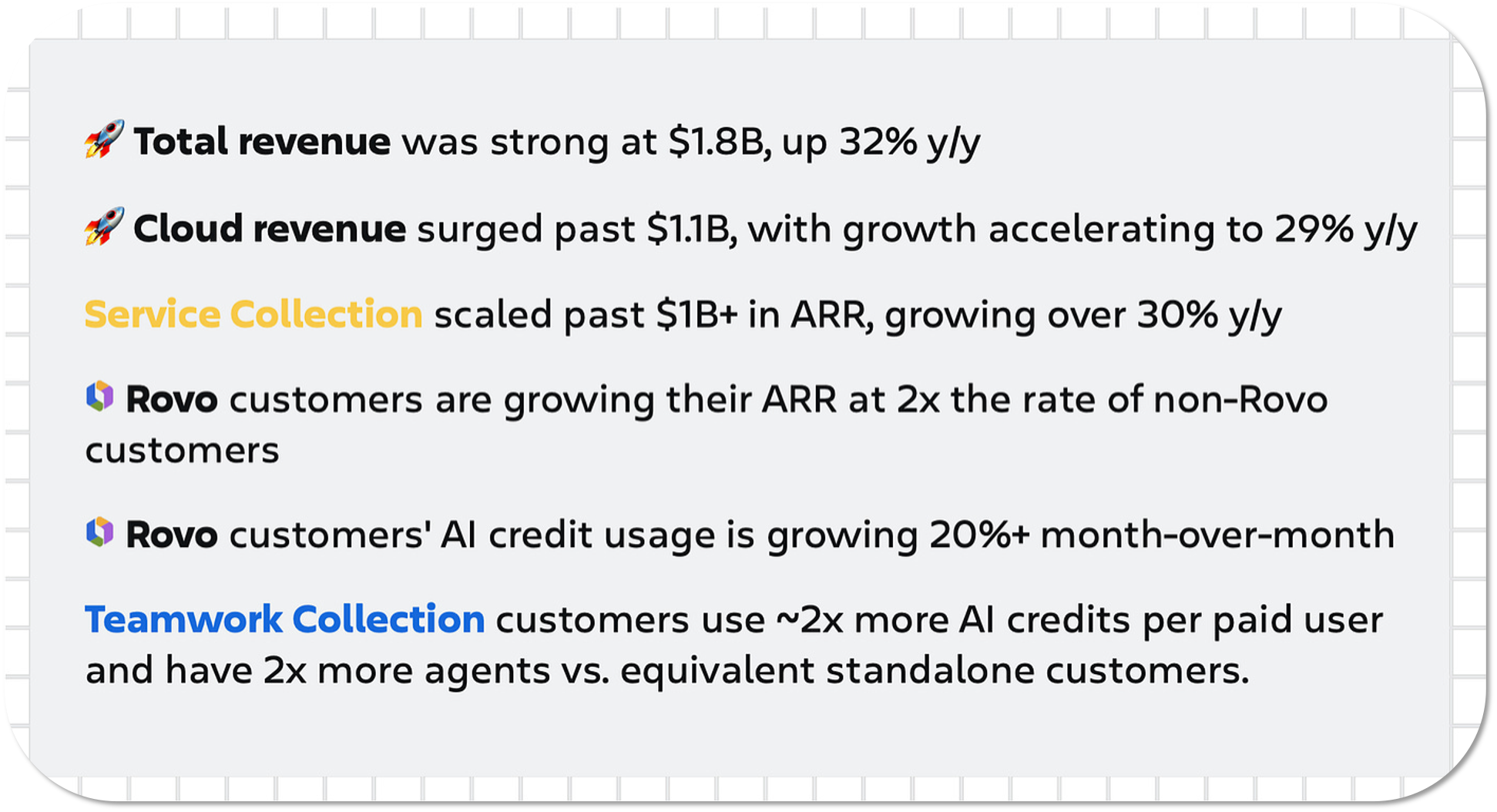
AI credit usage is growing +20% month-over-month. That’s an exponential curve, still in a very early stage of adoption.
75% of the Fortune 500 already has Rovo activated (Analyst Day data).
Teamwork Collection customers use 2x more AI credits and have 2x more agents.
1,000+ customers and 1M+ seats in the first 6 months of the Teamwork Collection.
Service Collection crossed $1,000M ARR, growing +30% YoY, with enterprise growing +50% YoY.
Service Collection customers using AI resolve incidents 13% faster and handle 20% more total incidents.
Customers using MCP server grow ARR at 2x the rate of those who don’t, as previously mentioned.
The Real Impact of AI = Efficiency, Not Cannibalization
It would be naive to say that AI has no impact on Atlassian.
It does, but the vector is different from what the market perceives: it is an increase in internal efficiency, not a drop in external demand.
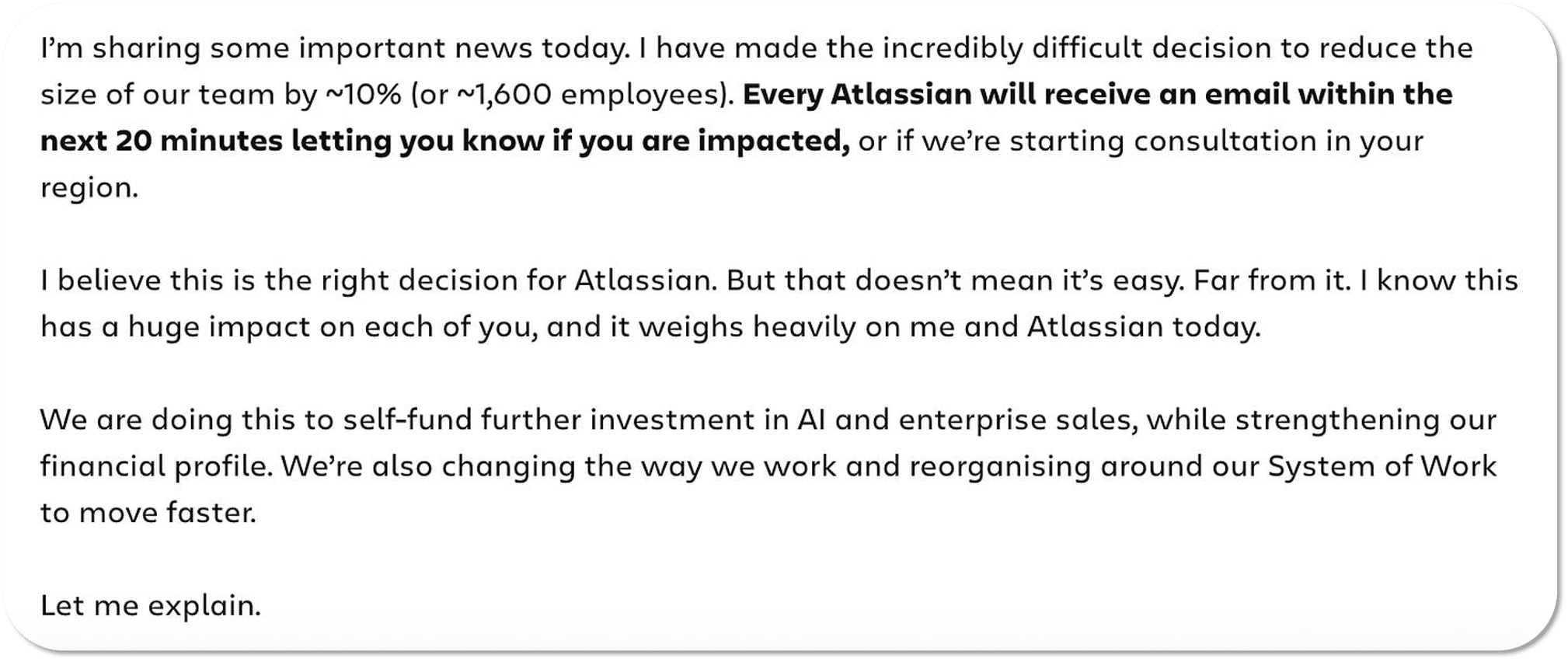
The 10% staff layoffs in March 2026 (1,600 employees, ~$224M in restructuring charges) are the proof: Atlassian itself is using AI to do more with less staff.

The rationale behind the latest acquisition: seeking efficiency
One of the most revealing recent acquisitions is DX (~$1,000M).
Management’s rationale was exactly this: how to measure whether investments in developer experience tools (including AI) produce real ROI.
DX becomes the tool that justifies spending on all other AI tools, including Rovo itself.
Every company investing millions in Copilot, Cursor, Rovo Dev, etc., wants to know if they are getting a return.
At the Analyst Day, Brian Duffy (CRO) shared a revealing data point: 75% of DX transactions are associated with AI and the ROI of agents specifically. It is the lever that every CFO is asking for.
Competitive Advantages: Product, Suite, Data, Switching Costs
QV: This is the most important part of the thesis.
As we have discussed in several articles, the 7 competitive advantages of intangible businesses against AI are the filter we apply before investing in any company potentially disruptible by AI.
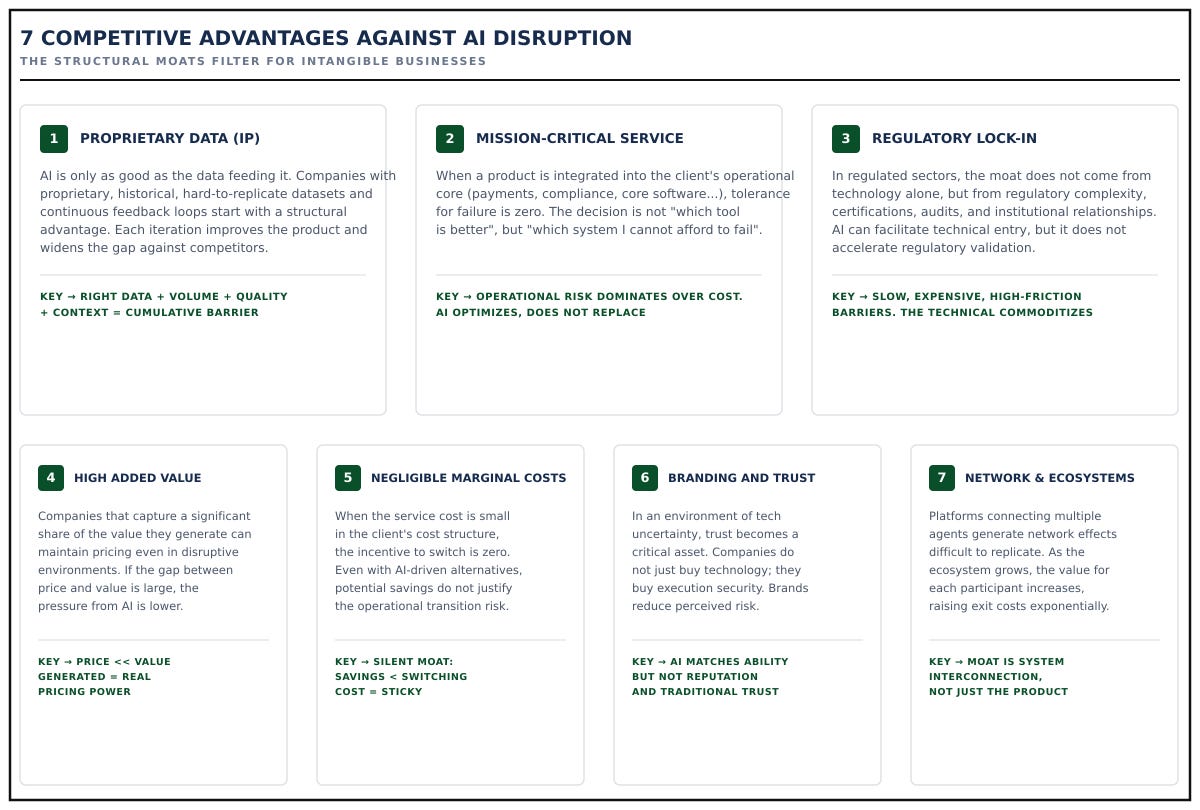
Before investing in a business that could be disrupted by AI, we must see which of those 7 advantages it possesses. If it doesn’t meet at least one broadly or two complementary ones, we are looking at an uninvestable business today.
In our opinion, Atlassian checks 2 of these boxes broadly and another 4 to a lesser extent, but they all complement each other. Let’s break each of them down in detail, followed by our conclusion.
The Product is the King
The most important thing for any business is to have a great product. If you have a great product, everything else, at some point, becomes easier.
And Atlassian doesn’t just have one great product; it has several great products, multiple products that generate billion-dollar businesses.
In the Q3 FY26 shareholder letter, Cannon-Brookes summed it up with the most quoted line of the quarter:

Atlassian’s Individual Products · A Quick Guide
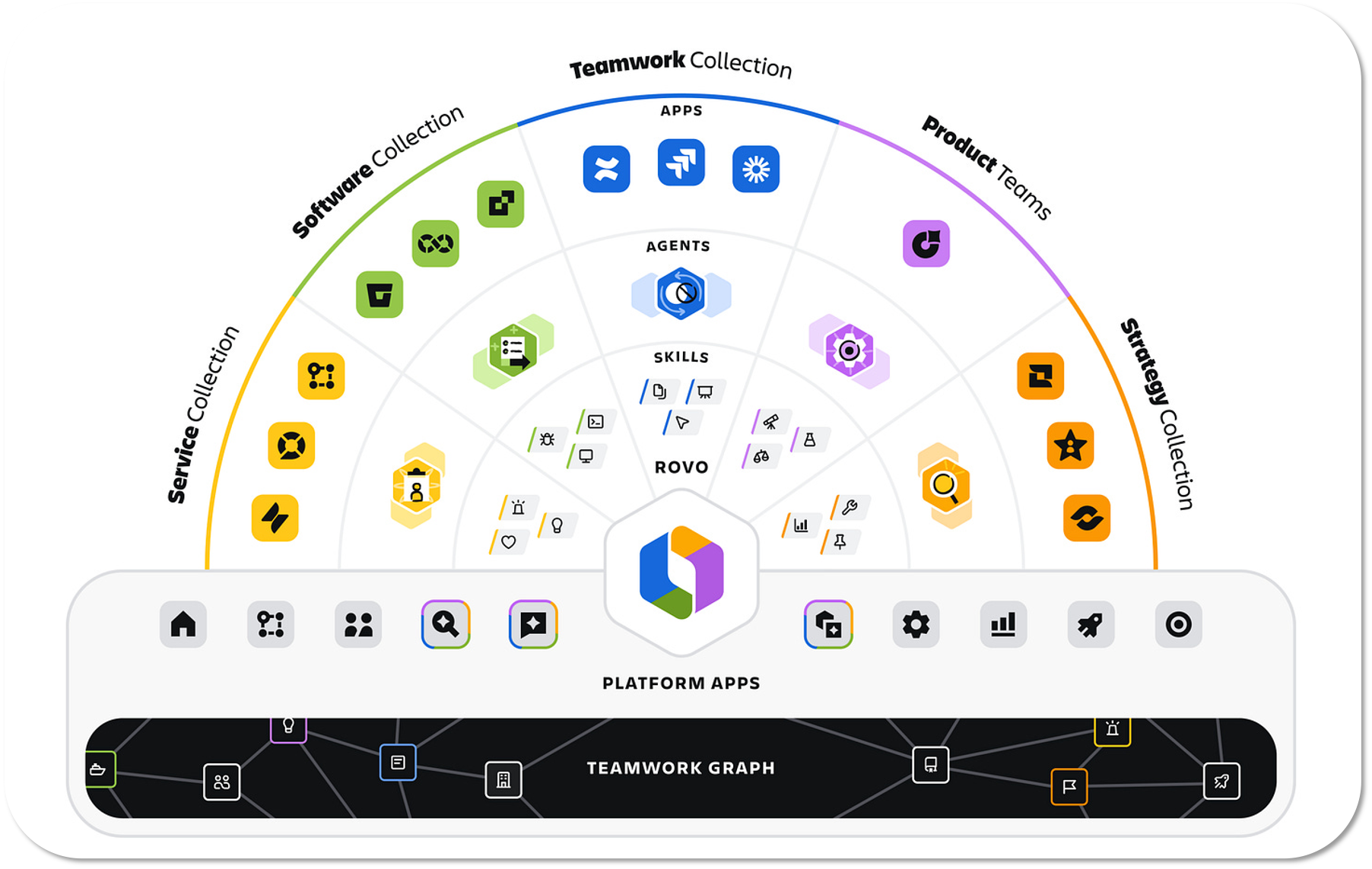
For anyone not familiar with the ecosystem: Atlassian structures its catalog into individual apps, which are then grouped into “collections” (optimized bundles with a discount and extra AI credits):
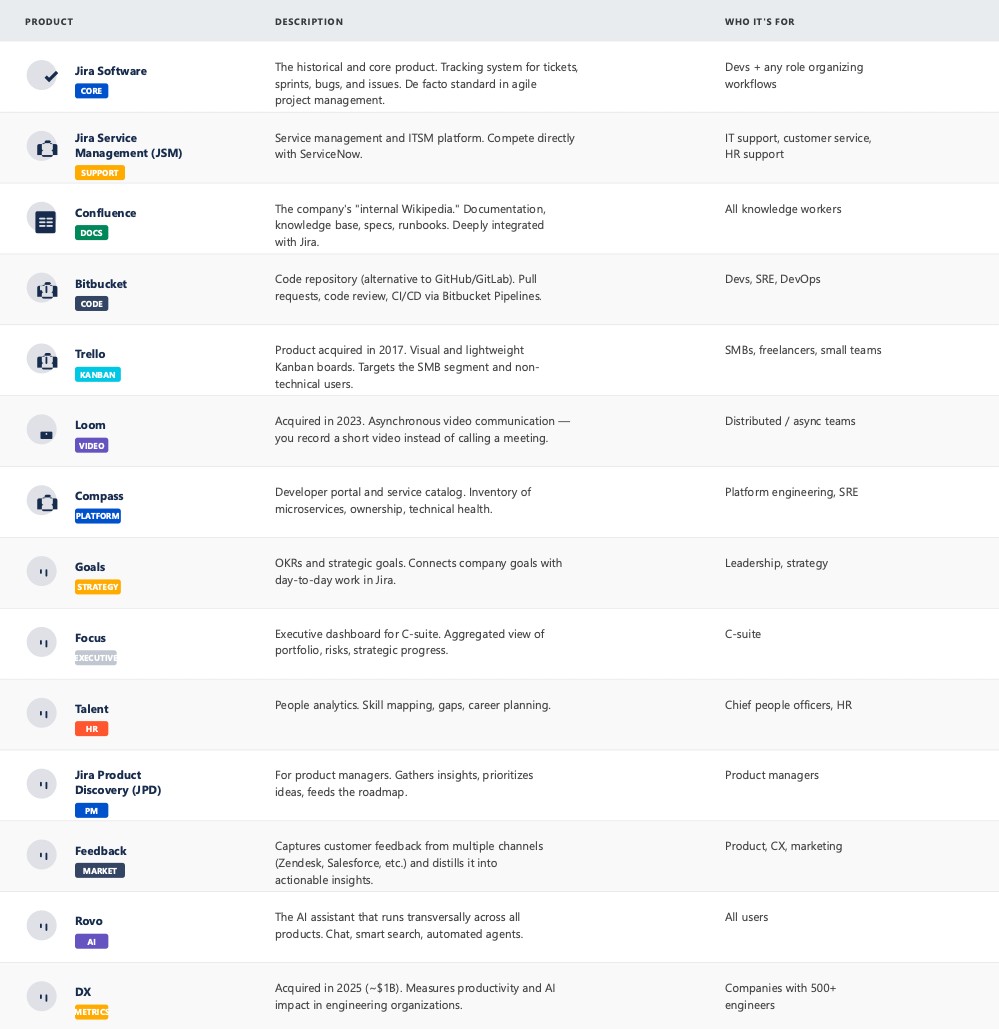
Collections (5 bundles with discounts + extra AI credits)
Software Collection: Jira + Bitbucket + Compass. For engineering teams.
Service Collection: JSM + Assets + Rovo. For IT, HR, and customer service.
Teamwork Collection: Jira + Confluence + Loom + Rovo (10x more credits than stand-alone). The main AI monetization motion.
Strategy Collection: Goals + Focus + JPD. For the C-suite.
Product Collection: JPD + Feedback. For product managers.
And beneath everything runs the Teamwork Graph: the data layer that connects all information from all products into a single knowledge graph that feeds Rovo and external tools via MCP. It is the differentiating component… and we analyzed it for you in depth.
Interconnected suite and upselling lever
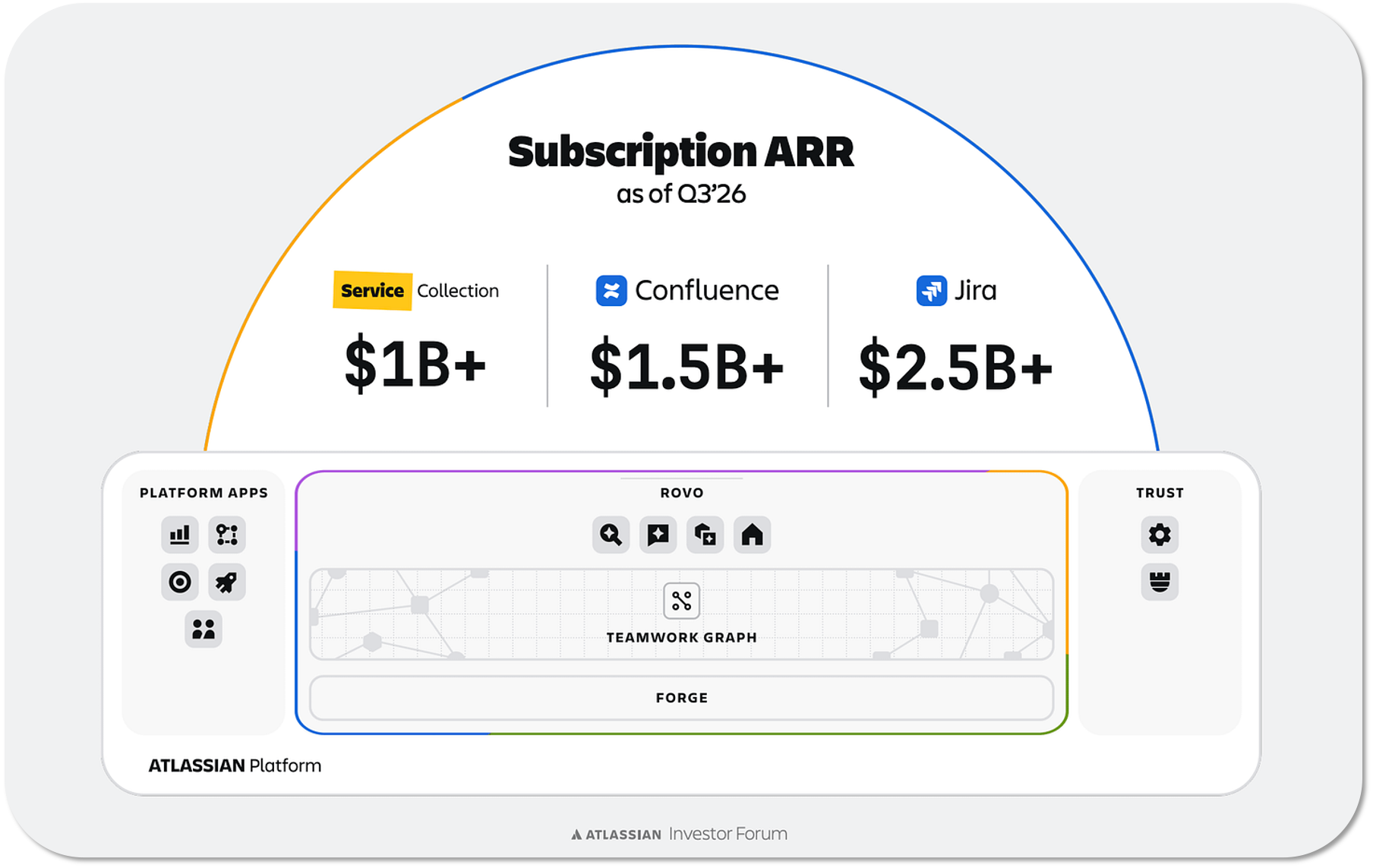
It’s not one product, but 10+ deeply interconnected ones. The individual scale of each one separately is very significant, as you can see from the following data:

Three billion-dollar+ businesses running on a single platform.
The data generated by each product enriches the others, opening up powerful upselling: the customer who entered with Jira for devs ends up buying the Service Collection for HR and IT, the Strategy Collection for the C-suite, and Compass for SRE.
Ultimately, as of today,
… they have the best collaboration product on the market.
But also, at a very attractive price…
In the service management category, JSM charges ~$55-85/agent/month on its Enterprise tier (with Rovo AI included in Premium and Enterprise), compared to ServiceNow ITSM Pro+’s ~$160+/fulfiller/month plus its additional modules.

For the time being, in our opinion, Atlassian has the best collaboration product on the market at a dramatically lower price. It is a rare combination in enterprise software.
The Teamwork Graph · The AI Moat
Atlassian has valuable data, it’s just different in nature compared to other major enterprise vendors:
Salesforce has the customer context.
ServiceNow has the incident and CMDB context.
Microsoft has the document context.
Atlassian has end-to-end work context. From the initial idea in Jira Product Discovery, through the sprint in Jira Software, the commits in Bitbucket, the documentation in Confluence, the incident in JSM, and the strategic decision in Goals.
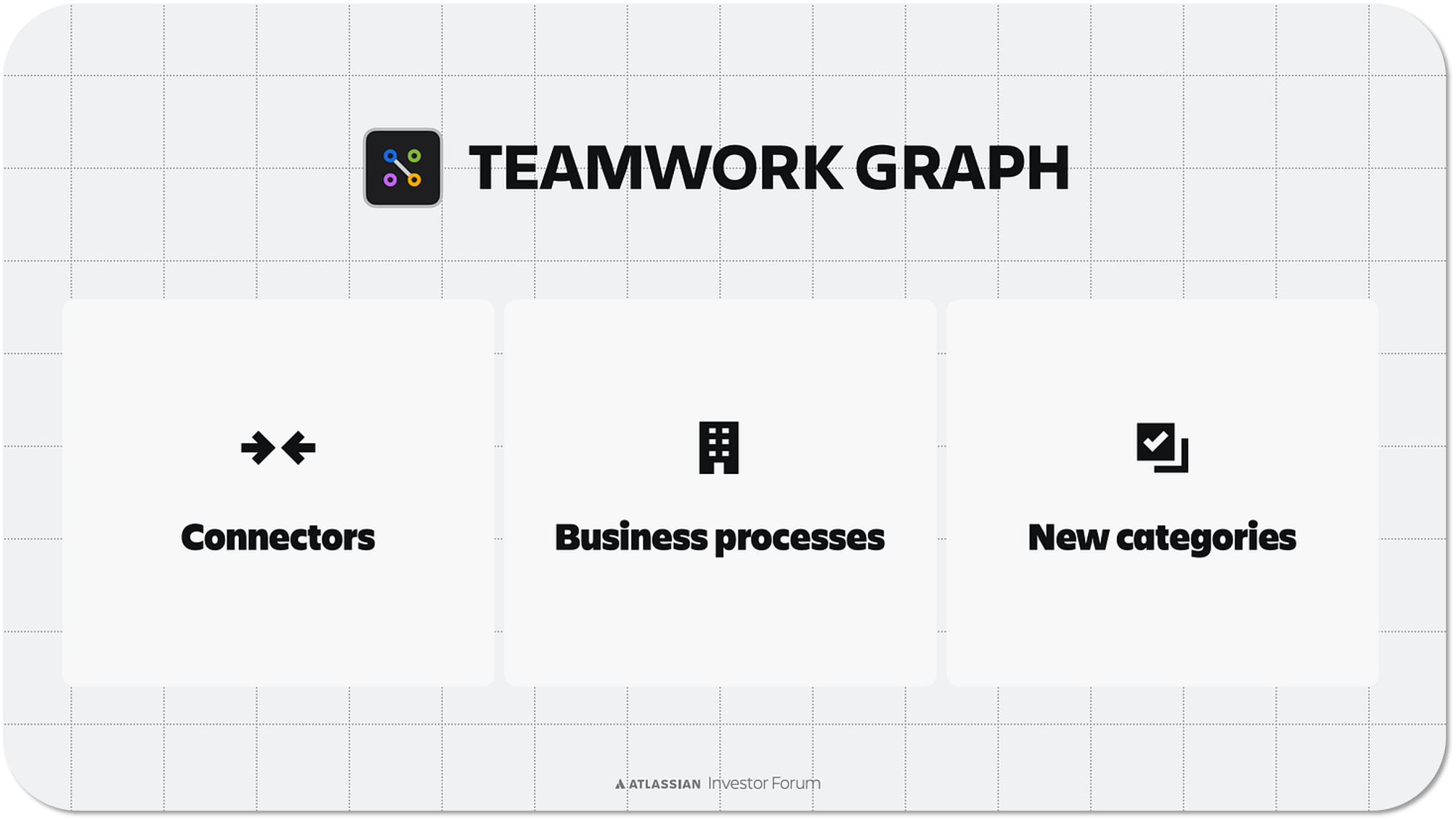
The ROI Demo · The Most Compelling Part of the Analyst Day
At the Analyst Day, Atlassian showed a live demo of the Teamwork Graph’s ROI, which is the best proof of a moat they have ever presented.
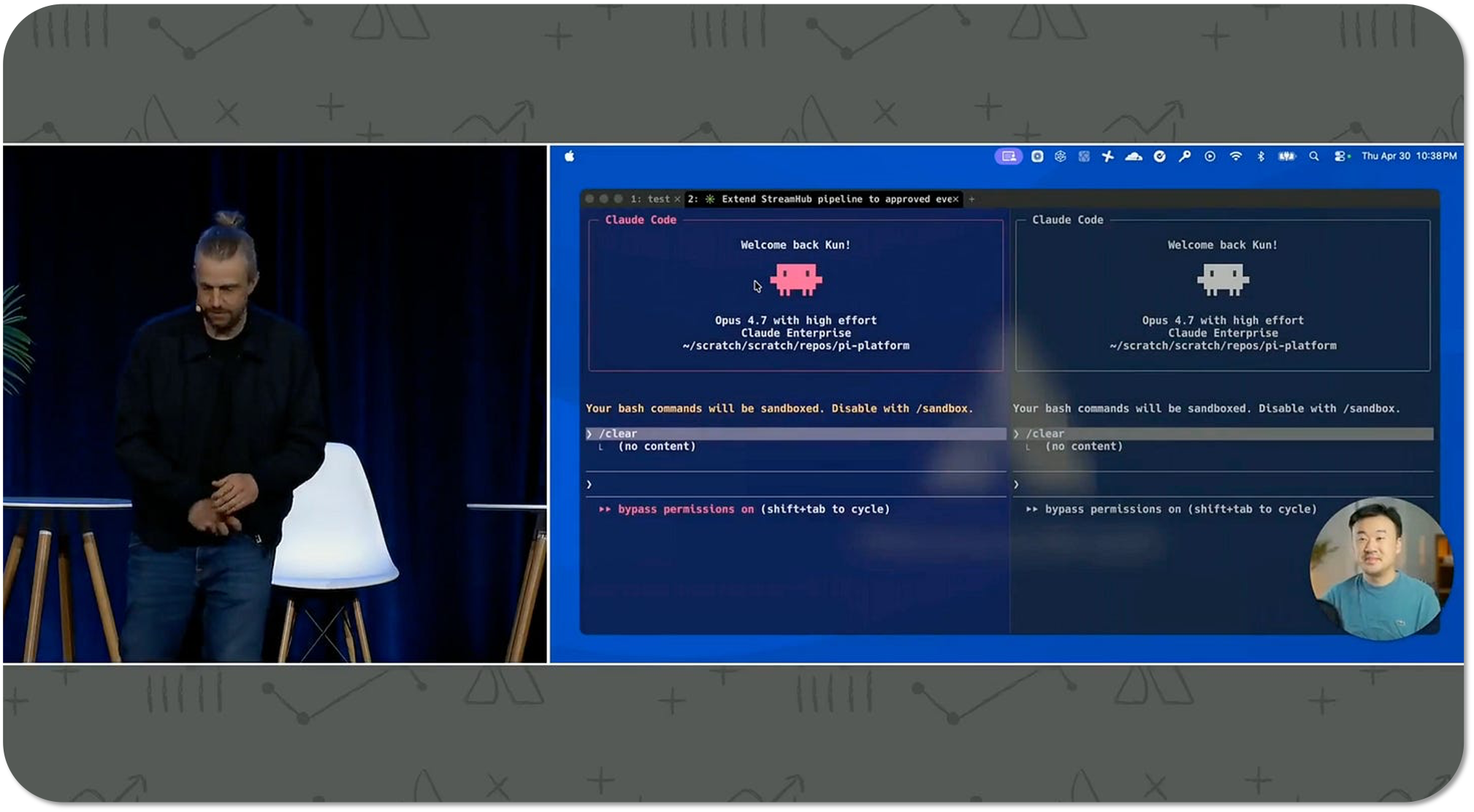
Using the exact same complex engineering task and the exact same agentic harness (Claude Code):
Without Teamwork Graph: $2.68 per task
With Teamwork Graph: $1.32 per task
They managed to get a very impressive result: 51% cheaper, 44% better output quality, 48% fewer tokens consumed, and it finished 1 minute faster.
And the math becomes even more favorable the more complex the tasks are.
Mr. Cannon-Brookes tied this directly to their competitive moat with a categorical statement about the enterprise AI era: there won’t be 20 or 30 SaaS vendors capable of doing this.
But what is context and why is it valuable?
First, let’s explain what context actually means in this scenario:
Context: all the information an AI model needs to have in front of it to understand what you are asking and provide a good response.
An AI model on its own is like a newly hired expert: brilliant in general, but knows nothing specific about your company.
It doesn’t know your projects, your code, your past decisions, who did what, when, or why. “Context” is precisely that specific information passed to the model in each interaction so it can reason about your concrete situation.
A Practical Example….
Imagine asking Claude:
“Why is this deployment failing?”
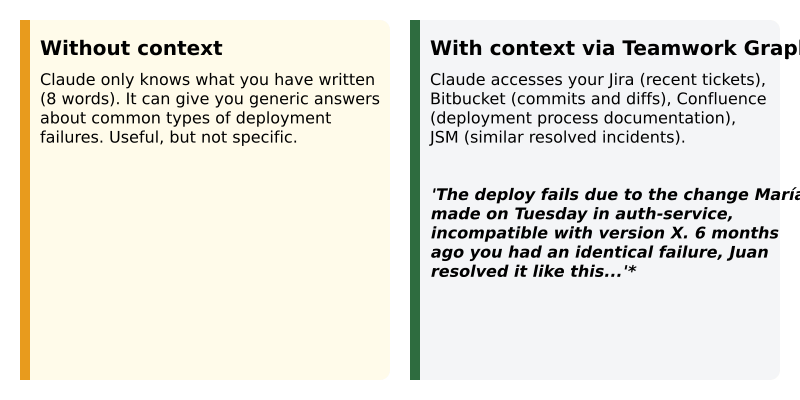
The difference in the quality of the answer is radical, and it comes 100% from the context, not the model itself.
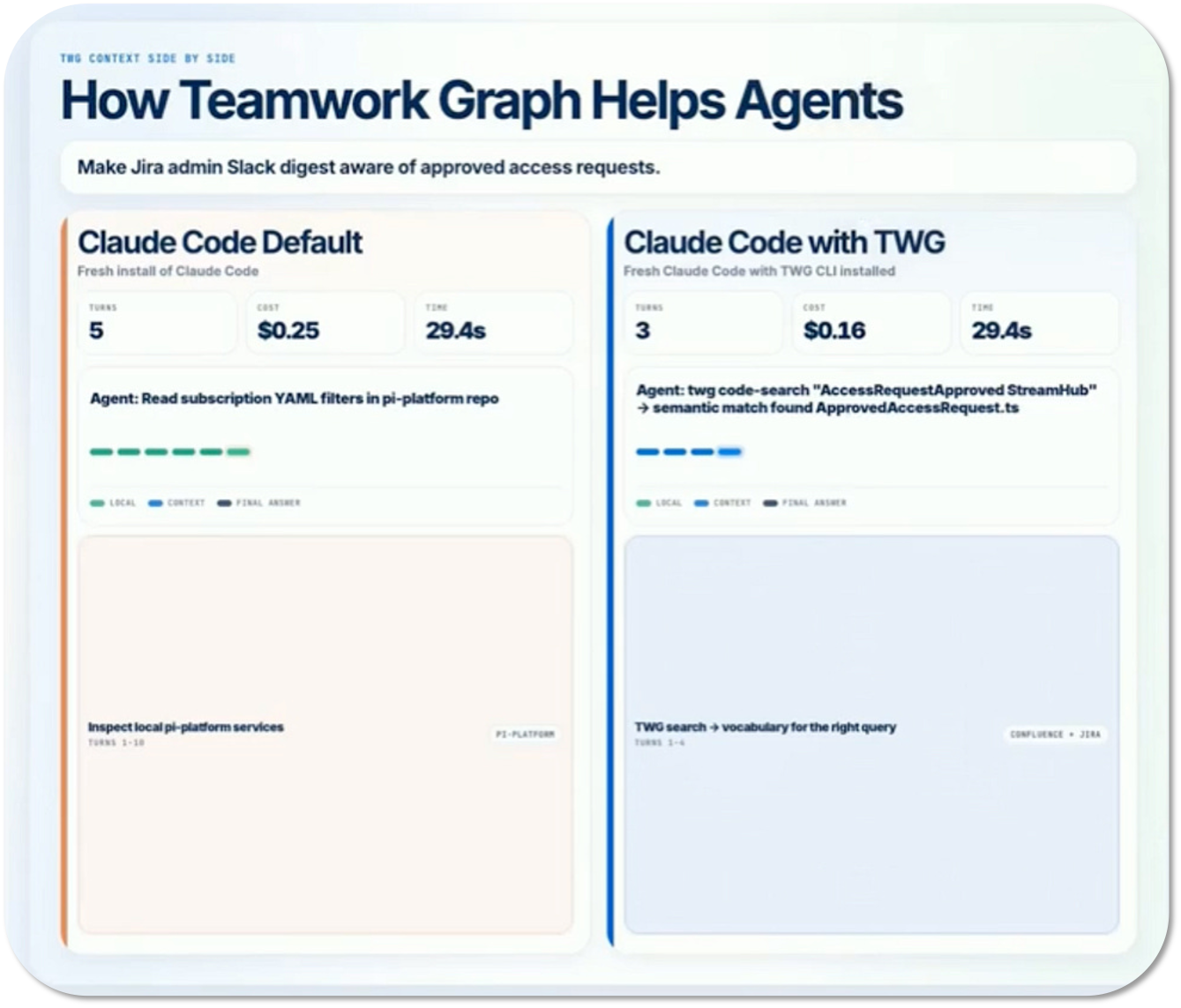
Why Atlassian Talks So Much About “Context”
Cannon-Brookes put it this way at the Analyst Day:
“Acceleration is context times intelligence”

Large language models (Claude, GPT, Gemini) are converging in capabilities; they are all getting smarter, and the gap between them is narrowing. But they all suffer from the exact same problem: they don’t know anything specific about your company.
Whoever provides the best context for your work wins, because it multiplies the model’s general intelligence by highly relevant, specific information.
Raw intelligence is a commodity; context is scarce.
Atlassian’s Strategic Argument
Atlassian claims to hold a unique advantage in context because it covers the entire work lifecycle:
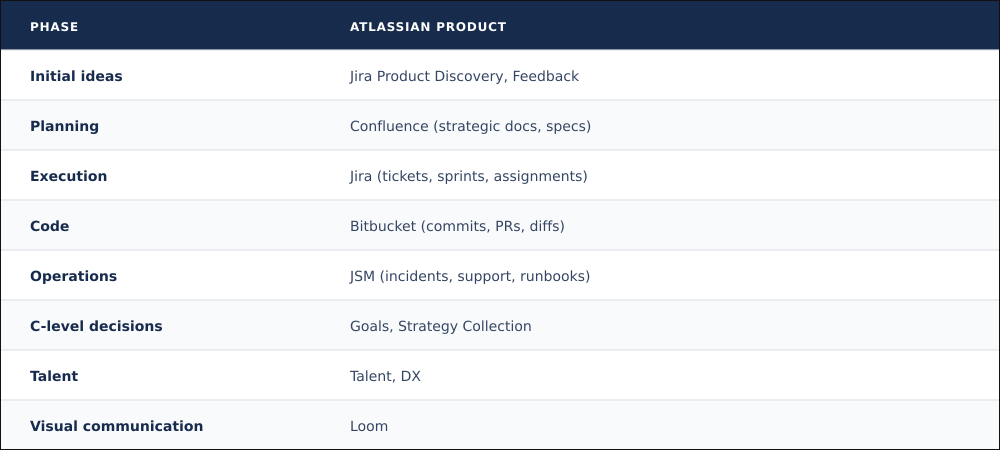
Other vendors have vertical context: Salesforce has customer context, ServiceNow has incident/CMDB context, and Microsoft has document context.
Atlassian has horizontal context across the entire workflow.

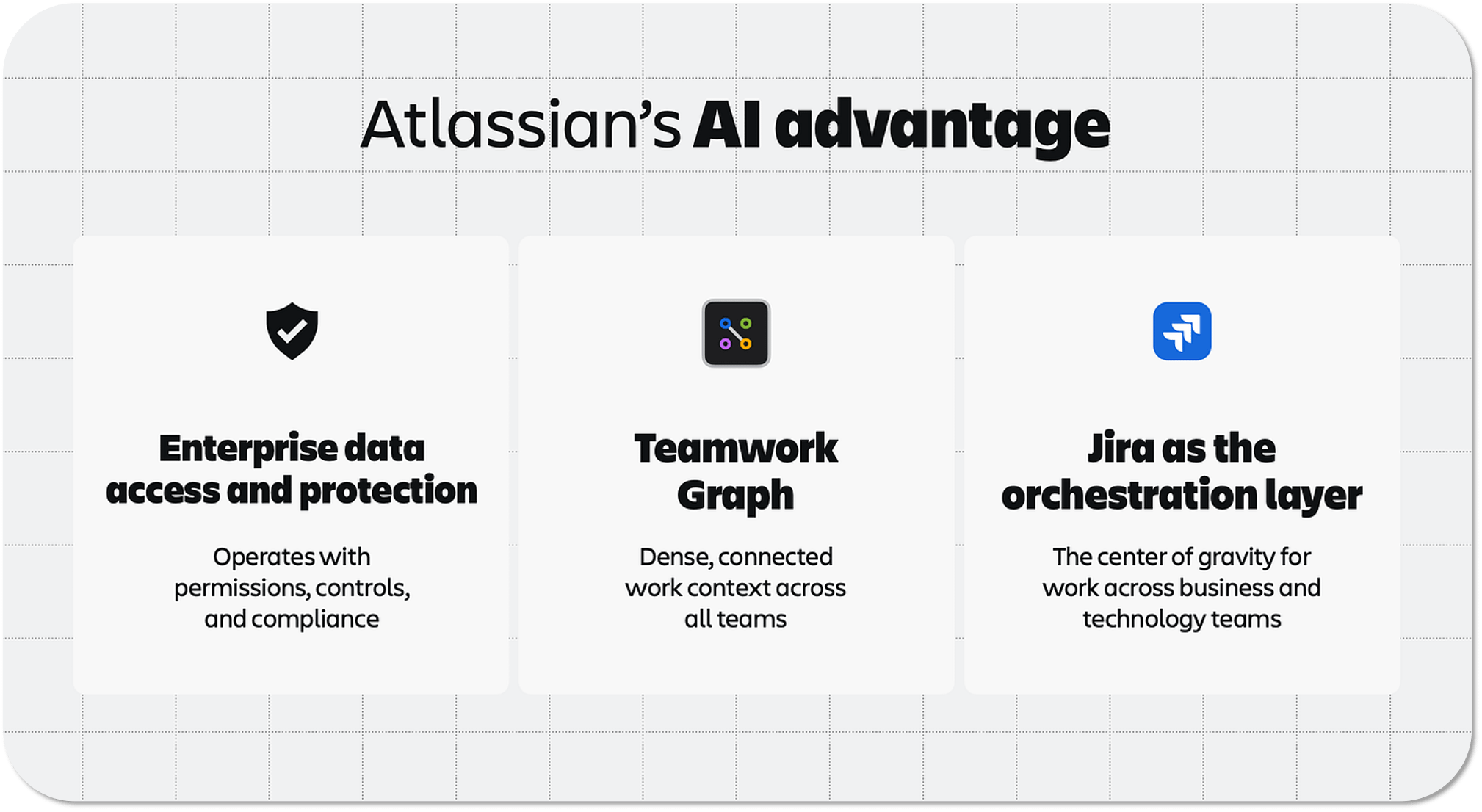
Growth via Enterprise Clients
Atlassian’s enterprise engine relies on a different sales model than ServiceNow or Salesforce.
Traditionally, Atlassian was the poster child for Product-Led Growth (PLG): the product sells itself, without a sales team, via self-service.
Even today, 55% of new customer acquisitions still come through self-service.
On top of that PLG foundation, they have layered:
A global network of certified channel partners for mid-market clients.
Enterprise direct sales (”enterprise advocates”) for complex deals.
In short, they are going after larger clients, bigger deals, and larger budgets because they see a massive market opportunity to capture.
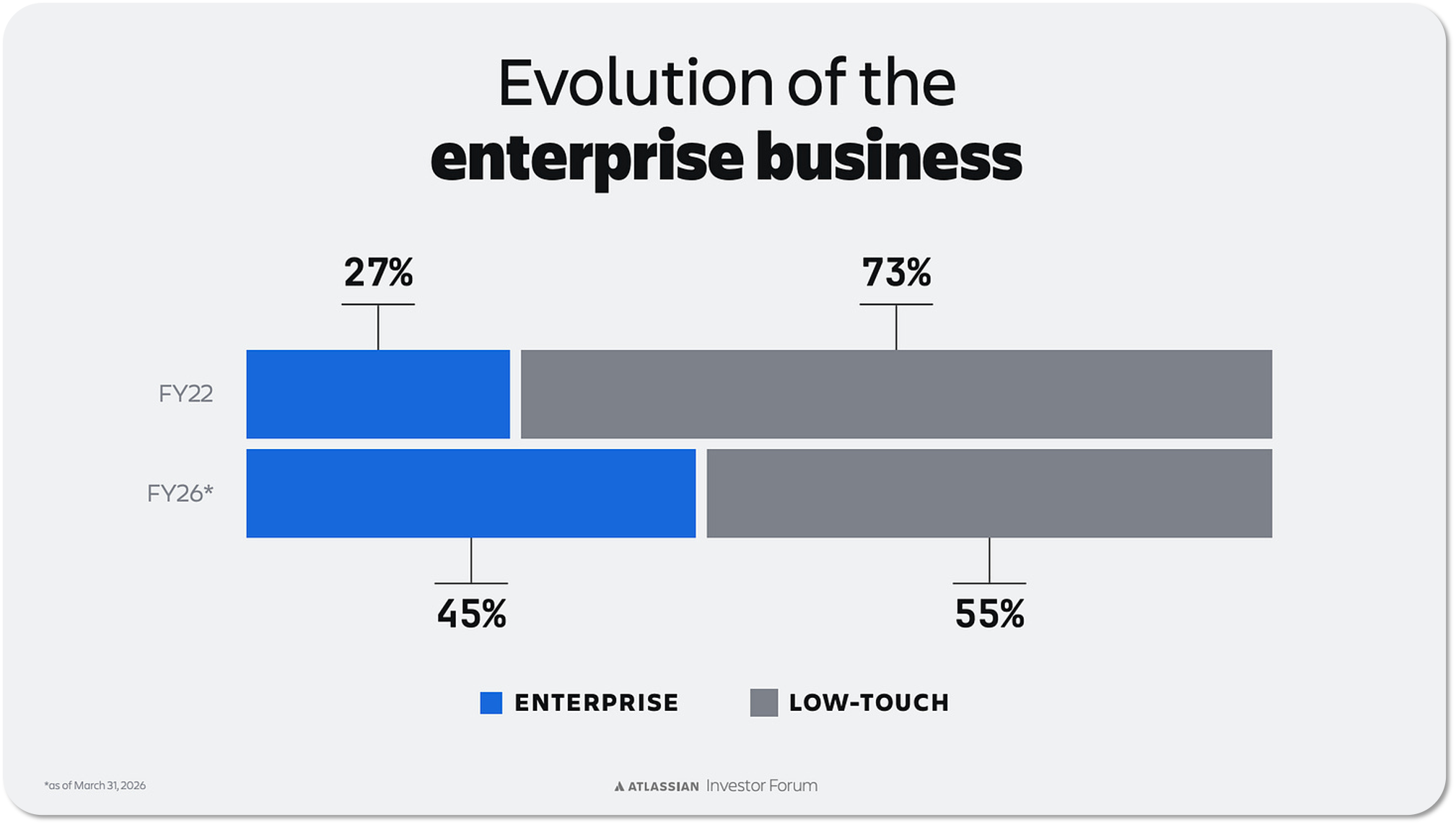
The Analyst Day added an important piece: for the first time in Atlassian’s history, they have signed partnerships with Global Systems Integrators (GSIs)… Accenture, Deloitte, and PwC.
Brian Duffy explained that these GSIs are opening doors to the C-suite on an unprecedented scale.
Mercedes-Benz (a customer that took the stage yesterday) came to Atlassian via Deloitte.
Infosys launched a dedicated Center of Excellence specifically for Atlassian.
Accenture is generating a material and trackable pipeline.
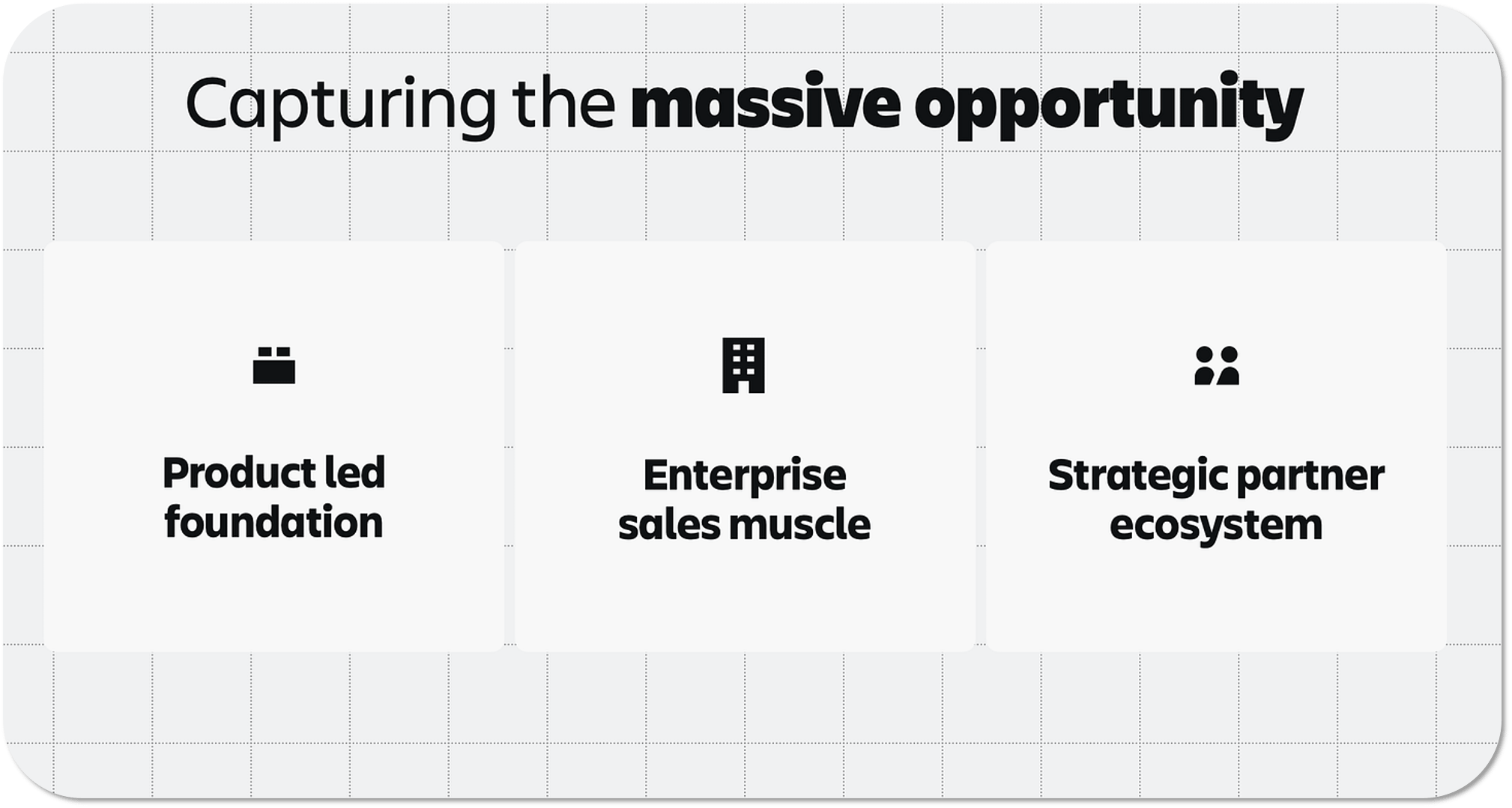
Mr. Duffy also detailed the sales team’s transformation: 4 years ago, Atlassian had 117 quota-carrying reps. Today, it has 400.
Sales rep productivity is “best-in-class” according to management; the next lever is scaling sales headcount while maintaining this high productivity.
Q3 FY26 numbers quantify this progress:
Deals >$3M: +79% YoY
Deals >$5M: +54% YoY
ASP (Average Selling Price): +22%
Small deals: +32%
They aren’t sacrificing any segment, at least for now.
Growth via Cloud
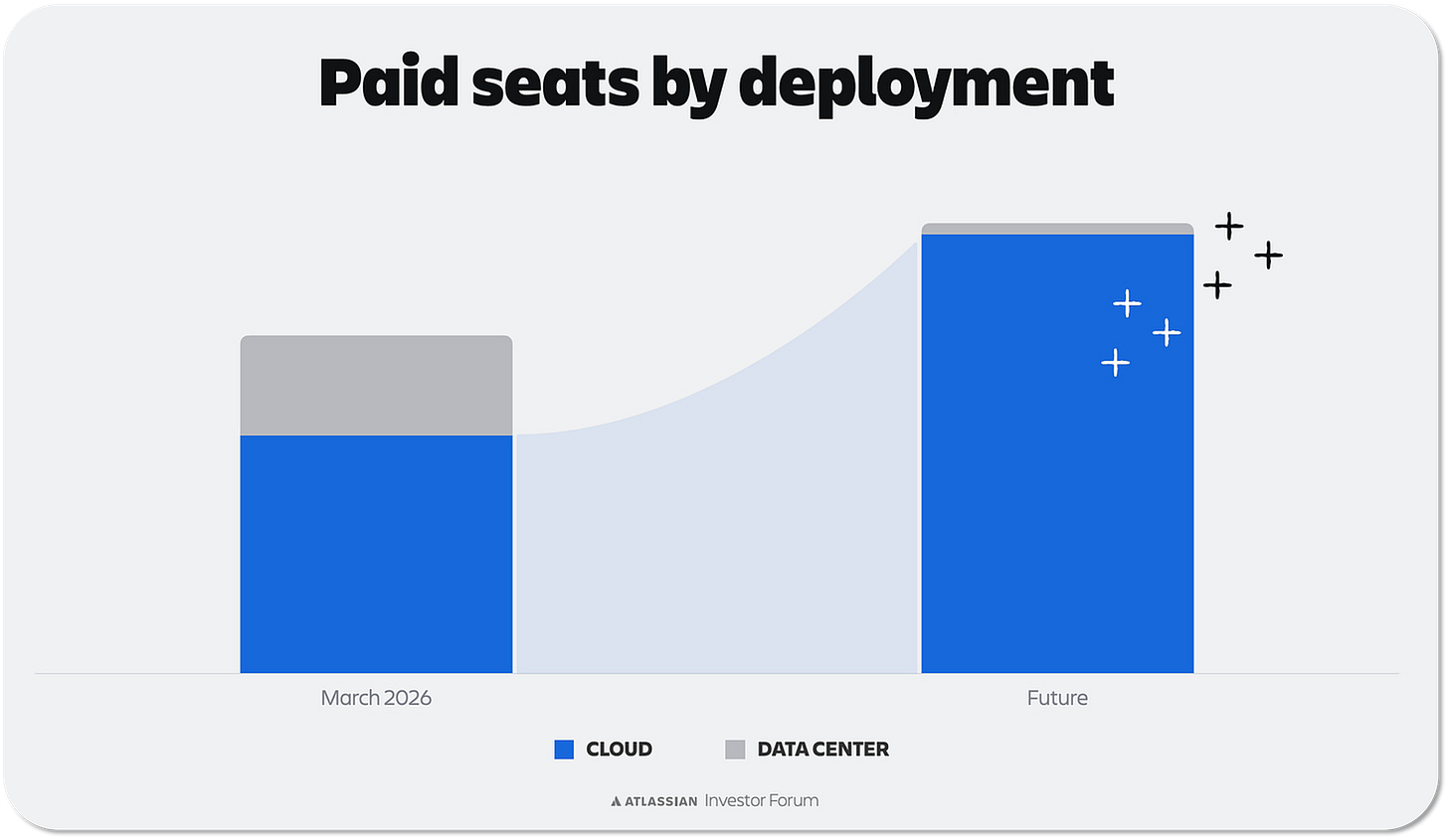
The migration from Data Center to Cloud is the most undervalued growth driver by the market. This is where Atlassian is playing a brilliant strategic game, making decisions that might hurt short-term investor perception but are highly beneficial in the long run.
Why is Cloud the structural direction for the long term?
All recent innovations like Rovo, Teamwork Graph, MCP server, all collections, and AI integrations run exclusively on Cloud.
Data Center still works, but its features are essentially frozen. This means any customer wanting to leverage AI, graph context, or new pricing models has to be in the Cloud; there is no real alternative.
Atlassian offers deployment flexibility within Cloud for complex enterprise cases, as they highlighted at the Analyst Day:
Standard Commercial Cloud on AWS (for most customers).
Isolated Cloud for regulated clients requiring complete tenant isolation.
Government Cloud on Google Cloud, certified FedRAMP Moderate.
All of these run on the same codebase. Any update from Atlassian is deployed to everyone simultaneously.
This is why they are winning customers in banking, defense, government, and healthcare. All of these are sectors that traditionally couldn’t adopt standard SaaS due to strict compliance rules.
The Cloud flywheel doesn’t stop after migration
Mr. Cannon-Brookes emphasized this:
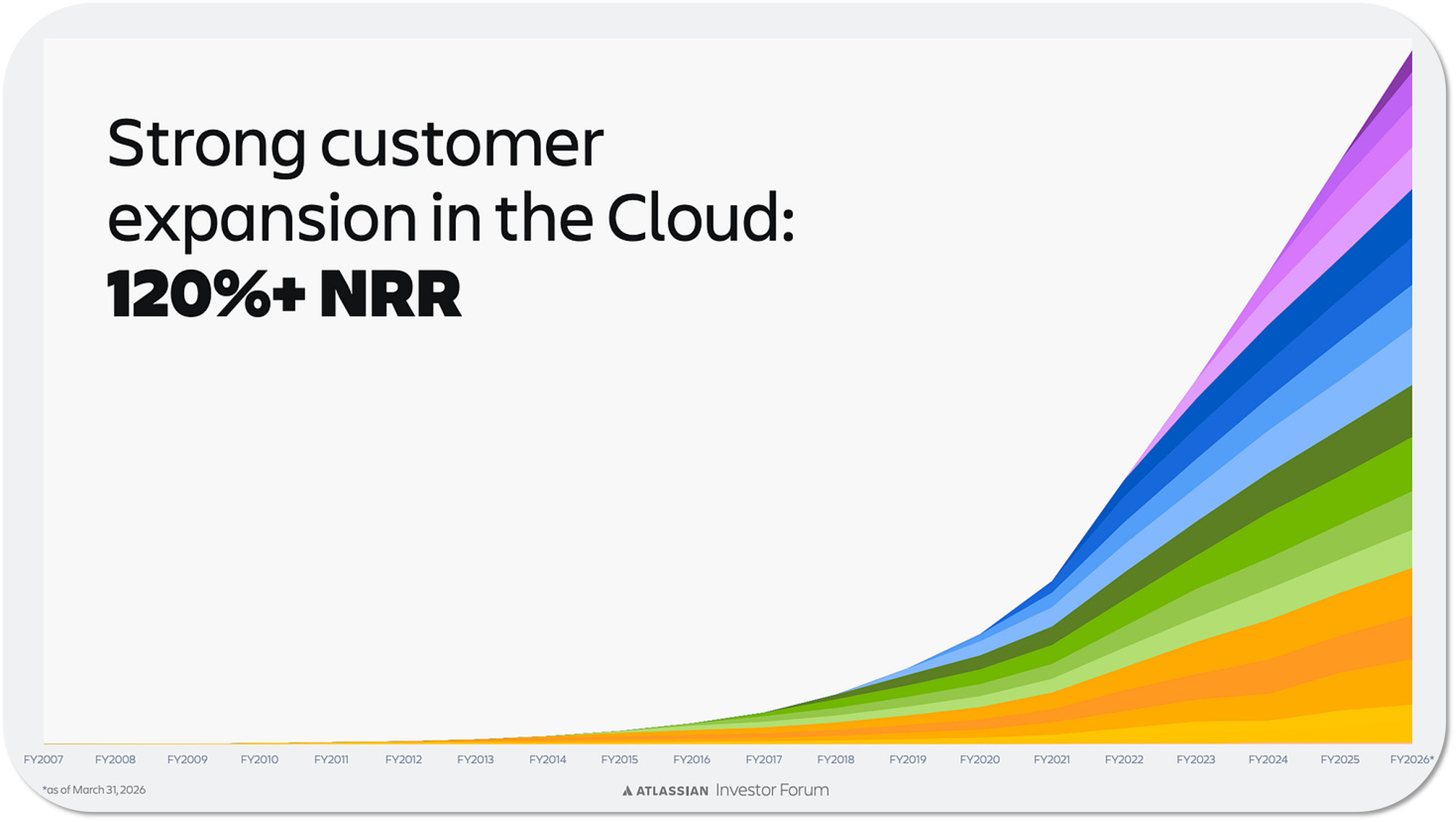
“Cloud is a flywheel, not a one-off project.”
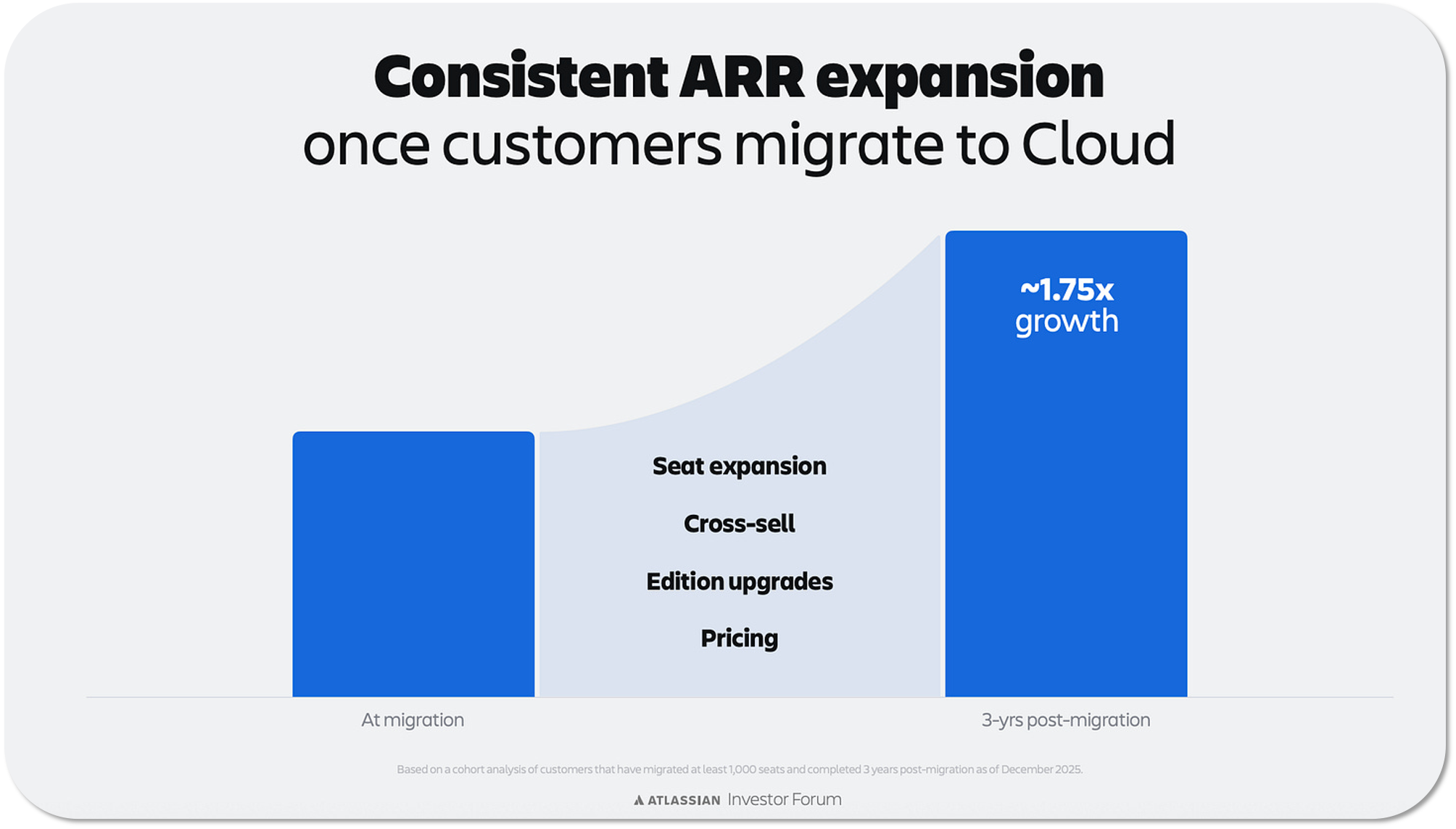
A customer gets onboarded, discovers Rovo, activates the Teamwork Collection, sees the ROI, adds DX, connects their graph, integrates MCP, and within 3 years, they are spending 2x more than they did on migration day.
A sustained Net Revenue Retention (NRR) above 120% is proof of this momentum.
Takeaways
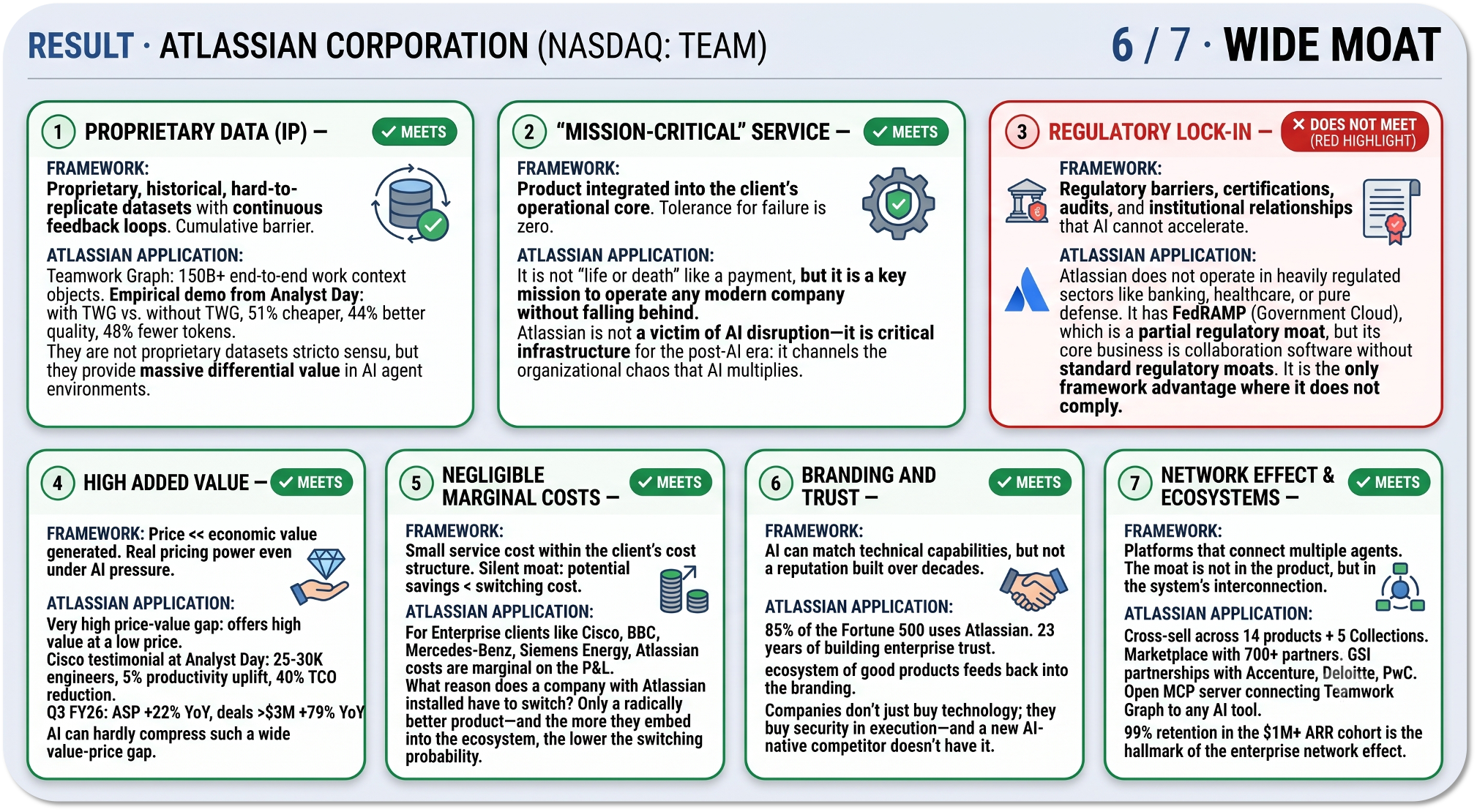
Atlassian holds 6 out of 7 competitive advantages against AI
Everything we’ve discussed points to one conclusion: Atlassian has broad and powerful competitive advantages against AI.
What follows is the core thesis for investing in Atlassian:
First is the empirical proof of how having end-to-end work context, where all the data from day-to-day work interactions, improves AI efficiency in terms of quality, speed, and cost savings.
In other words, this context and data are incredibly valuable in an environment where AI agents are doing the work. While it’s not the same as standard proprietary data, it offers a highly differentiating value.
If we start with the premise that AI will supercharge software production and trigger organizational chaos as companies change how they operate, then all that work has to be channeled and organized. And that is exactly the problem Atlassian has been solving since 2002.
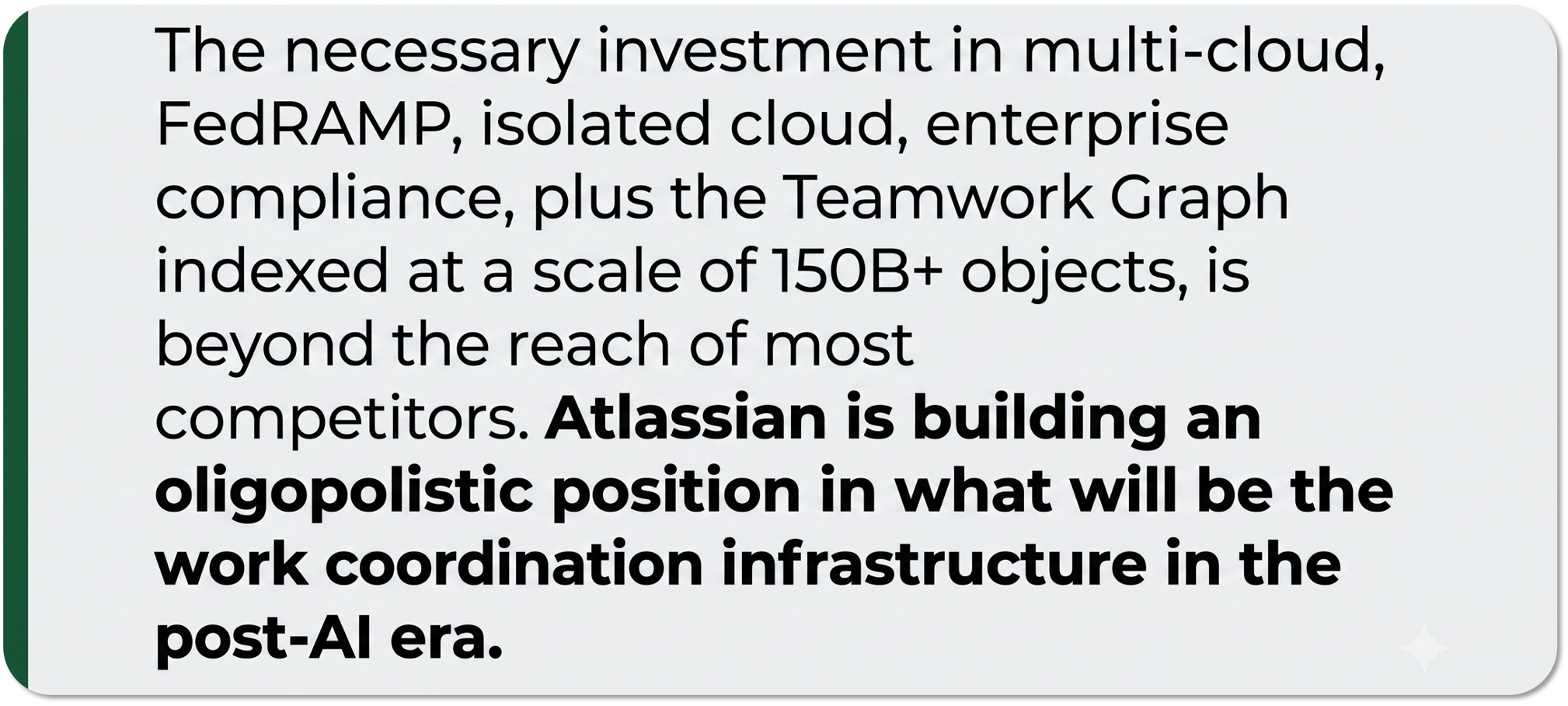
The company isn’t a victim of AI disruption; it’s critical infrastructure for the post-AI era.
While it might not offer a life-or-death, “mission-critical” service like processing payments or money transactions, it does offer a vital operational mission for any company that wants to keep up in today’s fast-paced, non-stop innovation environment.
On top of that, as we’ve seen, it provides massive value to customers at a low price. The gap between value and price is huge. Plus, for large companies in the enterprise sector, Atlassian’s cost is marginal. It really is just a very tiny drop in their overall budget.
If Atlassian’s collaborative product is currently the best, brings high added value to a key company process, and comes at a marginal cost, the question is:
What reason does a company already using Atlassian have to switch to something else?
The sole reason would be if a much better product came along offering dramatically higher value. But as customers get deeper into Atlassian’s ecosystem with more and more of their products, the likelihood of them switching drops even further.
This is why enterprise customer churn is structurally low w/ 99% retention in the $1M+ ARR cohort, according to Analyst Day data.
There’s a common thread running through all these advantages that shapes the final ones: the product. A great product ecosystem builds brand power and trust with customers, creating and scaling a powerful network effect. If using Atlassian makes a company work better, faster, and cheaper, every business will want to be on it.
The key, as always, is the product, and that’s the one thing that could break this virtuous cycle. Because of this, the CEO and the company culture are vital to maintaining their competitive edge.
Here’s a little infographic for you:
In our opinion:
Atlassian has broad and strong competitive advantages against AI. The only box it doesn’t check is regulatory lock-in because it doesn’t operate in heavily regulated industries; everything else is locked down.
If AI explodes software production and organizational chaos, that work needs to be streamlined and organized, which is exactly the problem Atlassian has been solving since 2002.
The company is not a victim of AI disruption; it is critical infrastructure for the post-AI era.
The 6 advantages are fully interconnected: great product → brand & trust → network effect → ecosystem → stickier customer → more context data → better product.
The key to keeping this virtuous cycle spinning is the product, and by extension, the CEO and company culture, which we’ll look at next.
CEO, Culture, Ownership, and Stock-Based Comp
On top of the competitive advantages we’ve discussed, there’s another key factor in the AI era for software and intangible-asset businesses:
The human (X) factor, corporate culture, and ownership structure.
Atlassian is still a founder-led company with real skin in the game.
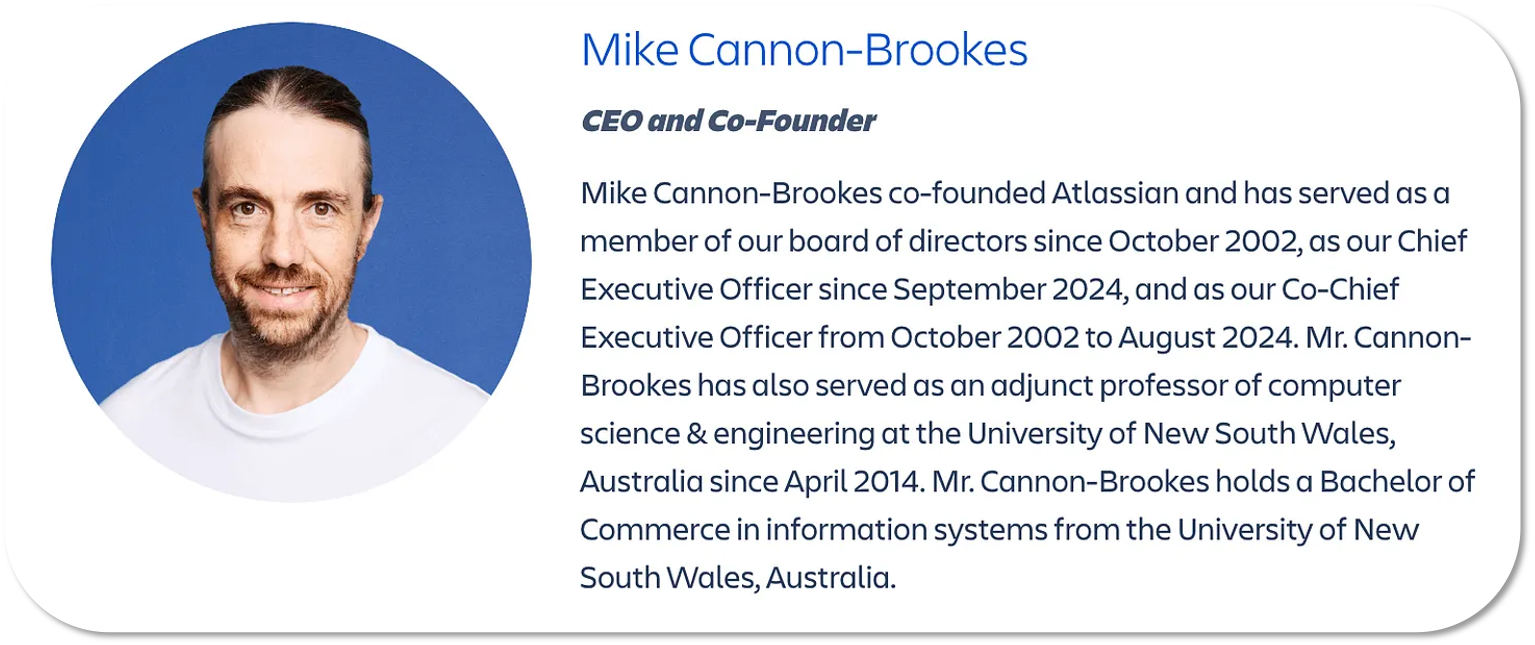
Mike Cannon-Brookes (sole CEO since September 2024, after Scott Farquhar moved to the board) and Farquhar together own about 40% of the company’s equity and control 85–87% of the voting power through a dual-class share structure (Class B shares have 10 votes each, compared to 1 vote for Class A). Individually, each owns around 20% of the economic interest.
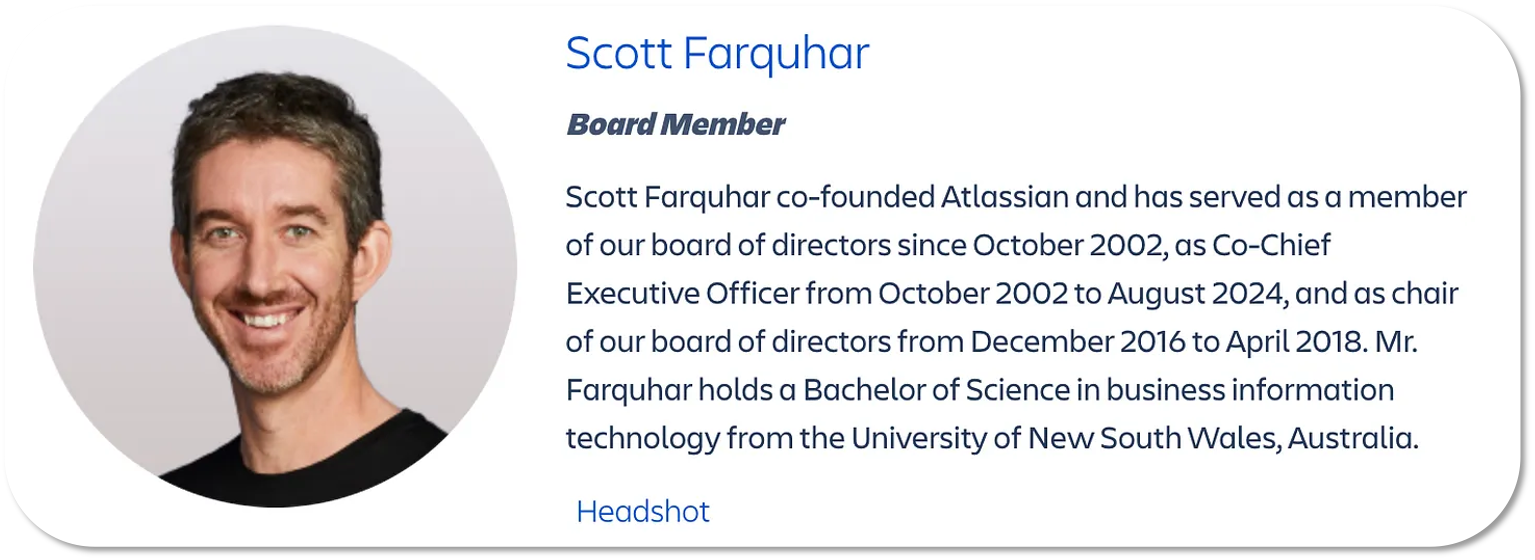
These aren’t professional, hired-gun managers who rotate out every four years with short-term compensation packages. These are two founders whose personal wealth is heavily concentrated in the company they run. During times of massive industry shifts, having founders at the helm with this much skin in the game and voting control is a huge structural advantage.
Founders think in decades, not quarters.

You can see it in their capital allocation decisions:
The opportunistic $610M acquisition of The Browser Company.
The $1B bet on DX (linked before).
The $991M in opportunistic buybacks in Q3 FY26 at a depressed share price.
Their willingness to take short-term pain (like the 10% layoffs) to speed up their path to GAAP profitability.
The ownership culture they’ve built is the other side of the same coin.
During major tech shifts, top-tier engineering, product, and design talent with real vision and judgment becomes scarcer and more expensive.
As the software business model shifts toward outcome-based pricing and AI agents executing tasks, every employee needs a personal incentive aligned with customer results.
This only happens when the team literally owns the work. Companies with significant employee stock ownership, broad equity plans, and a culture of “you are not just a resource, you are a co-owner” simply operate differently.
The Stock-Based Compensation (SBC) debate
This brings us to one of the most controversial parts of our thesis, as one of the loudest investor criticisms of Atlassian is its high stock-based compensation.
However, we believe that right now, this policy is a net positive. Having a large share of the workforce as owners exponentially increases their chances of success.
While SBC programs naturally dilute us as shareholders, management is currently making solid decisions to drive profitable growth, as we’ll see later.
In this light, Atlassian’s SBC (around $1.7B annually, or ~26% of revenue) stops looking like a purely dilutive cost and starts looking like alignment infrastructure.
There is still real dilution, but in our view, the right move isn’t to slash SBC dramatically. Instead, they should moderate it and offset it with aggressive buybacks.
And that is exactly what they are doing: in FY26, buybacks will outpace SBC for the first time ($1.8B vs. an estimated $1.75B), with the diluted share count expected to shrink by about 2.5% for the year, according to management’s guidance.
Note: It’s not the best, but it’s already uncommon in a software business.
Sustained and Consistent Growth
Atlassian is not a growth story that is just starting out. They have spent over a decade demonstrating high double-digit revenue growth with remarkable consistency across different macroeconomic cycles:
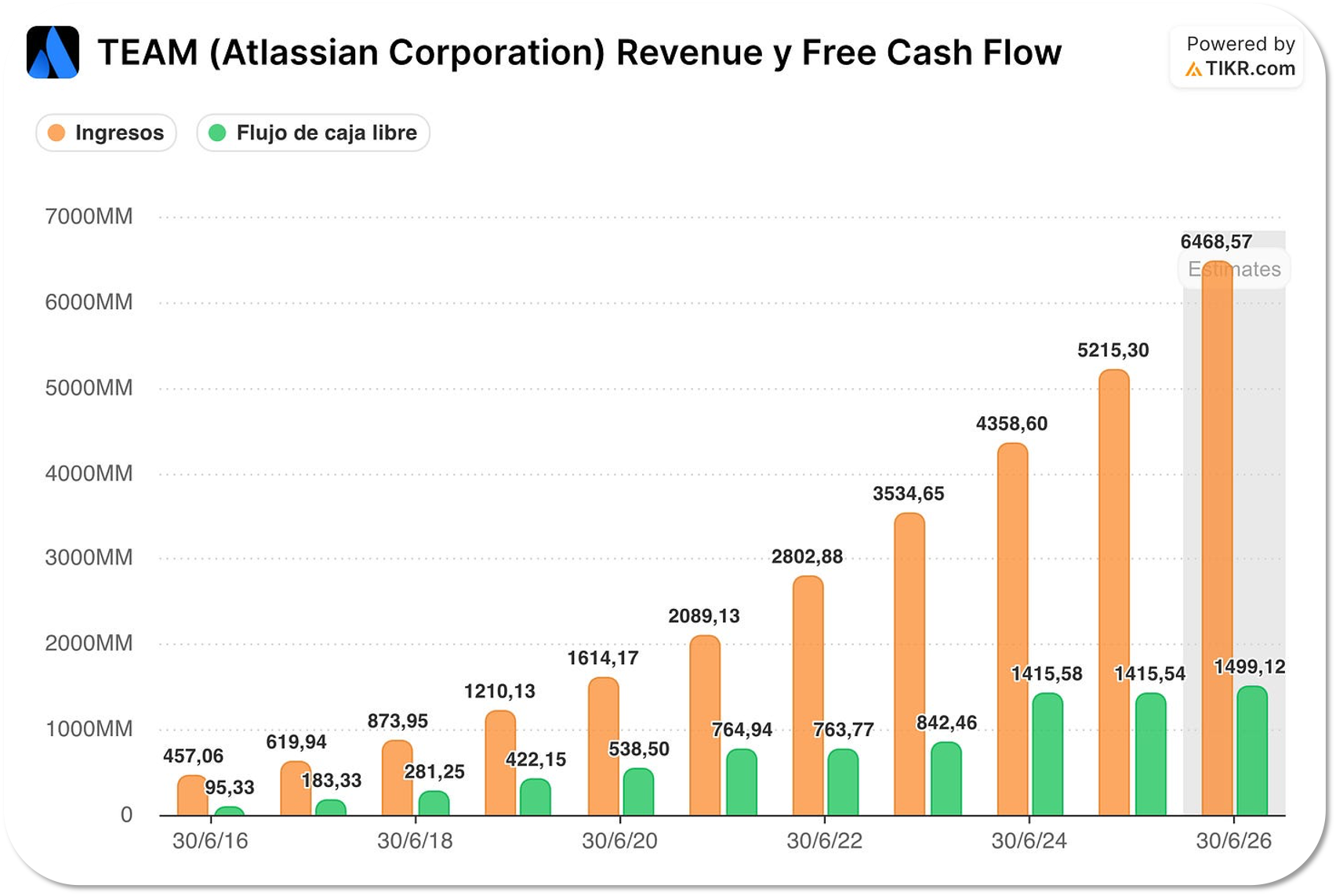
6-year CAGR: ~26%. The company has quadrupled its revenue in 6 years, maintaining a growth rate above 20% even after crossing the $5B mark, something very few companies in the history of SaaS have achieved.
The quality of this growth is what is most impressive:
Multiple business lines scaling individually: Jira $2.5B+ ARR, Confluence $1.5B+ ARR, Service Collection $1.0B+ ARR.
Confluence and Jira continue to accelerate in the Cloud: Cannon-Brookes emphasized this at the Analyst Day because the market believes the exact opposite.
Cloud seats (excluding migrations) are accelerating quarter over quarter: Pure organic demand, not just migration optics.
Cycle-resistant: Growth remained at 20%+ during the 2022–2023 bear market when the rest of the sector was slowing down.
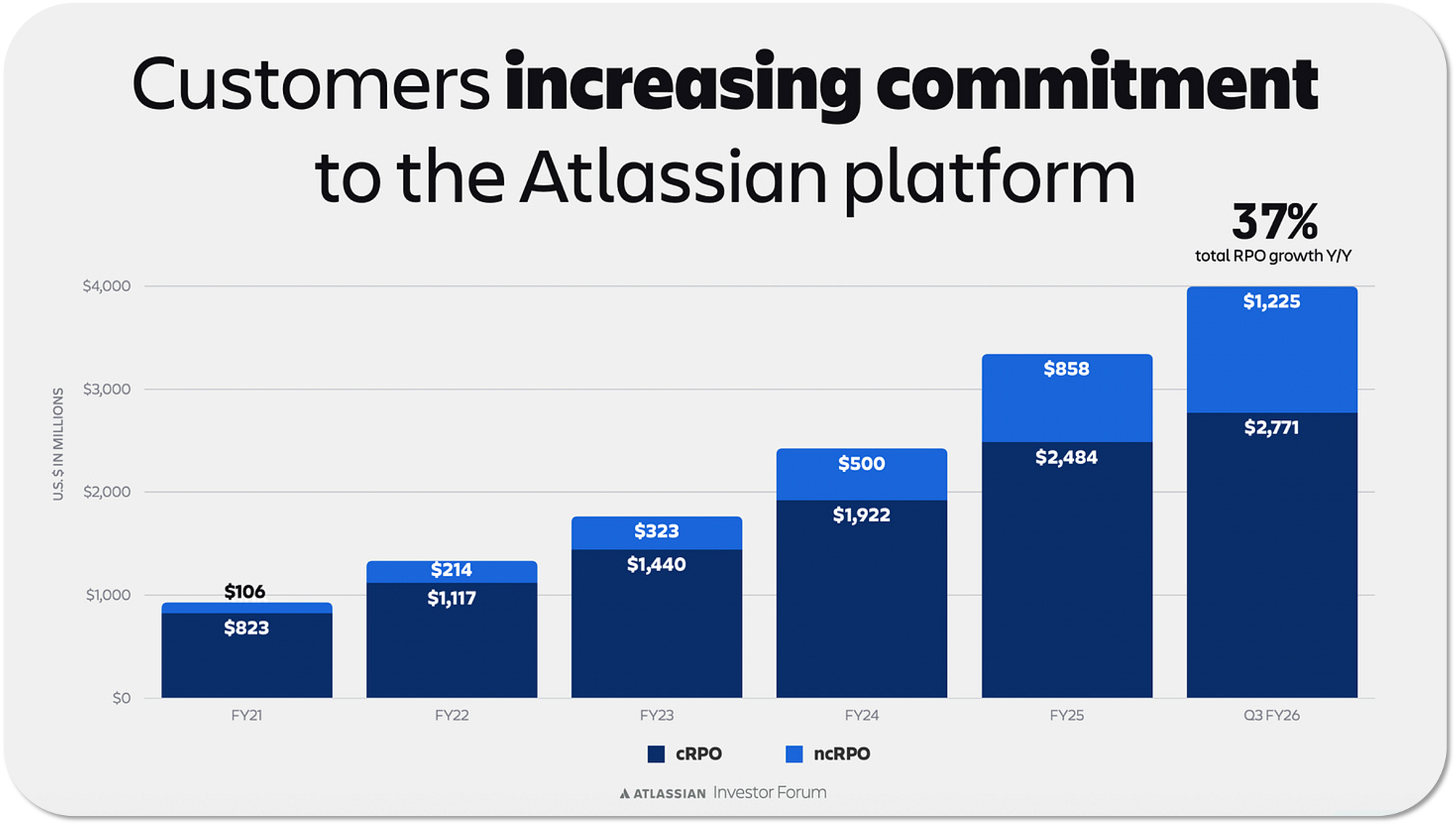
Backed by RPO growing at +37% YoY: This is outperforming recognized revenue, signaling future acceleration.
Sustained NRR above 120% for years.
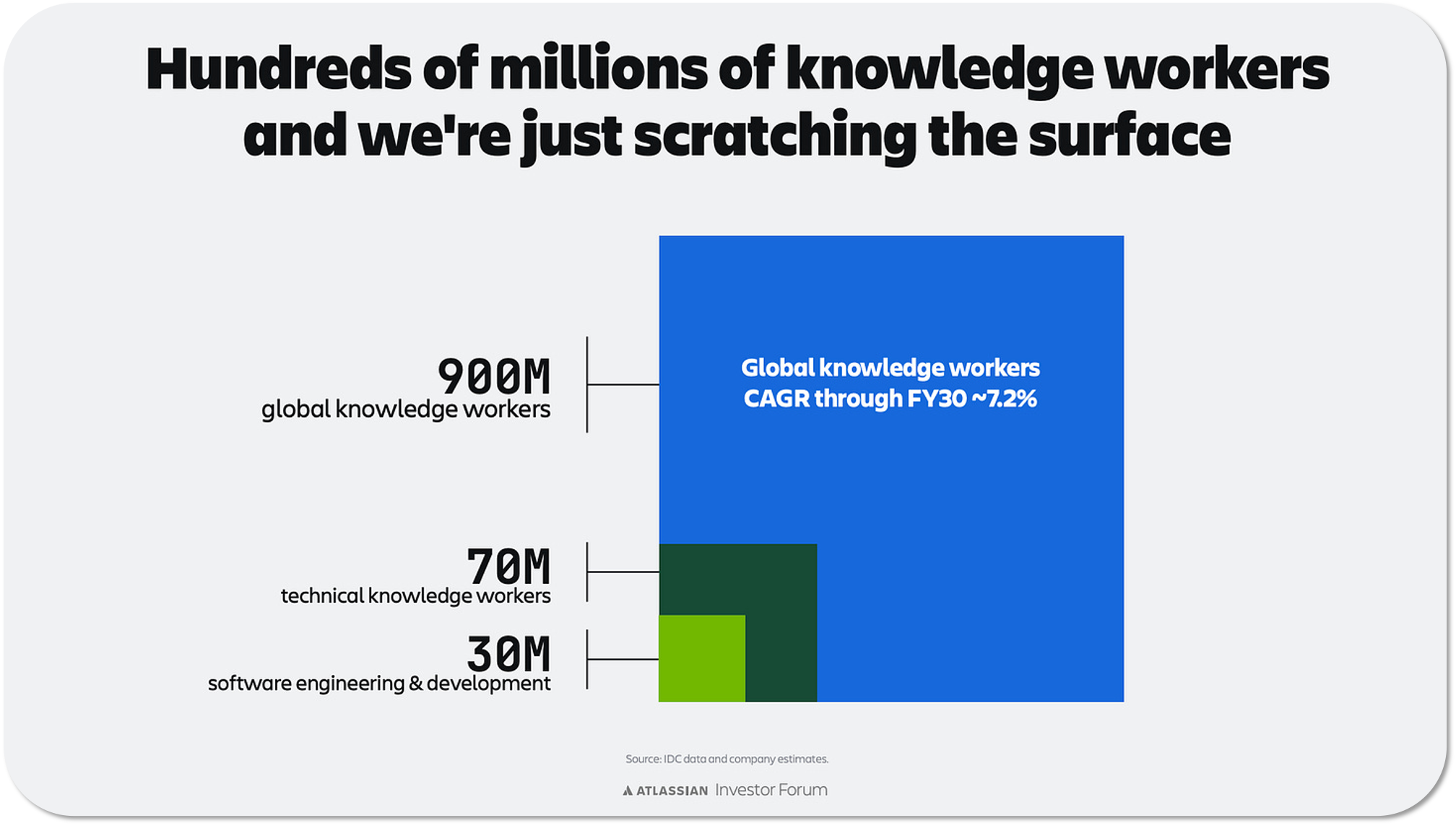
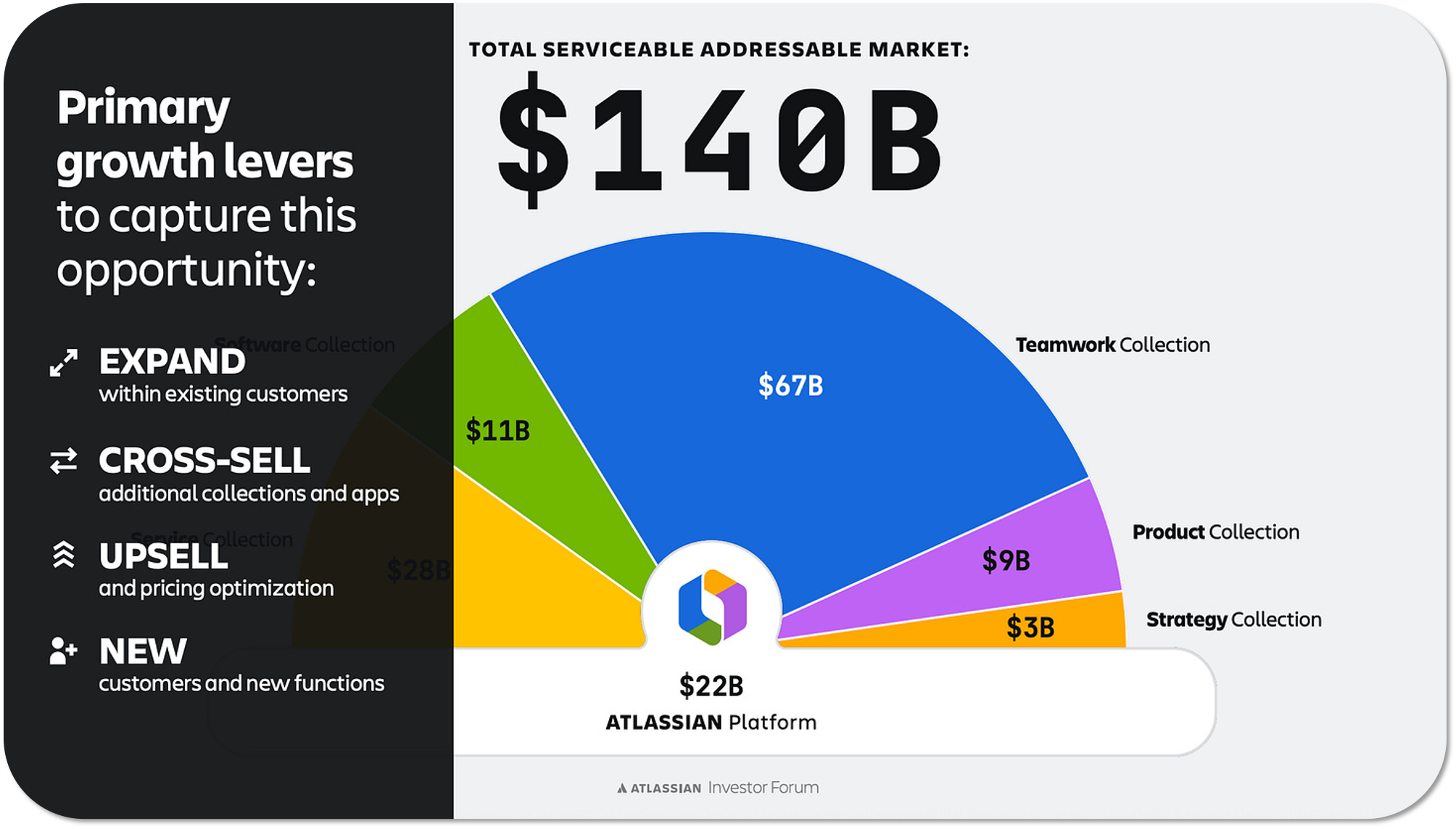
TAM updated at the Analyst Day to $140B
It is up from the previous ~$67B, recalculated as follows:
Software development: $17B (+9% annually)
Work management: $35B (+14% annually)
Service management: $24B (+13% annually)

With a $7B revenue run-rate, Atlassian captures barely 5% of its relevant TAM. That’s a runway that keeps it firmly in the “early innings” zone.
The company is well-positioned to keep growing at this pace by expanding the number of products its current customers use, boosting ARPU through cloud migrations and new pricing models, and winning new clients… all powered by the competitive advantages discussed above.
Market Structure: A Practical Oligopoly with Growing Demand

In its main categories, Atlassian operates in highly concentrated markets where only a handful of credible vendors compete for major enterprise deals.
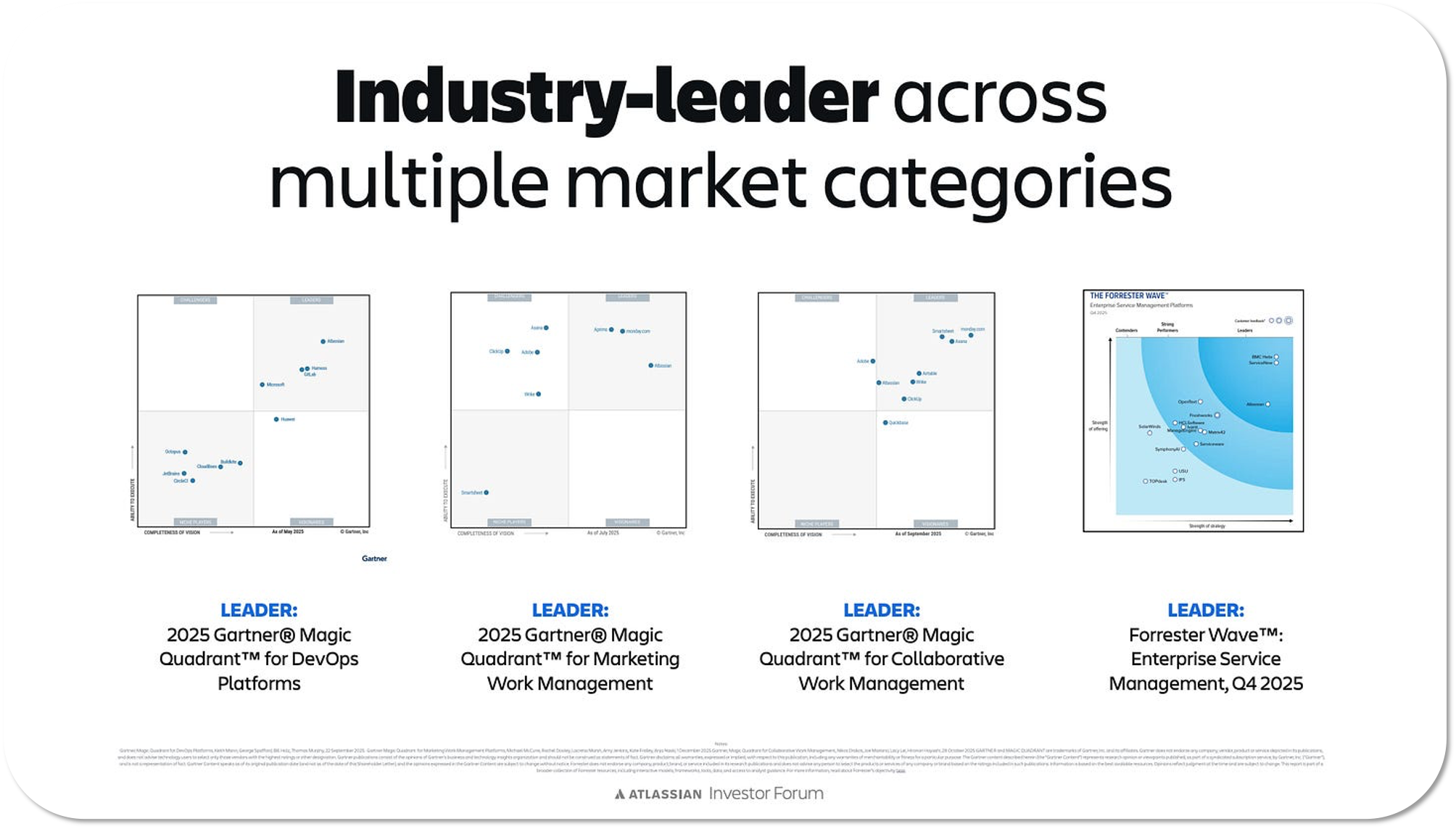
And here is a core point of the thesis: while supply is structurally concentrated, demand is about to expand massively.
Think more companies building software, more teams generating digital outputs, more organizational complexity needing coordination, and more IT services needing ticketing.

Our Synthesis
In Atlassian, we have a clear leader in collaboration tools operating within a structural oligopoly, right at a tech turning point where software demand is set to skyrocket.
The market narrative claims that AI will destroy its business model.
Our thesis argues the exact opposite: the chaos triggered by an AI-driven software boom will actually multiply the demand for solutions that organize and streamline that work.
The 10 pillars of our thesis:
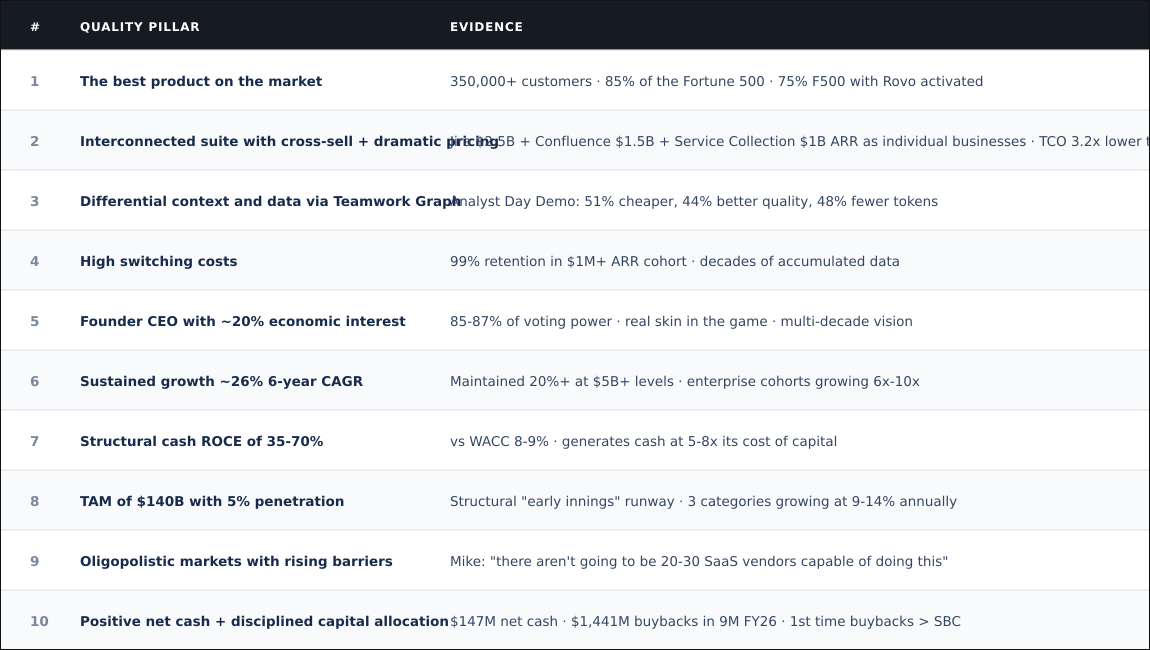
QV Conclusion
If our thesis plays out, investing in Atlassian at current prices will be highly profitable. The future value of the business (its terminal value) will be extremely high, making the stock a prime candidate to become a multibagger at today’s entry points.
The Numbers Challenging The Narrative
Atlassian just published its Q3 FY26 results, showing accelerated growth across all lines. At the May 6th Analyst Day, management doubled down on their strategic shift toward profitable growth. Let’s dive into the data.
For a company that’s web-rumored to be cannibalized by AI, the Q3 data tells a completely different story:
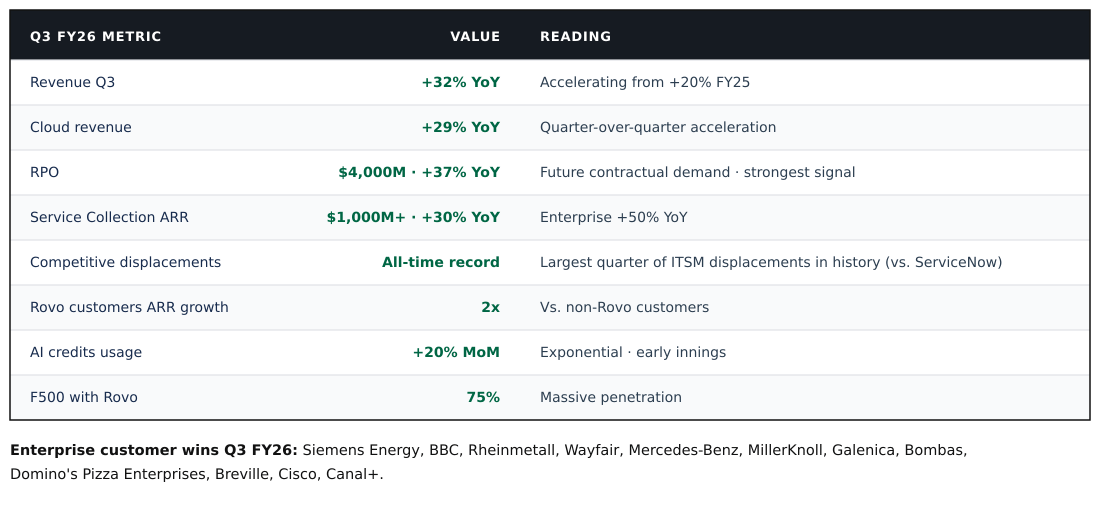
If AI were actually cannibalizing TEAM, we’d expect to see slowing growth, shrinking RPO, enterprise churn, and a drop in AI usage.
Instead, we see the exact opposite across every single metric.
History: FCF Minus SBC Has Been Negative
The market’s main criticism is valid, and the data backs it up: Atlassian doesn’t generate true FCF once you subtract SBC (stock-based compensation).
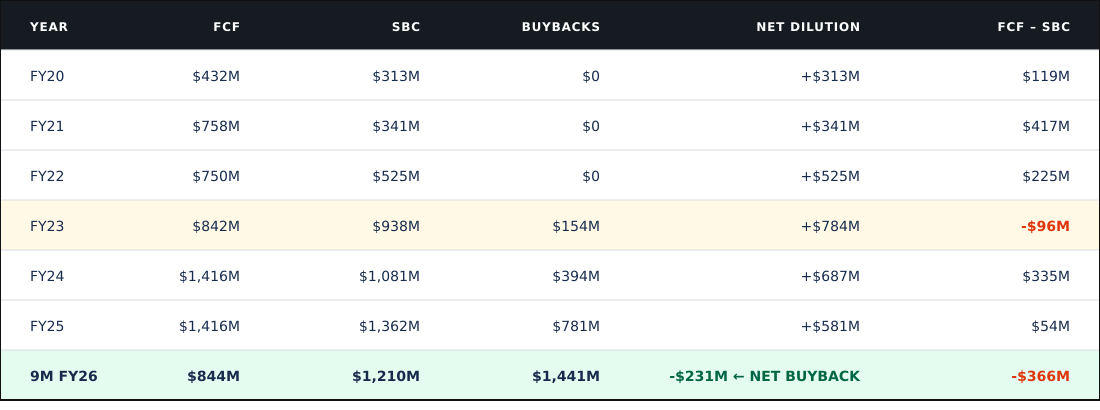
Looking at the full history of buybacks and net dilution, FY23 was the first year where SBC outpaced generated FCF, and FY26 is repeating that pattern. Because of this, the current market narrative is that the company…
“Buys growth through dilution.”
What’s Changing: The Inflection Point in Q3 FY26
Three data points from the quarter that just closed mark a clear shift in regime:
1. Buybacks as the new capital allocation policy.
In Q3 FY26 alone, they bought back $991M in shares. That’s more than in all of FY25 ($781M). There is still $2,200M left in remaining authorization. Management has explicitly guided that the diluted share count will drop by 2.5% in FY26. This is the first year in company history where buybacks outpace SBC in absolute value.
2. The share count is actually going down.
In 9M FY26, net dilution is at -$231M (buybacks are outpacing SBC issued). Diluted shares are expected to drop from 261M at the end of FY25 to 255M by the end of FY26. This “new capital allocation” isn’t just rhetoric; it’s more like the recent hard accounting.
3. Structural cost cuts are already executed.
The $223.8M in restructuring charges in Q3 FY26 are the result of the 1,600 layoffs in March 2026. For Q4 FY26, the GAAP margin directly benefits by 7 percentage points from this restructuring, lifting guidance from -2% to +4.5%.
The most important piece: The commitment at Analyst Day

The Analyst Day added a crucial element: management committed to a new, explicit priority for the first time… ”durable, profitable growth”, positioning it alongside Enterprise, AI, and System of Work.
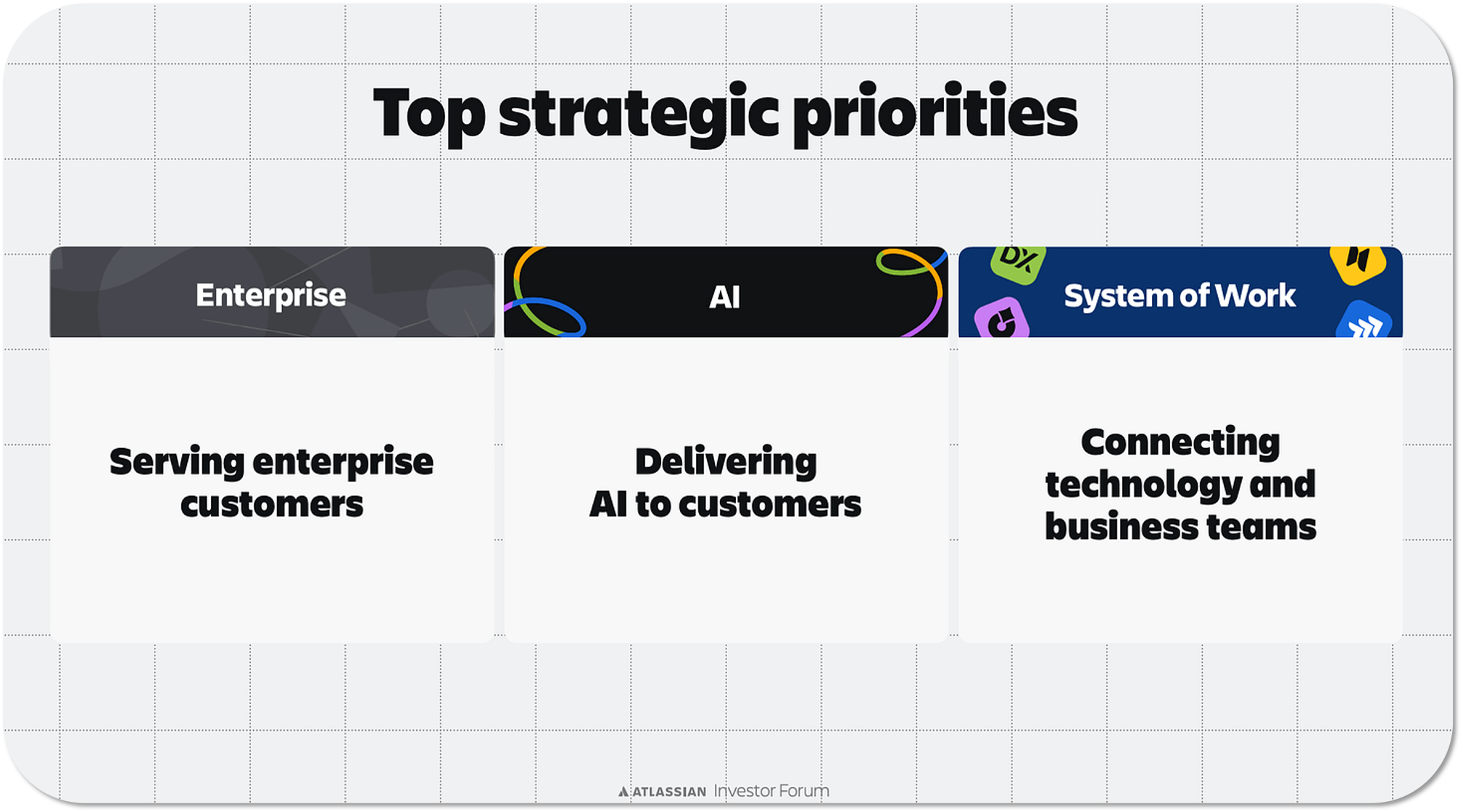
James Chuong (the new CFO who joined this quarter) closed his presentation by making it clear that they are accelerating the path to GAAP profitability with fiscal discipline starting in FY27.

How They Will Achieve It: Two Levers
(Lever #1) Aggressive buybacks as the new capital allocation policy.
In Q3 FY26 alone, they bought back $991M in a single quarter.
We expect a significant chunk of the generated FCF to keep going toward buybacks. This acts as a permanent shield against dilution, especially while the stock price remains depressed.
Net dilution in FY26 will be or, at least, should be negative.
(Lever #2) Structural cost cuts and R&D moderation.
The March 2026 restructuring (1,600 layoffs and a $224M charge) will generate ~$200M in permanent annual savings starting in FY27.
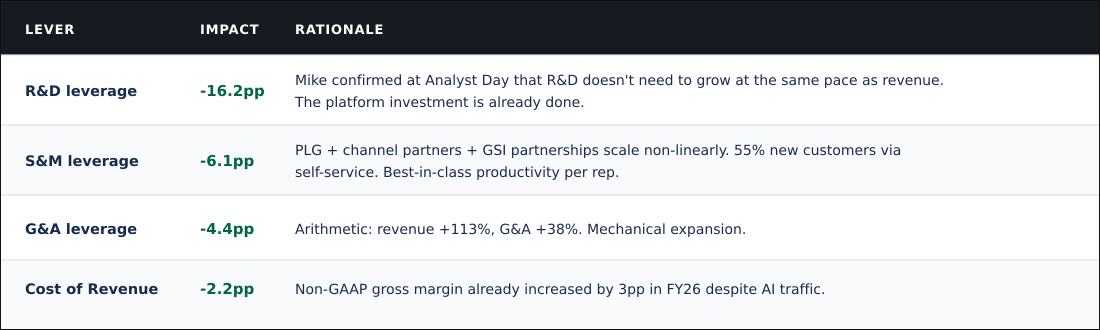
On top of that, Cannon-Brookes explicitly confirmed a key piece of the puzzle: R&D doesn’t need to grow at the same pace as revenue.
The massive platform investments, like multi-cloud, FedRAMP, and isolated cloud, are already done. From FY27 onward, R&D will grow slower than revenue, automatically boosting margins.
Three Additional Levers
Management highlighted three extra levers during their recent earnings calls (Q3 FY26 in April 2026 and Q2 FY26 in January 2026) and reinforced them at the Analyst Day:
Continuous Cloud optimization: Non-GAAP gross margin rose 3 percentage points YoY to 88% in FY26, despite a massive spike in AI traffic.
A slower hiring pace: The “self-funding model.”
Classic G&A leverage: Scaling revenue over a semi-fixed cost structure.
Current Multiples and Some Historical Context
The Two Ways to Read a Software Company’s Books
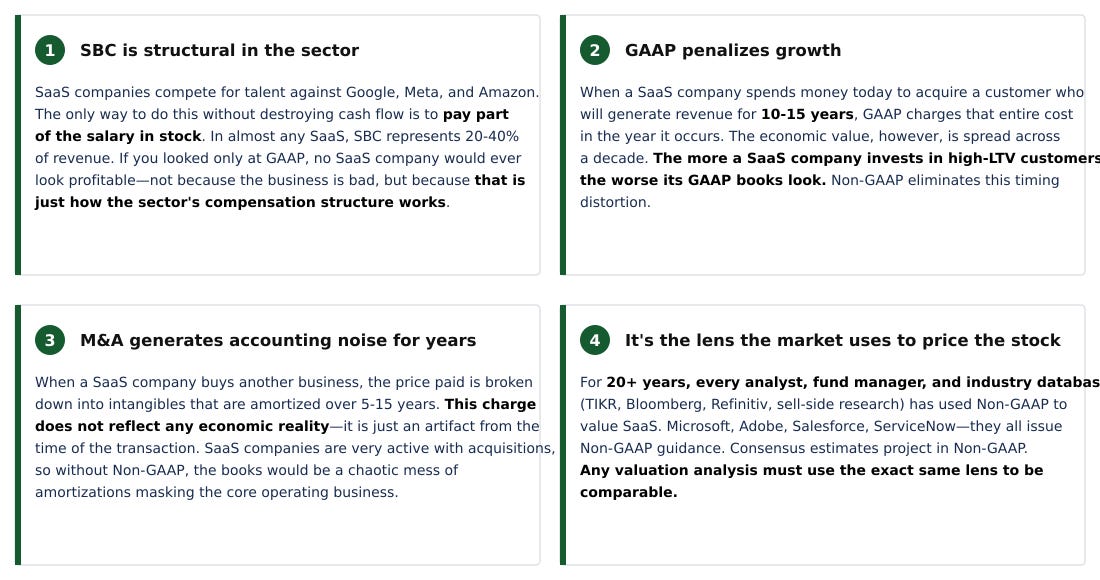
Before looking at the multiples, let’s break down the differences between GAAP and Non-GAAP, and why all SaaS companies report in Non-GAAP.
Every software company publishes its results through two distinct lenses.
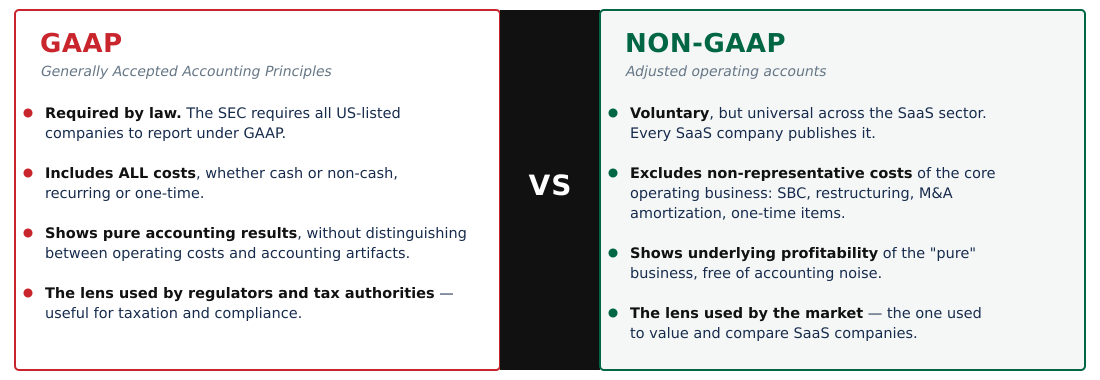
Here are the 4 reasons why ALL SaaS companies report in Non-GAAP, and why the market relies on this lens for valuation:
Current Valuation
Share Price: $88.80 | Market Cap: $22,53M | Enterprise Value: $22,640M

An Honest Take on the Multiples Table
Through the Non-GAAP lens traditionally used to value SaaS companies, TEAM is currently trading at all-time lows.
The NTM P/FCF of 10.56x sits well below the range it sustained over its 12 years as a public company. Between 2016 and 2024, this multiple stubbornly held between 30x and 80x.
Current levels represent the practical rock-bottom for the company’s stock price. The same goes for the NTM P/E: 14x today versus a historical average of 110x, compared to levels that historically always sat between 50x and 150x.

Even when adjusting for any accounting bias, current multiples are clearly at the bottom of any reasonable range.
Through the GAAP lens, the numbers still look high (a forward P/E of 101x on consensus EPS of $0.88) because the company is not yet sustainably GAAP-profitable.

Their Bridge into Profitability
Before looking at the projected P&L, we need to understand a critical dynamic affecting the revenue trajectory for FY26–FY28. Management revealed this during the Analyst Day, and consensus estimates still haven’t modeled it correctly.
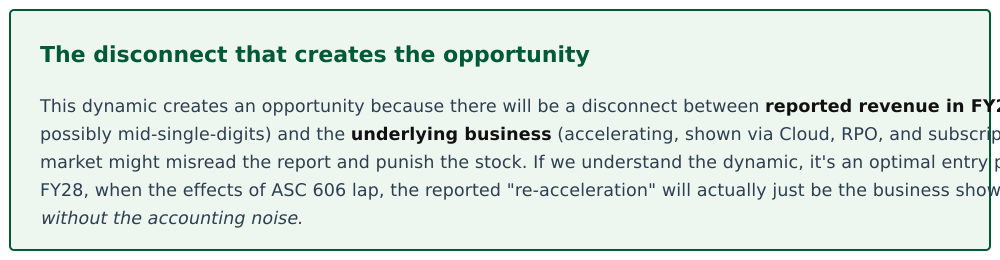
FY26 revenue is inflated; FY27 is going to look weak on the surface, but the underlying business is actually accelerating.
The Ascend Program
Atlassian has two versions of the same software: Cloud (a monthly SaaS subscription with smooth, predictable revenue) and Data Center (fixed-term licenses that companies install on their own servers, which recognize a lot of revenue upfront).
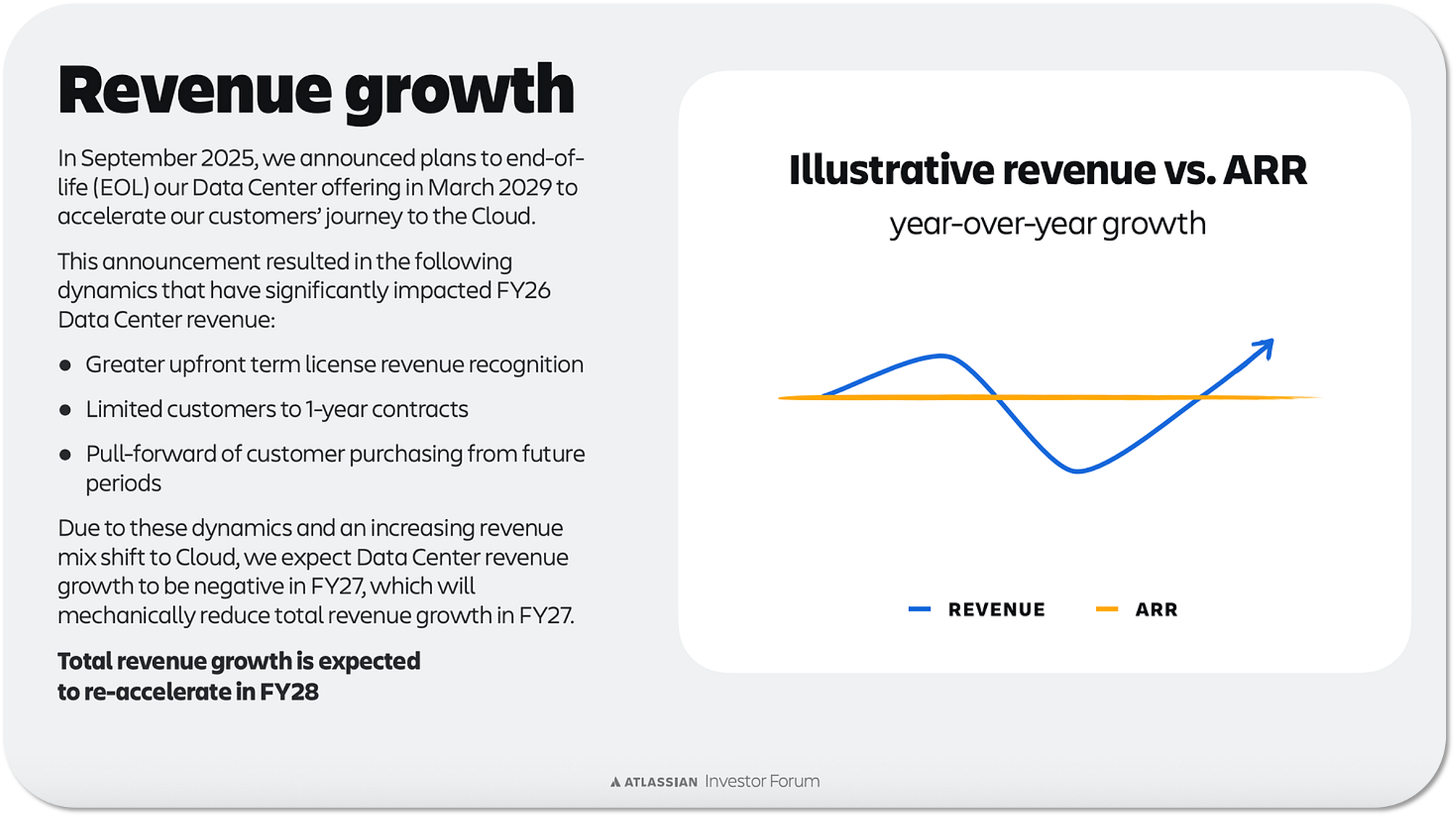
The Ascend program is the end-of-life (EOL) plan for Data Center. In September 2025, they announced that Data Center will cease to exist as a product on March 31, 2029.
In other words, no more support, no more updates, and no more security patches.
Originally, they were going to announce this in September 2026, but the maturity of their enterprise Cloud allowed them to pull the timeline forward by a year.
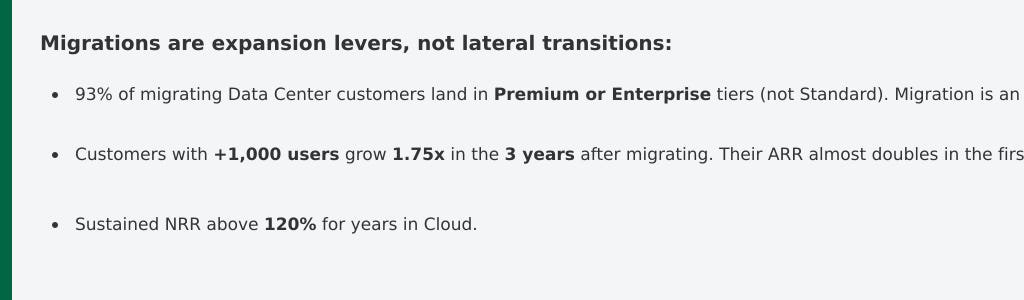
This forces all Data Center customers to make a choice: migrate to the Cloud before March 2029 or churn. So far, 93% are choosing to migrate, and they are landing on Premium or Enterprise tiers (not Standard).
How ASC 606 Works and Why It Creates a Pull-Forward Effect
ASC 606 is the US revenue recognition standard that dictates how a contract’s revenue is split between the signing date and the following months or years. For Atlassian’s historical Data Center contracts:
20% of the value was recognized upfront (on the day of signing), that the “license” itself.
80% of the value was spread out linearly over the life of the contract for ongoing support and maintenance.
When Atlassian announced the Data Center EOL in September 2025, ASC 606 forced a recalculation: the “future support” component loses accounting value because it now has a hard expiration date. As a result, upfront revenue recognition jumps from 20% to 50%. A lot more revenue is recognized right at signing, leaving much less to recognize in the outer years.
Additionally, with the EOL set for 2029, it no longer makes sense for clients to sign 3-year deals. Atlassian moved almost all Data Center customers to 1-year contracts, giving them three distinct opportunities to close the Cloud migration instead of just one.
The Pull-Forward: The Main Effect
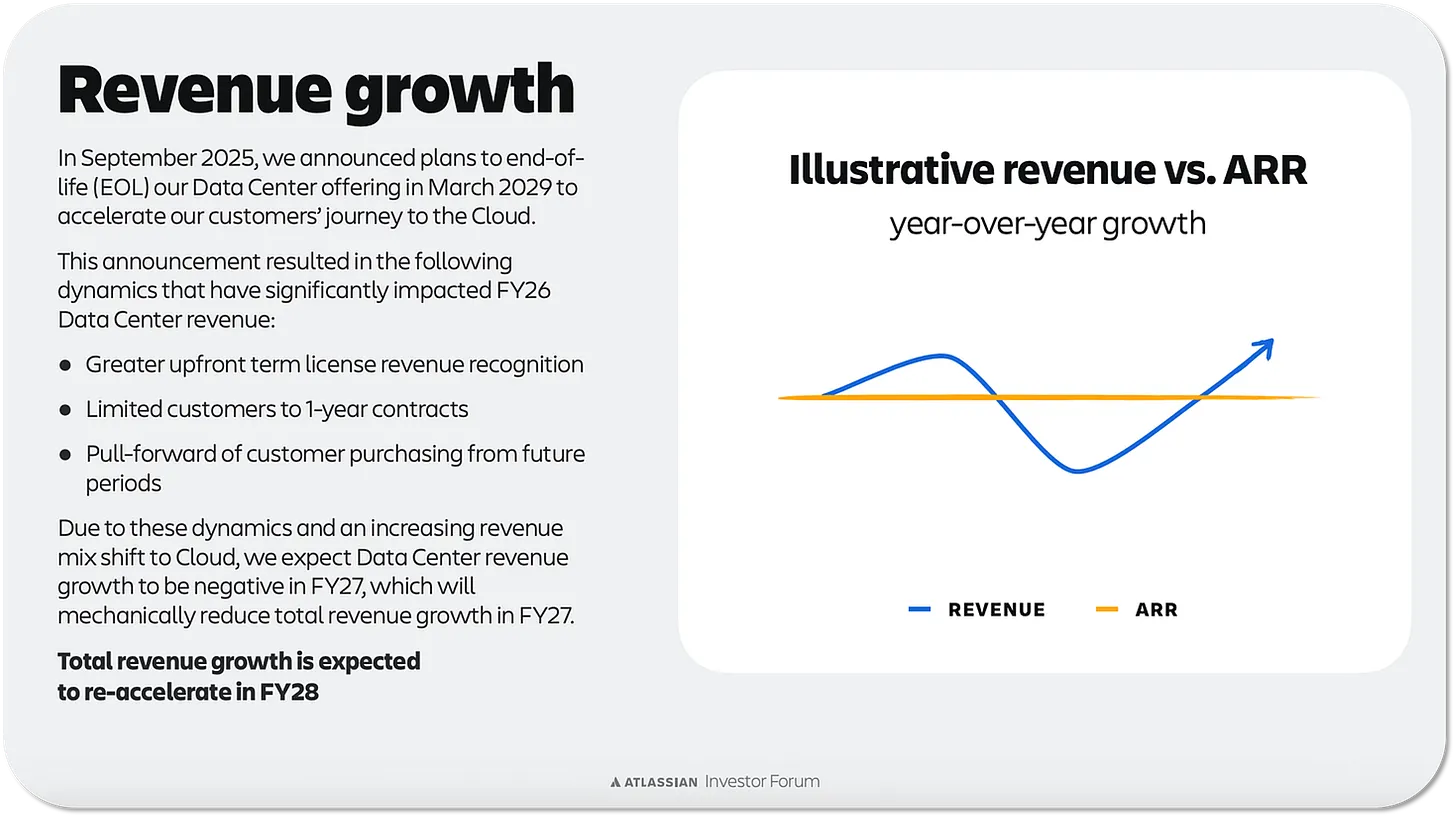
Knowing the product is going away, many Data Center customers decided to lock in one last large contract in FY26 before migrating. Management explicitly stated during the Q3 FY26 earnings call that they saw significant pull-forward activity shifting revenue from FY27 into FY26.

Why Atlassian Dropped the 20% CAGR Target and Pivoted to ARR
In 2024, Atlassian gave public guidance stating it would grow at a 20%+ CAGR for three years (FY25–FY27). That guidance was issued before they accelerated the Ascend timeline. Due to this pull-forward effect, FY27 reported revenue isn’t going to hit that 20% mark.
That’s not because the business is doing worse, but because accounting rules shifted that revenue forward into FY26.
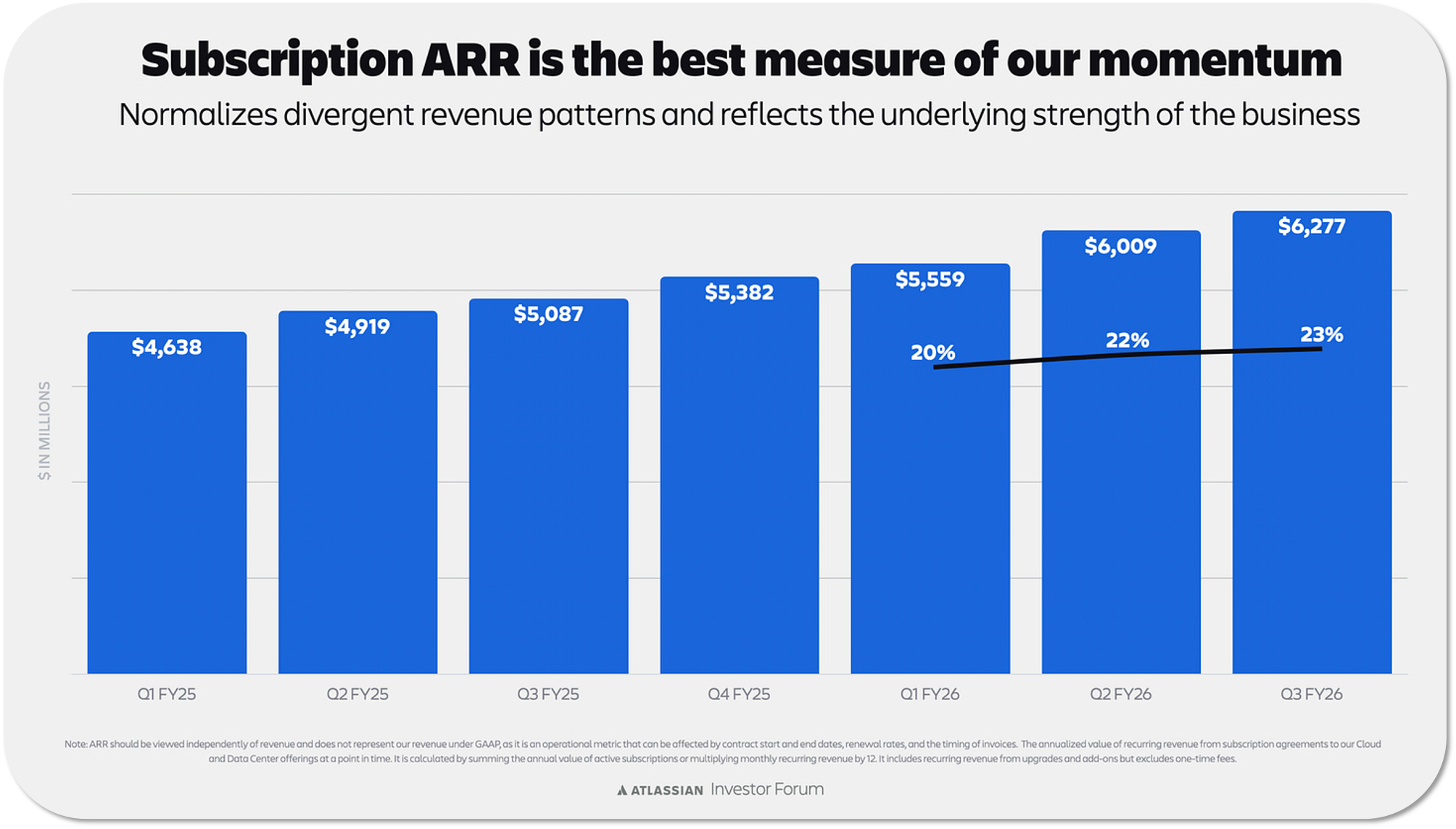
If they kept the target without context, it would look like an operational miss. That’s why they withdrew it and pivoted to subscription ARR, which normalizes the ASC 606 distortion and shows the true story: three consecutive quarters of operational acceleration.
Showing the Inflation: Reported Revenue vs. Real Business Signals
Here is proof that FY26 revenue is artificially inflated. Looking only at total revenue makes it seem like Atlassian is growing faster than normal.
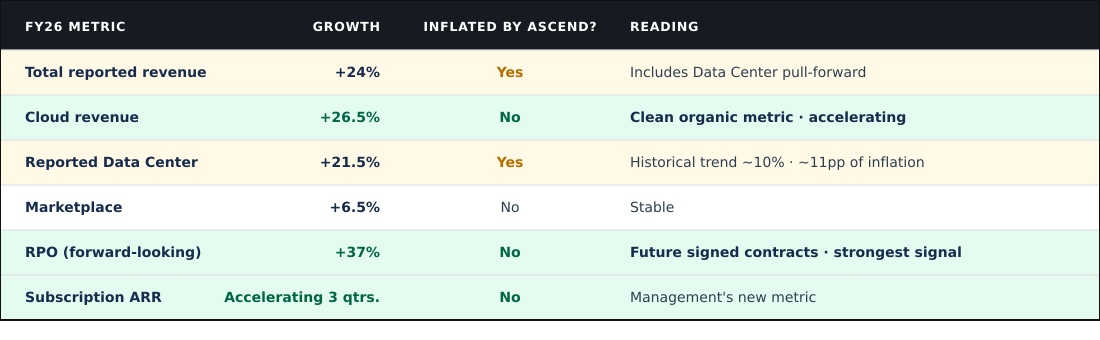
But if we look at metrics unaffected by Ascend, we get a much clearer picture of reality:
Cloud at +26.5% is the metric that best reflects the actual business. It’s accelerating compared to ~25% last year, not slowing down.
Reported Data Center at +21.5% (vs. a historical trend of ~10%) reveals roughly 11 percentage points of accounting inflation. Without Ascend, it would have grown around 10%.
RPO at +37% is the strongest indicator. It reflects signed contracts that will be recognized as future revenue. It’s growing much faster than reported revenue, pointing to future acceleration, not a slowdown.
The new metric management uses, subscription ARR (combined Cloud + DC), has now accelerated for three straight quarters.
If we normalize FY26 revenue by stripping out the pull-forward effect (an estimated ~$200–250M), “clean” growth would be around 20–21%, not 24%.
The Insight for the Thesis
This was one of the most revealing moments of the Analyst Day. When Cannon-Brookes started explaining how the accelerated shift to Cloud impacts reported revenue, he laughed on stage: “And now the bears are going to come out and say we’re slowing down and the business is struggling.” He said it half-jokingly because he knows GMT algorithms and casual investors will misread the data.
This isn’t an actual tangible business weakness, but more so a product of accounting (timing). Subscription ARR keeps accelerating, Cloud is growing at 29%, and RPO is at 37%. However, upcoming reports will show lower reported revenue growth, and most of the market will just read the headline and sell without understanding the underlying mechanics.
QV: That is the exact opportunity. When the market misreads the wrong metric, those of us who have done the homework get to buy at a discount. If reported revenue disappoints in FY27 and the stock drops while ARR keeps accelerating, that’s basically the perfectly wrapped up gift we’ve been waiting for.
The Value of Having Long-Term Founders at the Helm
One final detail connects directly to the competitive advantage of having a founder in charge: the decision to pull forward the Data Center shutdown by a year. This is a brilliant strategic move because it fast-tracks monetization per customer.
On Data Center, customers sign 3-year contracts with very little room to expand services because it’s operationally complex to add products, activate AI, or scale seats within an on-premises deployment.
On Cloud, however, that friction vanishes. A customer can add new products in minutes, turn on Rovo and AI agents instantly without installation, and grow seat counts organically.
The upselling potential skyrockets, and the data proves it: 93% of migrating customers land on Premium or Enterprise tiers (not Standard), and customers with over 1,000 users grow their ARR by 1.75x in the three years following migration.
This is where the CEO’s profile makes all the difference. A hired management team with short-term incentives, enjoying the tailwinds Atlassian has today, would have delayed this decision.
They would want to avoid the FY27 revenue trough that will spook Wall Street, keep from feeding the SaaS-pocalypse narrative, and protect the stock price for another year to secure their bonuses.
But Cannon-Brookes and Farquhar, holding 87% of the voting power between them and operating on a decade-scale horizon, did the exact opposite: they are shutting down Data Center now, precisely because it’s the right strategic moment.
Why now? Because Atlassian dominates its market, its product ecosystem is mature, AI has just opened a monetization window that only exists in the Cloud, and the sooner they move their customers to that layer, the deeper they embed them into the ecosystem. This makes it incredibly tough for any competitor to displace them down the road.
It is exactly the kind of decision a founder with skin in the game makes, and the kind a hired CEO chasing an annual bonus almost always ducks.
Three Scenarios for 2030 and Target Price
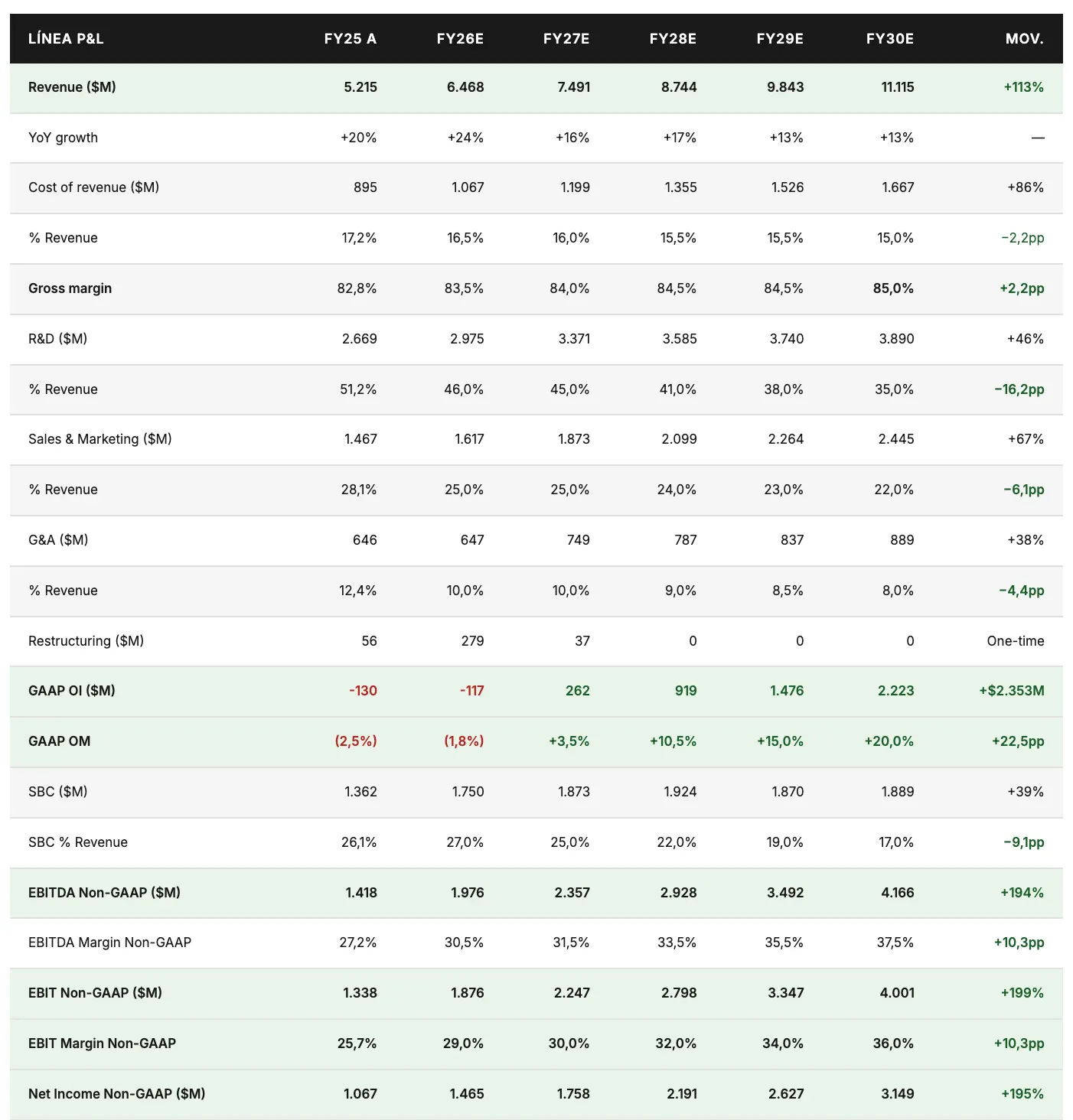
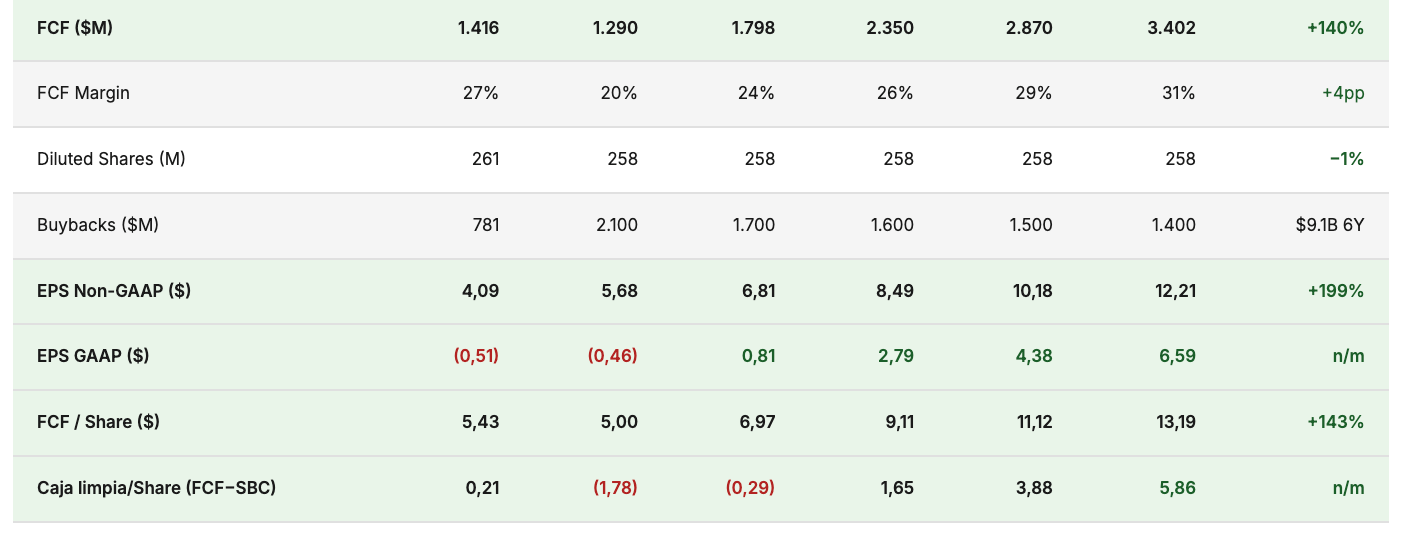
Projected P&L year by year to FY30
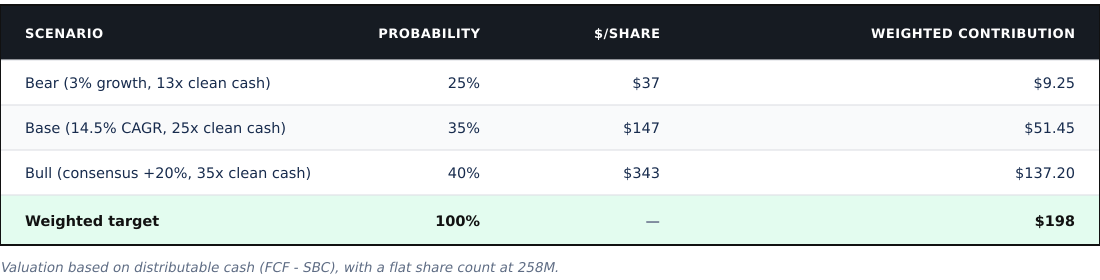
This is our base case scenario, and in our view, it is conservative:
On the valuation lens: how we handle SBC (the waterfall method)
A key question when valuing a SaaS company with stock-based compensation (SBC) at ~27% of revenue: how do you bake that equity compensation into your valuation? SBC shows up in two ways: as a non-cash expense on the P&L (which gets added back to FCF) and as share count dilution. The trap is either completely ignoring it or double-counting it.
The “zero times” trap means capitalizing gross FCF (including SBC) while assuming a falling share count. The “two times” trap means subtracting it from FCF and also modeling dilution.
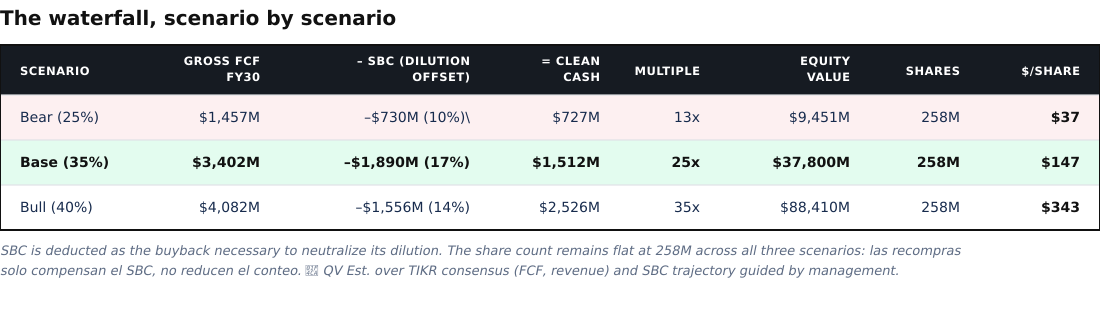
Our solution is an explicit waterfall that accounts for it exactly once: we start with gross FCF, subtract the buybacks needed to neutralize SBC dilution (roughly equal to the annual SBC), and arrive at “clean cash” (FCF − SBC). We then capitalize this clean cash and keep the share count flat at ~258M.

The first two approaches give you the same value per share; the third mistakenly gives credit for buybacks without paying for them. Regarding the flat share count: the buyback plan (~$9B over 6 years) at today’s depressed prices essentially offsets SBC dilution, keeping shares right around 258M. We aren’t modeling any extra share count reduction because that would require spending the exact same distributable cash we are already capitalizing.
That’s why we track “net dilution” as a kill criterion: if buybacks stop offsetting SBC, the share count will start growing, and distributable cash per share will erode. This metric directly tells you if SBC is eating away at shareholder value.
The 4 levers driving the +22pp margin expansion (GAAP)
The four levers we used for this margin expansion are:
Three scenarios through FY30
Philosophy behind the 3 scenarios:
The Bear case penalizes growth, margins, and multiples all at once. It’s our worst-case benchmark where the bear thesis plays out completely.
The Base case tracks our core thesis and the data already playing out, framed conservatively.
The Bull case captures the collapse of the “SaaSpocalypse” narrative and a re-rating to multiples typical of companies growing at 20%-.
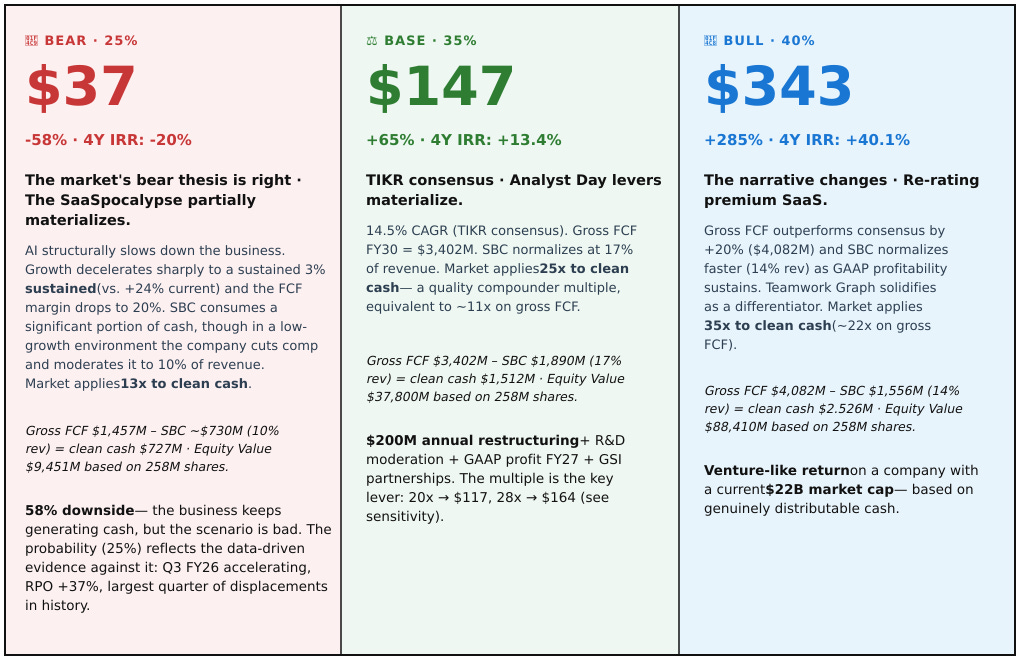
Why the Bull weight (35%) is higher than the Bear (25%):
Data from Q3 FY26 and the May 6th Analyst Day point much closer to the bull side than the bear side:
Revenue acceleration (+32% in Q3 vs. +20% in FY25)
RPO +37% (the most powerful forward-looking signal)
AI credits +20% MoM
Rovo customers growing 2x
Largest quarter of ServiceNow displacements in history
New GSI partnerships (Accenture, Deloitte, PwC)
Teamwork Graph ROI demo
Public commitment to GAAP profitability in FY27
We give the Bull case the highest weight (40%) because of how re-ratings work: the market moves irrationally, and the moment the AI narrative shifts from being seen as a threat (like today) to a catalyst, the upward swing will be massive.
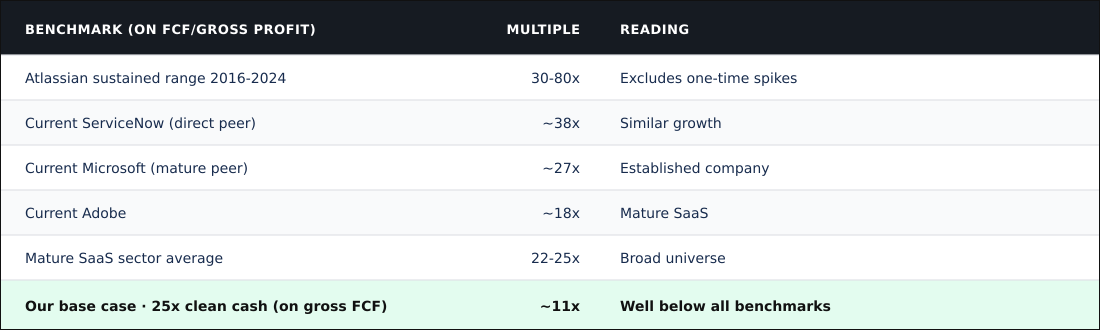
The exit multiple in the Base case: 25x on clean cash (≈11x gross FCF)
We capitalize the FY30 base case clean cash ($1,512M = $3,402M FCF − $1,890M SBC) at 25x: resulting in an equity value of $37,800M and a price of $147 based on 258M shares.
That 25x multiple on clean cash is equivalent to just ~11x on gross FCF, a quality compounder multiple that remains highly conservative compared to industry peers (which are measured on gross FCF or gross profit):
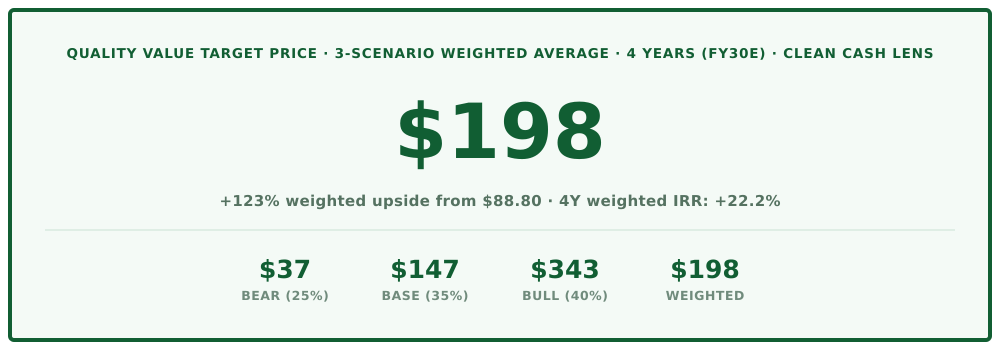
Weighted target value for 2030
Our Action Plan
Let’s be honest: if the bear case plays out, we will lose money. A -15.5% annualized IRR over 4 years (a 50% downside) is no consolation; it’s just a bad investment. No asymmetry can rescue us from that.
But the probability of that scenario is capped by the evidence we’ve analyzed throughout this thesis: Q3 FY26 acceleration, RPO up 37%, the biggest quarter of competitive displacements in history, 6 out of 7 competitive advantages from the QV framework, and a founder CEO with real skin in the game.
The base case yields a +32% IRR, which is an exceptional return. The bull case hits a +60% IRR.
The downside is real if AI structurally cannibalizes the business.
But then again, all the pillars of our Quality thesis, a leading product, 6/7 competitive advantages, the Teamwork Graph acting as an AI moat, a founder CEO, 35-70% Cash ROCE, a $140B TAM with just 5% penetration, and oligopolistic markets, combined with the Q3 FY26 inflection point, make that bear case highly unlikely in our view today.
The upside will be unlocked by the narrative shift that management is actively pushing for. And following the May 6th Investor Day, they have articulated this strategy more clearly than ever, in our view.
Realism about the short term
But the reality is that, at least in the short term, stock volatility is going to be very high. AI uncertainty will hang over the company for months or even years, and we need to be ready for it. Right now, the market simply doesn’t know Atlassian’s terminal value… and that’s exactly where this volatility comes from.
As you’ve probably gathered throughout this thesis, we estimate its future value will be very high and believe it’s a great investment. But let’s be clear: it’s not risk-free.
Let’s be honest here: even though the data shows we’re likely right, we are still dealing with an investment tied to innovation uncertainty. Because of that, at least for now, we cannot give it a heavy weight in the portfolio.
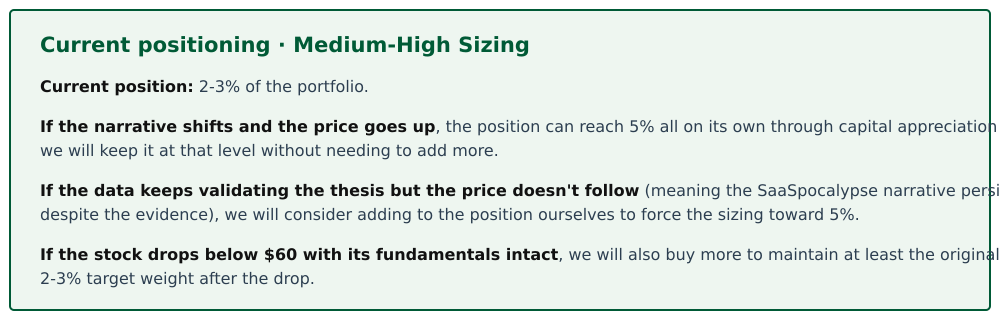
With all of this in mind, and even though we’ve covered the company extensively, there’s still more to it. If you want to continue reading, you can check it out here…


🙏 Feel free to ❤️ and comment so that more people can discover and enjoy our Substack 😇
Big $TEAM guy here!
The non dev roles are probably even more at risk. I’ve lead these teams from CEO, cto, pm role and id argue that now all you need is a technical product person. QA, pm, designer, jr devs and scrum master are all filled by a good agentic harness. Im in the trenches and see far less need for meetings, cross team communication and documentation which is what a lot of jira does. I still use loom which they bought but this is pretty easy to spin up am open source version yourself now. Maybe a couple of hours work with a vps and Claude does mg the lifting. There’s definitely some great finds in the saaspocolypse space but I think this one would need an extremely hard pivot to be relevant in 5 years