


You guys seem to have enjoyed last week’s post on bonds, so here’s the second part of this two-part series.
Again, I prepped these posts in anticipation of my interns arriving. It’s partly meant to train them, and partly to make sure they don’t break anything during days one through five.
The first post covered debt and how to evaluate bonds. This second part will dive straight into due diligence.
If you haven’t checked out part one yet, go give it a read (it’s free):

To keep things practical, I’ll be using simplified examples of actual deals I’ve analyzed and real due diligence I’ve conducted in the past, together with some live transactions I’m working on right now.

Due diligence sometimes sounds like a monumental, Herculean endeavor… like one of those vast, soul-crushing tasks that takes a lifetime to complete and requires a massive supply of coffee.
And NGL, sometimes it really is a massive, multi-headed beast. But regardless of how terrifying it looks from a distance, the secret to surviving it is simple: you just have to chop it up into smaller, bite-sized, digestible subtasks… Substack?
Wait, what?

See what I did there?
Smooth transition. Now go ahead and subscribe:
TBH, the difference between doing proper due diligence and just winging it is the difference between a massive payday and a catastrophic, loss-making end.
Think about it like buying your first house. You wouldn’t just look at the shiny kitchen countertops and sign the papers. No, you’re going to look into every single nook and cranny. You’re checking their latest termite testing, their insurance coverage, the exact date the garage burnt down because Grandma allowed cousin Jake to handle the electrical wiring… You want to know everything.
Logically, people should do the same thing when purchasing a company (aka buying a stock), right? And yet, they completely drop the ball.
Due diligence is your operational floor; it is your ultimate financial security line.
Why the average investor refuses to extend this basic level of care to their portfolio is honestly beyond me. It’s usually a toxic, cocktail combination of pure greed and intense FOMO.

I guarantee you the average person is losing absolute heaps of money out there because their version of “deep research” looks less like a thorough investigation and more like casually checking out a ticker on Yahoo Finance for two minutes, getting a rush of adrenaline, and then immediately sprinting over to Robinhood to grab a few titles.
Don’t be that person. Treat your investments like a house you actually have to live in, or prepare to watch the roof cave in!

#1. Desk Research & Hard Financials
Before you even think about putting on your detective hat and stepping out into the wild, you have to survive Phase I.
This is the absolute foundation of your valuation journey, where you anchor your initial numbers and see exactly what this company looks like when it’s trying to behave on paper.
This is the mythical land of the Excel Warrior.

You are essentially locked in a room with a mountain of spreadsheets, tasked with staring down historical balance sheets, income statements, and cash flows until they start telling you the absolute truth. It’s a deep dive into the corporate anatomy to see where the cash actually flows, where it gets trapped, and whether the company’s past matches the beautiful story management is trying to sell you.

Quality of Earnings and Other Adjustments
Once you’ve cataloged the raw data, it’s time to start scrubbing the corporate makeup off the face of the financials with an aggressive Quality of Earnings (QofE) review. This is where you play financial myth-buster: you pull apart the numbers to normalize EBITDA, audit sketchy revenue recognition policies, and map out the net debt and working capital bridges.
Scan the Income Statement and footnotes for “Non-Recurring Expenses,” “Restructuring Charges,” or “Other Operating Income.” Pull these out and recalculate a truly Normalized (real) EBITDA to see how the core, everyday business actually performs without the helpful accounting cosmetics.
Your entire goal here is to strip away the one-off accounting tricks, creative adjustments, and management’s overly optimistic spin to ensure the baseline numbers are completely real before you build anything on top of them. You are checking for luck, but also checking for cyclicality, seasonality, and mistakes.
Here’s a list of useful tasks of a similar nature you should perform:
Our Cash Flow Lie Detector Test: Calculate the Cash Conversion Ratio by dividing Operating Cash Flow by EBITDA over a three-to-five-year period. If EBITDA is growing beautifully but OCF is flat or shrinking, management is recording profits that aren’t actually turning into cold, hard cash.
Revenue Recognition and Reconciliation: Compare the quarter-over-quarter growth rate of Accounts Receivable (A/R) against the growth rate of Total Revenue. If A/R is skyrocketing significantly faster than sales, it’s a massive red flag that they might be stuffing the channel by booking aggressive uncollected revenue at the end of the year to hit their targets.
Working Capital: Calculate Days Sales Outstanding (DSO), Days Inventory Outstanding (DIO), and Days Payable Outstanding (DPO) to map out the exact Cash Conversion Cycle. This shows you exactly where the cash is getting trapped, whether it’s tied up in dust-gathering inventory or slow-paying customers.
CAPEX vs. D&A: Track Capital Expenditures (Capex) relative to Depreciation & Amortization (D&A) over time. If Capex is consistently lower than D&A, the company might be underinvesting in its physical assets to artificially boost short-term free cash flow, leaving a massive operational bill for you to pay later.
Footnote Sherlock Holmes: Comb through the audit notes specifically looking for changes in accounting policies, shifts in inventory valuation methods (e.g., LIFO to FIFO), or sudden adjustments to useful asset life assumptions. These subtle tweaks are the classic way companies stealthily manipulate their earnings per share.

Preliminary Valuation
Note: if you jump straight into the valuation model without actually understanding the underlying numbers, you’re just building a house on quicksand.
This holds double-true if you’re feeding data into your favorite AI and asking it to do the heavy lifting for you. Especially with smaller companies, AI models have a nasty habit of hallucinating or outputting absolute nonsense if the inputs are messy.
It’s the golden rule of data: garbage in, garbage out.
So, do yourself a favor and comb through those financial statements yourself first. You need to be the one to spot the traps before you let the machine try to solve the puzzle.
Once you’ve beaten the historical data into an honest state, you get to play architect and lay down the initial valuation model framework.
Using management’s baseline assumptions as a starting point (while keeping a very skeptical eyebrow raised), you can build out your core DCF models, comparable trading multiples, or asset-based valuation sheets.
Discounted Cash Flow (DCF) Models: Imagine a magical machine that spits out a $100 bill every single year. How much would you pay to buy that machine today? A DCF calculates the answer by looking at all the cash a company is expected to make in the future and translates it into today’s dollars. Because a dollar tomorrow is worth less than a dollar today, a DCF discounts those future cash flows to figure out what the whole business is worth right now.
Comparable or Precedent Trading Multiples: If you want to sell your house, you look at what similar houses in your neighborhood recently sold for. Multiples do the same thing for businesses. You look at similar, publicly traded companies or recent business buyouts in the same industry. If competitors are selling for 10 times their annual profit, you multiply your target company’s profit by 10 to get a ballpark value.
Asset-Based Valuation Sheets: Imagine a business completely fails, goes bankrupt, and has to shut its doors tomorrow. What’s left? This method ignores future profits and simply adds up the value of everything the company physically owns (e.g., factories, real estate, inventory, and equipment) and subtracts any debts they owe. It’s essentially calculating the liquidation value, sometimes even at fire-sale prices.
This isn’t the final, bulletproof version of your thesis, but rather a digital sandbox where you map out how the business is supposed to work based on the hard numbers you’ve just validated.
You’re setting the baseline math reality so that when you finally step away from the screen to do some real-world investigating, you’ll know exactly which assumptions need to be pressure-tested.

#2. Commercial Validation
The goal here is to take management’s beautiful Excel-based dreams and violently smash them against market realities to see if the deal thesis actually holds water, or if it’s just a fragile house of cards waiting to collapse at the first sign of competition.
You kick things off by putting the market’s Total Addressable Market (TAM) and the company’s unit economics on the chopping block. It’s time to verify if the market size and growth runways are actually as vast as advertised, or if management is hallucinating their growth potential.
Now, we don’t recommend you go completely ham on this end and get bogged down in endless macro-forecasting; just do enough to ensure that management isn’t selling you a total pipedream.
You dig deep into the gritty operational metrics, auditing Customer Acquisition Costs (CAC), Customer Lifetime Value (LTV), true pricing power, and customer churn. You’re essentially checking to see if they are buying revenue at a loss or if they have a sticky, loyal customer base that will actually stick around.
Unit economics like these are crucial, and most of the time, they provide the first real hints about the company's true economic moat or competitive advantages.

Regulatory Review
Next, you dive headfirst into the regulatory and compliance jungle, mapping out the invisible tripwires that can instantly kill a deal.
You are screening everything from supply chain routing and payment flows to transaction counterparties, looking out for any hidden circumvention risks that might invite a regulatory hammer down the line.
Whether you are auditing specific regional compliance frameworks, like navigating complex EU-specific ESG mandates, labor standards, or legal/tax structures, you are ensuring the company isn’t accidentally importing a massive, ticking legal liability.
You want to make sure their supply chain is completely clean and that their cost-effective suppliers in Vietnam aren’t operating in a global penalty box.

Test it out
Finally, you take all these messy macro and regulatory realities back to your digital sandbox for a brutal round of scenario modeling and stress-testing.
You take that pristine baseline model from Phase I and intentionally try to break it. You map out aggressive, base, and absolute nightmare-fuel worst-case scenarios, simulating what happens to the valuation if inflation spikes, a critical supplier goes bust, a new competitor triggers a price war, or a major regulatory shift slashes their margins.
By the time you finish this phase, you’ll have a battle-tested framework ready for the ultimate test: going out into the field to gather real-world intelligence.

#3. The Scuttlebutt Layer
What we’re all here for… our beloved Scuttlebutt.
This is where we throw the spreadsheets out the window, leave the comfort of our climate-controlled offices, and step directly into the wild to find out what is actually happening on the ground.
You are looking for the unvarnished truth that never makes it into an investor relations PPT or news release, ensuring your valuation is backed by operational reality rather than corporate fiction.
Note: We usually talk to a large number of external players to help us validate information. This includes the likes of suppliers, clients, industry experts, ex-employees, and many others. It’s actually only at the very end of our research cycle that we reach out to discuss things directly with management.
However, we want to streamline things for you here by giving you a simplified approach that you can easily pull off as an individual investor, especially if you push through and leverage your local edge (visit local companies).

Going through Management
One of the key targets is the management team. However, instead of sitting through another rehearsed, glossy slide deck, you are looking for raw, unscripted human behavior.
You kick things off with corporate culture and management assessment, treating every interaction as an amateur psychology study to evaluate executive alignment, genuine integrity, and operational execution style. You don’t just want to hear the CEO’s grand vision; you want to look at how they react when things go off-script.
Pro tips incoming:
Ask about their first jobs.
Ask about their latest interactions with low- and mid-level employees.
Ask about their failed products.
Ask about decision-making in tough times (e.g., COVID).
Ask about the competitor they hate the most.
You can even go personal and ask about their family, their kids, or the values they grew up with.
But most importantly, always end every single questioning line with a “Why?”
Know that you are quietly taking the temperature of middle management and tracking organizational turnover rates, because if the talented people who actually run the day-to-day operations are sprinting for the exits, that beautiful margin expansion you modeled in Phase I is nothing but a fantasy.

On-Site Visit
Sometimes, especially for manufacturing-based companies, you must put on your steel-toed boots and head straight into the operational value chain for some mandatory on-site inspections.
You are doing physical asset walks and factory floor tours, checking capacity utilization with your own eyes and watching inventory management to see if the physical reality matches the capital expenditure projections on the balance sheet.
While you’re there, you practice the fine art of chatting up frontline workers, floor staff, and local engineers. These are the people who actually know which machines are constantly breaking down, where the real bottlenecks live, and whether safety standards are a priority or just a poster on the wall.
All of these insights will spot operational risks months before they ever show up as a line item on an income statement… plus, it really helps develop and expand your circle of competence.
What better way to learn than by asking a niche specialist with a ton of experience directly about it?

Note: Right now, we’re conducting due diligence on an elderly care facility.
Checking the building, the gardens, the town, and the rooms (plus chatting with staff) is absolutely essential in this case.
There is no subsitute for your gut feeling on-site.

Well-rounded Intelligence
To build a 360-degree intelligence, you must zoom out and interview the entire ecosystem surrounding the business.
Pro tip: Don't just do a single interview per group, aim for a few instead. The wisdom of crowds and the law of averages will give you a much more complete picture.
Because we want to make it concise we’d suggest interviewing customers to find out if they actually love the product or if they are secretly planning to jump ship the moment a cheaper alternative arrives. This may be easier than you’d think especially for B2C businesses.
You can always like a Coke consumer if they like New Coke.

You can also call up suppliers to verify payment terms and supply chain stability, and you can talk directly or shadow competitors to see if the company’s supposed “pricing power” survives out in the open market.
If you can, you should also hunt down ex-employees for a little post-mortem debrief, because nothing illuminates hidden cultural toxicity, operational vulnerabilities, or structural flaws quite like a candid conversation with someone who no longer relies on the company for a paycheck.
Note: On this last point, make sure those former employees aren't just disgruntled or incompetent, as they'll give you a pretty misleading picture.

#4. Synthesis, Calibration & Pricing
It’s time to bridge the gap between what management said was happening and what you know is happening, turning our assumptions until now into a bulletproof valuation to make a decision.
For starters, you should go through a brutal round of assumption calibration. Take that digital sandbox model you built in Phase I and start hacking away at it with your newly acquired Scuttlebutt scalpel.
Did that competitor interview reveal that the company’s moat is actually a shallow puddle?
Down go the terminal growth rates.
Did the factory floor walk reveal a bottleneck that will require a massive tech upgrade?
Say goodbye to your optimistic margin expansion expectations and crank up the projected Capex.
You are adjusting the cost-of-capital parameters and growth levers based on what is actually happening in the real world, ensuring your model reflects physical truth rather than corporate hope.
By the end of this process, you should be able to adjust the finer details of your assumptions. Do note that this is more a matter of adjusting within a range of accurate assumptions than of pinpointing a precise valuation.
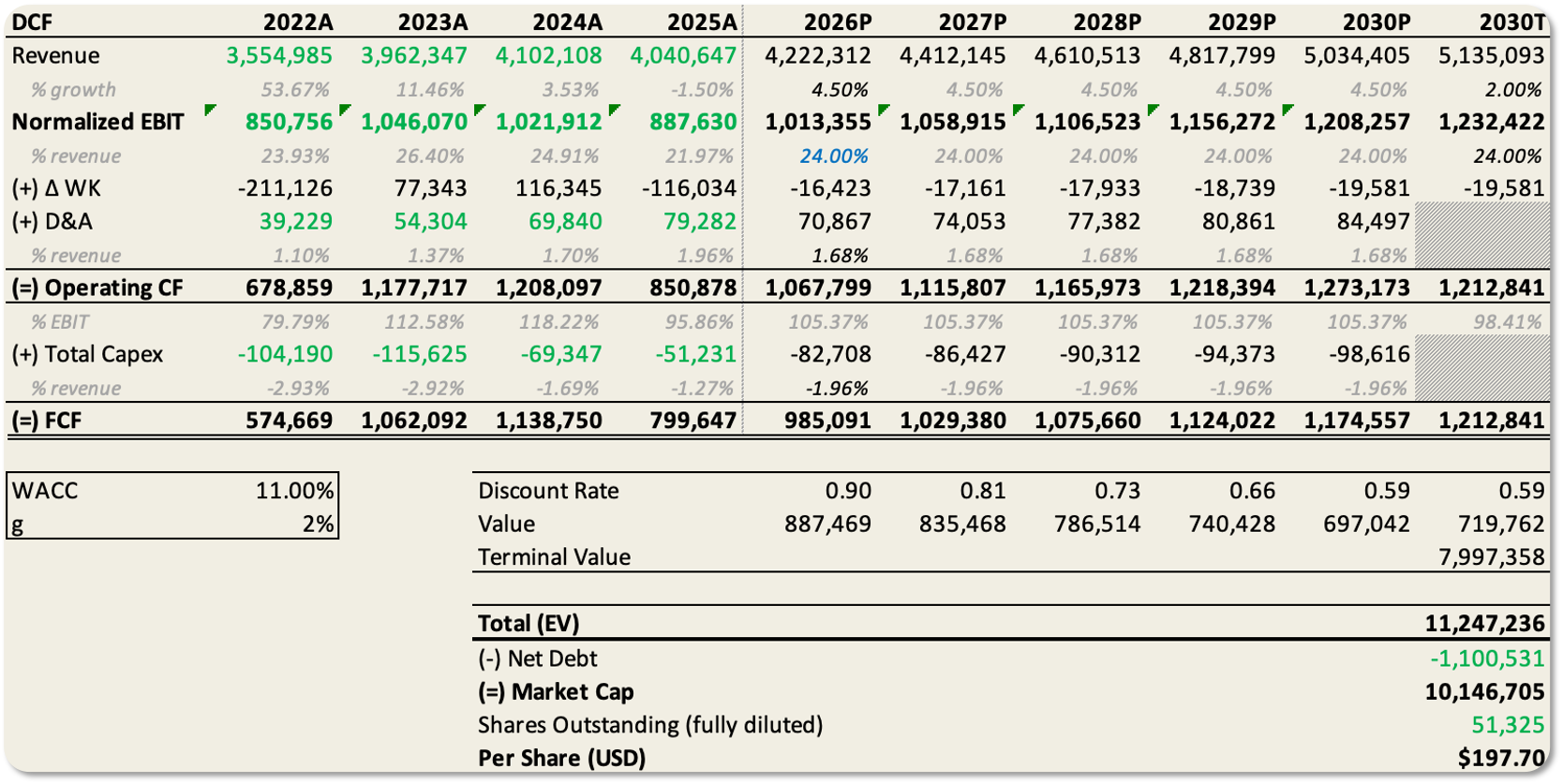
If you are spending too much time there, it’s probably a big fat NO.
The disconnect between value and price should be obvious once you make approximately accurate assumptions and stakeholders confirm these.

Margin of Safety
Next, you apply the ultimate investor shield. This is a calculated buffer built directly from the operational, legal, and cultural red flags you unearthed during your due diligence.
If the ex-employees warned you about a toxic middle-management culture or the suppliers hinted at upcoming pricing pressures, those risks get priced right into the final valuation range.
You are intentionally building a financial shock absorber into your target price, ensuring that even if the business hits a few hidden potholes post-acquisition, your investment returns won’t go flying through the windshield.
We usually apply a 50% discount to the valuation your model outputs, and that should be your target entry price.

SPA Drafting (if Private)
Note: This applies mostly to private deals, not so much to buying a regular stock in the market, though it could definitely apply to stock purchases using derivatives.
With your battle-tested valuation range in hand, you step up to the negotiation table for final deal structuring. This is where you determine how that price is paid.
If your Scuttlebutt investigations revealed some lingering uncertainties around customer churn or regulatory shifts, you don’t just walk away; instead, you get creative.
Pro tip: This is going to sound super fancy. We’re confident we could do an entire lecture series on these, but for now, we’ll just provide a quick overview and the key items to look at.
You map out clever earn-out structures, clawback provisions, and strict corporate governance protections based on your unified findings. By the time you sign on the dotted line, you haven’t just bought a company based on a spreadsheet; you’ve structured a deal that perfectly aligns the final price with the ground truth.
But how do you actually lock these terms and conditions down so the seller can’t wiggle out of them? Enter the Share Purchase Agreement (SPA).
You can visualize this doc by thinking of a prenuptial agreement for corporate acquisitions. It’s there to ensure that what you thought you bought is exactly what shows up at your door.
Core components of a battle-tested SPA include:
The Price Tag & Payment Mechanics: This is where you outline exactly how and when the cash moves. You don’t just write a single check; you bake in those Scuttlebutt-inspired earn-outs (making the seller earn their payout based on future performance) or deferred payments to keep them cooperative post-closing. You also establish whether you’re using a “Locked Box” mechanism (fixing the price on a past balance sheet date) or “Closing Accounts” (adjusting the final price on the exact day you take the keys based on working capital).
Representations & Warranties (R&Ws): This is the seller playing a high-stakes game of “truth or dare” under oath. You force them to make definitive statements of fact about the state of the business—swearing that the taxes are paid, the intellectual property is theirs, and no major clients are secretly planning to dump them next month. If they lie, your R&Ws are your legal ticket to claw back your money.
Indemnities (The “You Broke It, You Fix It” Clauses): While warranties are general promises, indemnities are your laser-targeted, heat-seeking missiles. If your due diligence uncovered a specific, ticking time bomb—like an unresolved legal dispute or a sketchy tax position—an indemnity forces the seller to cover the bill dollar-for-dollar if that bomb explodes post-acquisition.
Conditions Precedent (CPs): The ultimate deal-stoppers. This is the checklist of absolute prerequisites that must happen before a single dollar changes hands. If the company fails to secure a critical regulatory green light, or if a vital supplier refuses to sign off on the ownership transition, the CPs allow you to walk away with your capital completely intact.
Restrictive Covenants: The classic “don’t copy my homework” clause. You want to make sure the former owner doesn’t take your hard-earned cash on Friday and open up an identical competing shop right across the street on Monday. This legally bars them from competing with you or poaching your newly acquired rockstar employees for a designated number of years.

If you found value in this analysis, please hit the ❤️ button and share your thoughts in the comments. It helps us bring institutional-grade research to a wider audience.
And if you liked this post, we’re confident you’ll love this:

Practical and sharp - especially the push beyond spreadsheets into real-world validation.
That said, it reads closer to an ideal playbook than a repeatable process. For most investors, the challenge isn’t knowing the steps but executing them without bias or overconfidence.
Still, a strong reminder: good investing starts where comfort ends.
Great post, thanks for sharing. Always interested in different perspectives on this - how do you think about stock-based compensation when assessing profitability and valuation?