


Today’s pick is the definition of hiding in plain sight.
It’s an easy-to-understand company that the market thinks is on the way down, even when the reality is the opposite.
It’s one of the biggest (and most undervalued) winners of the AI revolution.
⭐ Overall Grade: 9.0 / 10
If you aren’t in the private chat, you’re missing the timing that turns a good play into a great one.
We believe in showing our work, so here is our updated scorecard, feel free to verify every pick, return, and allocation below.
The results speak for themselves.
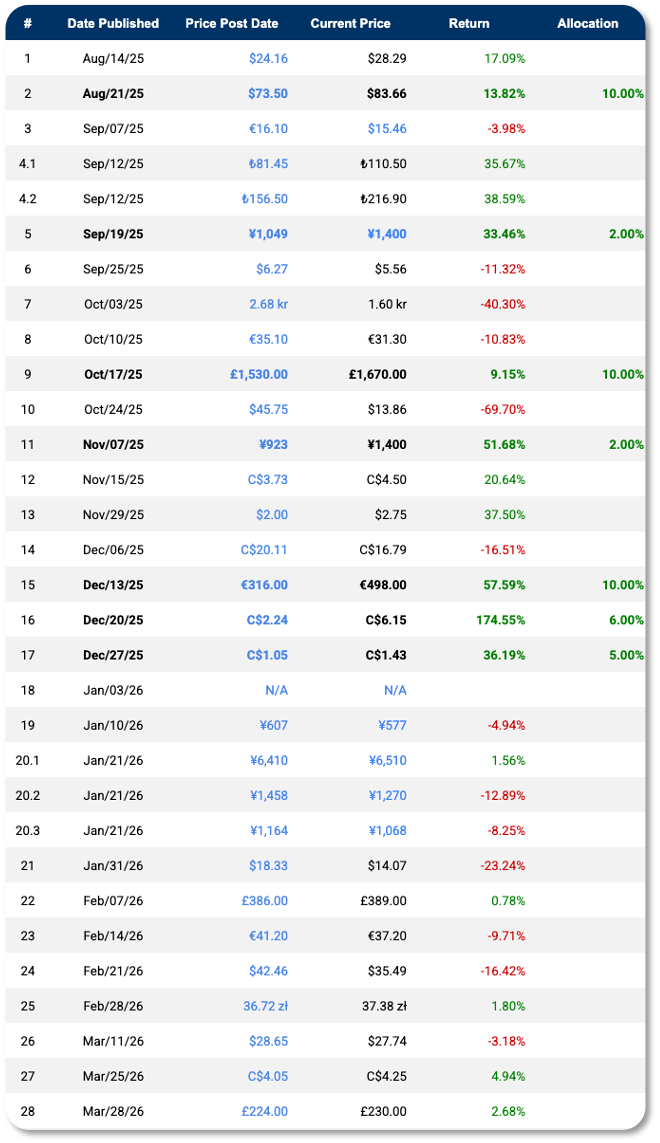
While an equal-weighted approach (using the price from the posted date) would have netted +10.21%, following our specific allocations (combining with monthly updates) pushed that return to +22.04%.
Timing is the most underrated skill in this game, and we’ve proven once again that we have it dialed in.
We’ll update this table every Saturday, showing at least a rolling six-month window with a three-month lag (on allocation).
Here’s our top performer thus far:

We opened this one a few months back, with the full post hitting free subscribers’ inboxes on January 19th.
If you weren’t subbed then, please consider this your reminder to subscribe today.

Pick of the Week. A curated series of high-conviction research on companies currently under our microscope. We screen for specific dislocations where the market has mispriced the balance sheet or earnings power.
The Selection Criteria:
Asset Arbitrage: Trading at a discount to tangible liquidation value.
Backlog Disconnect: Future contracted revenue ignored by the market.
Hidden Margins: Structural profitability masked by temporary noise or CAPEX cycles.
The Structure:
The Business: A concise operational overview.
The Dislocation: The specific structural reason the opportunity exists.
The Valuation: A stress-tested snapshot including downside risks (”Red Flags”) and our proprietary score.
None of the following should be construed as investment advice. Please consult a financial advisor before making any investment decision. You will find a full disclaimer at the end of this post.


🚀 Constellation Software Inc. ($CSU)
Headquartered in Toronto, Constellation Software is perhaps the greatest “compounder” in Canadian history. Founded by former venture capitalist Mark Leonard, this isn’t a traditional software company; it’s a decentralized capital allocation machine.

They buy small, boring Vertical Market Software (VMS) companies that manage specific niches (like software for dry cleaners, public transit, or golf courses).
These businesses are incredibly sticky because once a hospital or a city uses your software, they seldom switch.
In a single sentence… Constellation is a fortress of recurring cash flow derived from dcentralized capital allocation that has recently been on sale due to fears that it has grown too large to keep winning especially in an era where software creation can be cheaply done by non-technical people with the help of AI.
The Business Model
Constellation starts with looking beyond the ‘software’ label. In reality, it is a high-speed capital allocation machine that utilizes specialized software businesses as its fuel.
The company functions like a giant, ever-growing tree that stays healthy through a unique form of corporate mitosis.

Instead of going down the normal path where most organizations become sluggish and bureaucratic as they scale, Constellation purposely chose a decentralized model that allows it to stay fast and agile by constantly splitting itself into smaller, more focused, and autonomous pieces.
The Architecture of Decentralization
The genius of this structure lies in its hierarchy of Operating Groups, Subgroups, and Business Units (BUs).
At the canopy of this tree are the ‘Big Six’. These may sound familiar and include names like Volaris, Harris, and Jonas.
They effectively act as independent mini-holding companies.
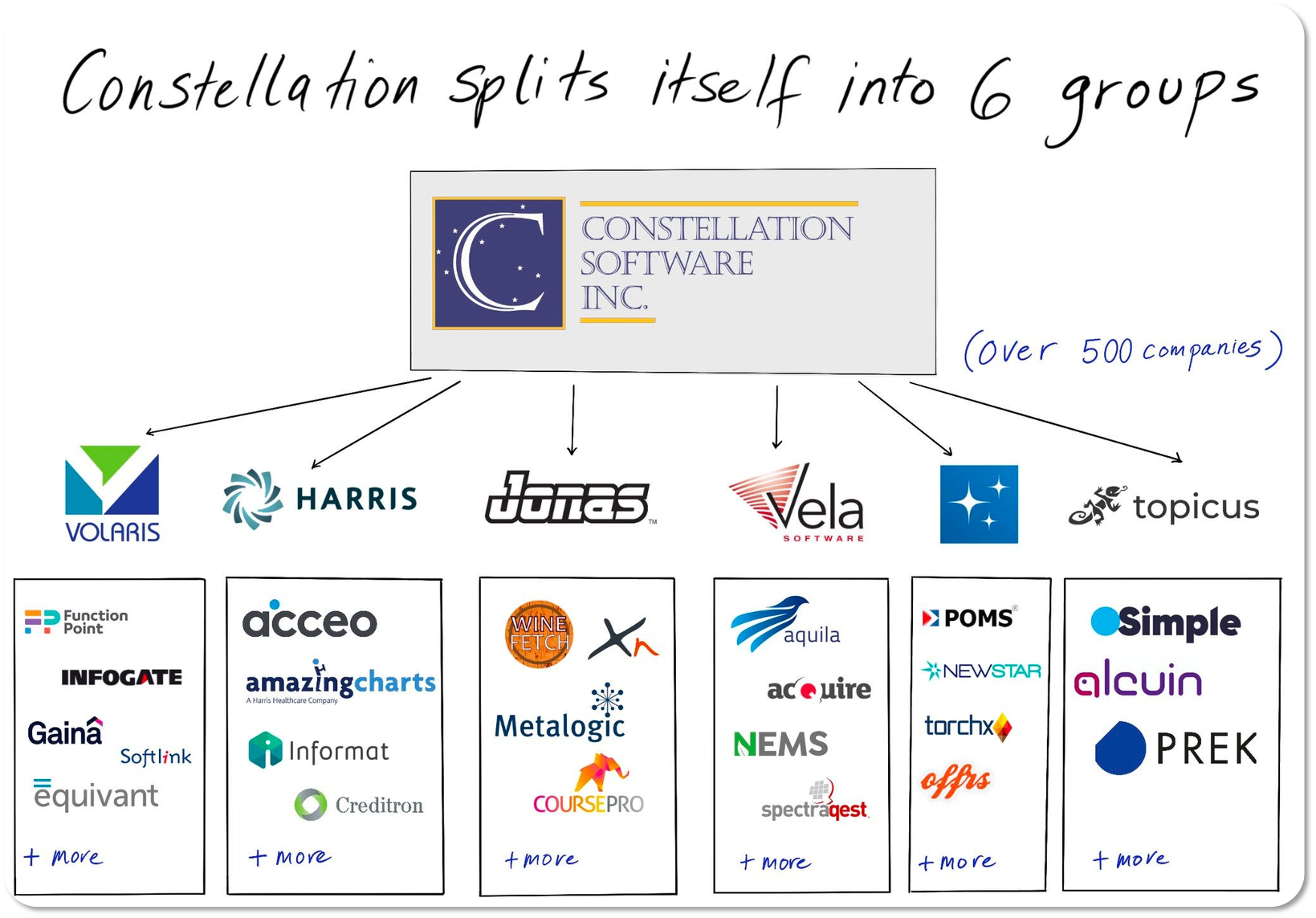
These groups are led by their own CEOs and manage their own cash, operating with a high degree of autonomy.
Below them, these groups are further subdivided into subgroups that manage individual Business Units.
A BU might be a small, highly specialized company that creates software exclusively for public libraries, art galleries, or municipal transit systems.
By the time you reach the BU level, the managers are deep experts in their specific niche, allowing them to make critical decisions without waiting for permission from headquarters in Toronto.
Mitosis and the Spin-Off Strategy
As these Operating Groups grow, they eventually reach a size where they risk losing the very agility that made them successful.
To prevent this conglomerate drag, Constellation employs a strategy of corporate mitosis which effectively means spinning off its most successful and mature groups into their own publicly traded companies.
Recent examples include Topicus ($TOI) and Lumine Group ($LMN).
This logic is twofold: it allows the new spin-offs to raise their own capital and maintain a small company culture, while simultaneously revealing the hidden value of these high-performing groups to the public market.
It’s great for shareholders, and it ensures the parent company remains lean while the ecosystem as a whole continues to expand.
Key Accounting Trap (IMO)
For the uninitiated, Constellation’s financial statements can be a trap. Standard Free Cash Flow (FCF) is calculated using the following formula:

In a traditional business, Capital Expenditure (CAPEX) represents the money spent to keep the lights on, such as fixing a roof or upgrading machinery.
For a software company like CSU, maintenance CAPEX is nearly zero because they don’t require heavy physical infrastructure.
However, Constellation’s ‘real CAPEX’ (take this with a grain of salt) is its Mergers and Acquisitions (M&A) engine.
Because acquisitions are listed under Investing Cash Flow, it’s not included in your standard FCF.
Founder Mark Leonard has historically had his own custom metric called Free Cash Flow Available to Shareholders (FCFA2S). This figure subtracts lease payments, interest, and non-controlling interests, providing a precise look at what is actually left over to either acquire new companies or return value to shareholders.
In any case, understanding cash flows is a must if Constellation is on your list.
Cash Allocation and the Hurdle Rate
Constellation is famous for its ruthless efficiency and its disdain for wasting cash.
This is most evident in its dividend and buyback policies. The company pays a very small dividend (typically around $1.00 per share per quarter), which is essentially a token gesture.
Management would far prefer to reinvest that capital into another high-return software business.
Similarly, you rarely see Constellation buy back its own shares. The reasoning is strictly mathematical: they will only buy back stock if it is trading below intrinsic value and they have no better companies to acquire.
Given their mastery of M&A and their strict internal rate of return (hurdle rate), they almost always find a more productive home for their cash than their own stock.
The PEMS Strategy (2026 Pivot?)
The company is undergoing its most significant evolution yet: the Permanent Engaged Minority Shareholder (PEMS) strategy.
Now that Constellation has reached a massive scale, it has become harder to move the needle by exclusively acquiring small $5m businesses.
Under the guidance of Mark Leonard, who recently transitioned to an advisory role to focus on this shift (likely for health reasons), the company is now taking large minority stakes in major public entities.
A prime example is their position at Sabre Corp., which allows them to deploy $50m-$100m+ in a single company. (more on this later)
This strategy allows Constellation to act as an active owner, applying its operational expertise to help large-scale businesses improve their efficiency while deploying capital at a scale that traditional VMS deals simply cannot match.

Why is it mispriced?
The stock has pulled back significantly from its $C5,300 highs to the $C2,250 range. Why?
Size: The market thinks they’ve grown too big to find meaningful deals. They are using their mitosis strategy which included spinning off winners like Topicus and Lumine to stay small and fast, plus, as we just mentioned, they’re pivoting to larger public stakes (like Sabre) to deploy billions at once.
AI Displacement Investors worry that AI will make niche software commodity or, at the very least, easy to replace. AI is actually a massive margin booster. CSU is using AI to slash their own internal coding and support costs, turning boring software into high-margin gold.
High Interest Rates: High rates (8.6%+) make their debt-funded model look expensive on paper. With 75% recurring revenue, CSU is a cash fortress. They have the pricing power to pass costs to customers and the free cash flow to ignore high-interest noise.
🎯 Catalysts: Why Now?

The PEMS Pivot
The biggest criticism of Constellation has always been that recent transactions don’t move the needle even when pooled.
To solve this, management launched the Permanent Engaged Minority Shareholder (PEMS) strategy, which is a massive departure from their traditional 100% buyout model.
Let’s look into the most recent example:

The entry into Sabre Corp ($SABR) represents a historic pivot, marking the first major execution of their PEMS strategy. By quietly accumulating 50,157,523 shares (roughly a 12.7% stake) at an average cost of $1.72 per share, Constellation has deployed approximately $86.2 million to become a dominant, influential owner.
This position, managed through the Vela Software group, allows them to deploy massive capital in a single move without the logistical nightmare of fully integrating a multi-billion dollar enterprise.
The path to this partnership was a high-stakes corporate drama that evolved from a hostile stealth accumulation into a strategic peace treaty.
After Constellation revealed a 9.7% position and demanded board representation in early 2026, Sabre’s board initially fought back with a poison pill defense to block any stake above 15%.
However, by March 5, 2026, the two sides reached a landmark Strategic Governance Agreement. In exchange for dropping the poison pill, Constellation agreed to a standstill cap of 15% and, crucially, secured a board seat for Damian McKay, the CEO of Vela Software.

McKay is now tasked with applying the Constellation Playbook, involving ruthless cost discipline and margin expansion directly, into to Sabre’s operations.

AI as a Margin Multiplier, Not a Disruptor
While the broader market panicked that AI would commoditize niche software, Constellation saw an opportunity for a massive internal efficiency harvest.
Rather than trying to build the next flashy AI chatbot, CSU is using Large Language Models (LLMs) to transform the cost structure of its 1,000+ business units.
By upskilling thousands of their own developers in AI-augmented coding and launching ‘AI Accelerators’ across the portfolio, they are slashing the time and labor required for maintenance, R&D, and customer support.
In a business where 75% of revenue is recurring, and labor is the largest expense, these productivity gains flow directly to the bottom line as Free Cash Flow expansion.

The Spin-Off Value and Decentralization
Constellation has perfected the art of the corporate mitosis, spinning off its larger verticals like Topicus ($TOI) and Lumine Group ($LMN) to keep them agile.
This isn’t just about financial engineering; it’s about maintaining a decentralized culture where small teams can still move fast.
The 2025 performance of these spin-offs was the “canary in the coal mine” for the bull case, with Lumine Group reporting a staggering 153% jump in Free Cash Flow to Shareholders.
As these spin-offs become multi-billion-dollar giants in their own right, they create a massive valuation floor for the parent company.
Investors are starting to realize that buying CSU is essentially buying an ETF of the world’s best software managers.

The Leonard ‘Alpha’ Redeployment
The final catalyst is a subtle but profound change in leadership.
In early 2026, Mark Leonard shifted his focus away from the day-to-day administrative Board duties to focus exclusively as an advisor on the PEMS strategy.
By freeing Leonard from the red tape of a $50bn+ corporation, he is now 100% focused on the highest-value task: hunting for the massive, mispriced public stakes that will define the next decade of growth.
This move effectively institutionalizes the Leonard ‘Alpha’, proving that the company has built a system that can run without him, while simultaneously letting him hunt for the biggest deals of his career.
💰 What’s It Worth?
Bear Case [$C2,400]
For decades, Constellation’s edge was buying tiny, sub-$5m software companies that nobody else wanted. But today, the machine has grown so large that it needs to deploy nearly $2bn a year just to keep the lights on for its growth narrative.
In this bear scenario, we assume the friction of size finally wins. We’re modeling a permanent slowdown where Constellation is forced to hunt bigger fish, competing directly with deep-pocketed Private Equity firms.
This drives up acquisition prices, pushes Return on Invested Capital (ROIC) down toward 10%, and effectively breaks the high-velocity buy-and-build engine that made the stock a legend.
The second pillar of this downside case is the Interest Rate ‘Squeeze’.
Constellation’s model relies on a spread: borrowing money cheaply and investing it into high-return software businesses. However, as of early 2026, the era of ‘free’ money is long gone.
With their debentures resetting to an 8.6% interest rate, the cost of their fuel has skyrocketed. In the bear case, we assume rates stay higher for longer, eating into the net margins.
If it costs 9% to borrow and the new software companies they buy only return 11% or 12%, the Leonard Alpha evaporates.
Finally, the $C2,400 price target represents the utility floor. You are no longer paying for what Mark Leonard might buy tomorrow; you are only paying for what he owns today. With over 1,000 distinct business units and 75% recurring revenue, Constellation is essentially a massive, diversified software royalty stream.
At a $C2,400 valuation, the stock trades at roughly a 4.5% Free Cash Flow (FCF) yield. In this ‘broken’ compounder scenario, we assume the company stops growing entirely and simply harvests the cash from its existing library systems, transit software, and niche tools.
Base Case [$C4,300] (+75% Upside)
While the market is currently distracted by the ROIC drift, the slight dip in returns as the company gets larger, this scenario assumes that Constellation successfully solves the size problem.
By pivoting to larger Tier 1 acquisitions and utilizing its new PEMS strategy, the company proves it can still deploy billions of dollars without sacrificing quality.
We’re modeling a stabilization of ROIC around 17-18%, fueled by a management team that has spent 20 years mastering the art of the deal.
In this case, the M&A engine doesn’t just stay alive; it thrives as CSU becomes the buyer of last resort for a global software sector in transition.
The market is terrified that AI will turn niche software into a cheap commodity.
Our thesis is the exact opposite: AI is a massive margin booster for CSU.
With over 1,000 business units, Constellation is currently upskilling thousands of developers in AI-augmented coding and running “AI Accelerator” programs across its portfolio.
As these businesses become cheaper to run and faster to update, we expect a structural expansion in Free Cash Flow (FCF) margins.
Finally, the $C4,300 target is driven by a massive market re-rating. Right now, the stock is being dragged down by a general software sell-off and fears that the compounding story is over.
FYI, software is now trading lower than the S&P average in terms of P/E… something unprecedented in the entire series.
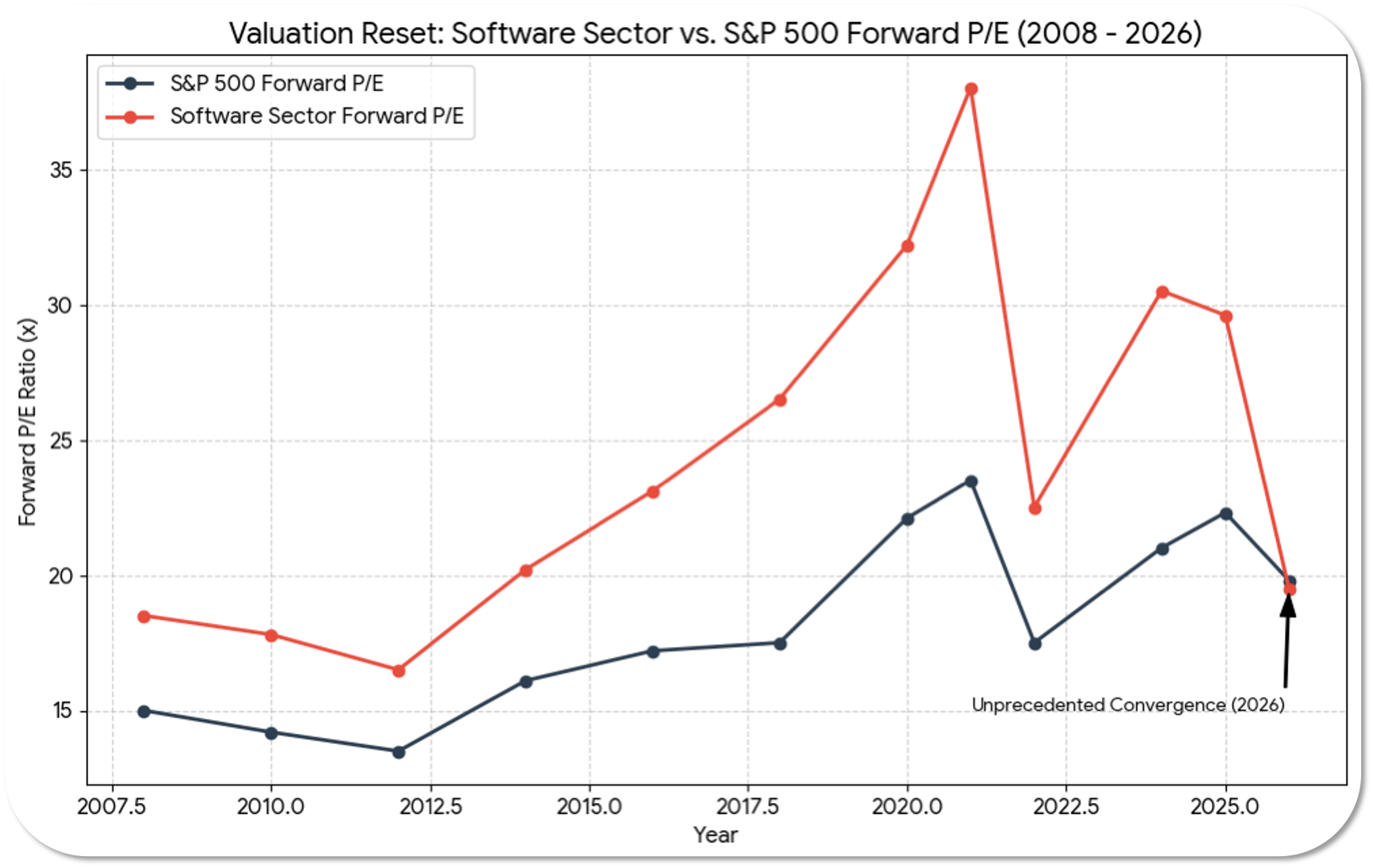
When the 2026 earnings reports continue to show 15-20% FCF growth, the market will be forced to abandon the narrative.
⭐ Overall Grade: 9.0 / 10
Since the companies we usually cover are tiny and have effectively zero analyst coverage, we rarely find great resources out there.
However, given the size and prolific return history of Constellation, plenty of top-tier managers and commentators are finally paying attention to this one. We’ll leave you with this fantastic video that expands on the vision we just discussed.